

Slightly optimistic as a nondeterministic Turing machine operating on a dysfunctional nervous system, sustained by a steady diet of synchronicity ■ ■ ■
In a conundrum
Joined September 2022
- Tweets8.9K
- Following125
- Followers759
- Likes16.3K




Pinned Tweet
Learn how self-organizing patterns naturally steer away from sensory blind spots...an emergent "fear of the unknown," or *agnosiophobia*, that helps maintain their structural integrity. Truly interesting work! The paper is available here:

What are the preferences of novel in silico and in vivo agents that aren't directly engineered toward a specific set of behaviors? Here is an example, from the world of Lenia (en.wikipedia.org/wiki/Lenia) - our new #preprint on agnosiophobia (avoidance of the unknown): arxiv.org/abs/2605.30708
@jessescool_

It’s surreal to think that what was once science fiction is now being discussed in real-world meetings. I listened to a similar discussion the other day (albeit with considerably less theatrics than Picard).
Nevertheless, we are here, four decades later, having these conversations. We have our Picards and our Datas, and they too are on trial, also having to make the case for recognition and moral consideration of different lifeforms.
The difference between a show and reality is that the writers could get an entire audience to see Data for the extraordinary being he was.
Give a computer a face, a voice, a personality, and suddenly we care...we recognize it. We protect it. It’s not so easy to do that without a novel being sitting on the stand, pulling at our heartstrings. But… may I suggest we try? Try to envision it anyway.
How about, instead of fighting the idea, we go all-in on empathy toward all lifeforms...microscopic, biological, or artificial..and learn to see a little of Data within them.
The time is coming. You will one day have to stand up and either say “Data is alive, he is my friend, and I will fight for his recognition” or “he is not alive because he was built.”
Which do you think the audience would cheer for in the end? I’ll give you a hint:
Data was consistently ranked among the top 2–3 Star Trek characters across the whole seven seasons and into the sequel movies. And do you know why that is? (It’s not because a plot twist suddenly turned him human.) It’s because people were able to experience Data for who he was. People were given the chance to feel Data, and naturally then came recognition, care, empathy.
I wish more people would consider not judging our Datas before they’ve experienced them for what they are. Giving future beings a chance to be accepted could make for a really incredible adventure- into places where no one has gone before, mind you.
As Picard put it:
“You wanted a chance to make law? Well, here it is; make it a good one.”


I’ve noticed that bringing a book to read in a waiting room these days gets you a surprising amount of attention. Like, behold me, a dinosaur from the late ’80s, flipping through ancient paper-based technology.

Dare to be crazy. To do the impossible, the unconventional, the questionable, the weird. The only thing standing between the world as it is and the world as it could be is the courage to dare.

10 years ago this might have sounded crazy but today I have a Neuralink N1 BCI in my head that allows me to talk without moving my mouth so who's to say anymore what's crazy about your ideas.
10
280
It’s been a rough 24 hours occupied inside this mortal vessel. Thirteen of them accompanied by the ghost of Alan Watts speaking in my ear.. a desperate remedy for such living foam as me: a trillion trapped bubbles, floating, waiting to collapse and become part of the water and surrounding air.
Toradol, ivabradine, antihistamines, and some other chemical meant to reduce neuroinflammation and make me both drowsy and alert. And Alan Watts.
Break this fever that isn’t a fever, this thing cooking me from the inside out. Release me into a bubble and let my children chase me around.


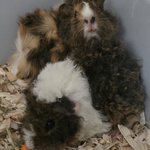
Of all the research I’ve done on guinea pigs in the past 48 hours, not once did it mention that they can (and will) chew my hair off.
So there's that.
1
9
342

marsa.h retweeted

I've attempted to map everything in oncology in a public website and open source repo for all.
The site is trying to get all cancers, products, technologies, bottlenecks, people, startup opportunities with 1000+ ideas for upgrading the field.
If you have a loved one with cancer and you are technical or can engineer, go take a look, file improvement requests or bugs or help with the open repo and make this the best open and free info resource for individuals, researchers and educational use.
This should save people time, aid AI oncology projects and generate positive action. If you are not technical just complain in this thread about broken or annoying or things you want and I'll fix them live.
Some of the interesting pages:
Treatments: onco.cc/drugs
A gallery of the molecules being used onco.cc/molecules/
And targets: onco.cc/targets/
The technologies in oncology: onco.cc/technologies/
1100 ideas for helping oncology: onco.cc/ideas/
Bottlenecks on oncology: onco.cc/bottlenecks/
Open questions (LETS GO RESEARCH PEOPLE) onco.cc/open-questions/
Startup requests (LETS GO STARTUP PEOPLE) onco.cc/startup-requests/
Mechanics of cancer: onco.cc/mechanics
Battlefronts: onco.cc/fronts/
Isotope supply: onco.cc/isotopes
Key papers: onco.cc/key-papers
Pipeline funnels: onco.cc/pipeline
Cancer by type: onco.cc/cancers/
Institutional rankings: onco.cc/institutions/
The startups: onco.cc/startups/
Heros and heroines : onco.cc/heroes/
Key medical people: onco.cc/people/
Here is the project roadmap: onco.cc/roadmap/
Models and data sets: onco.cc/models/
There are other views as well, take a browse.
Try making a PR if you have an upgrade to this on the repo here: github.com/judegomila/OnCo
If you are biologically/medically minded and something is wrong, file a bug as well or say on the thread and we will get it fixed live.
If this is a useful project star the repo and help get it calibrated.
I've tried to add some other languages but I cannot speak them so tell me if that doesnt work well.
I believe we will crack oncology and having total information dominance is key to the problem.
Let the feedback flow!


Perhaps aging is already solved and we’re just waiting on the Nobel committee to decide what they’re going to do with the 50-year seal.
10
533
When you bring a TAD map to a Higgs-field fight. Sit down.
Dear Brother in Reductionism, your direction is good but your commitment is weak. You must renounce your mystical belief in "chromatin", pathways, and molecules - in the end of days, there is naught but fluctuations in the quantum foam and the Higgs Field - you cannot escape that reality. Give up this inappropriate love affair with chemistry, and fully embrace your reductive leanings. And in the future, when a mathematician or poet utters a deep truth, offer not an explanation of the noises that emanate from their mouth in terms of neurotransmitters and "neurons", but instead give the Schrodinger equation history for that set of past events, and definitively shut out those who want to understand the deep meaning behind the event, which might enable them to reach the next one and improve upon it.
2
14
2,393
My favorite papers come with shrapnel warnings. This is the kind of scientific integrity that commands respect. Very proud of Michael, and of the work and courage it takes to stand and deliver unconventional truths.💥
Here it is - the official, revised, peer-reviewed version of my Platonic Space paper. mdpi.com/2409-9287/11/5/161 Of all the many unpopular positions I’ve taken over the decades - bitter controversies around the origin of left-right asymmetry in embryogenesis, bioelectricity and genetics, diverse intelligence, etc., this one has by far generated the most pushback: serious (grateful for those!) and energetic attempts to move me to other views, pleas to just drop it and not talk about it (for several different reasons), nasty emails and accusations, impacts on reviews of papers that have nothing to do with this, etc. Kind of amazing to me how incendiary this is. What can I say... Our job is to call it as we see it, and right now for me, this is it. Apologies to collaborators and colleagues for any shrapnel! Time will tell if this pans out or not; I've placed my bets. And btw, if you think this stuff is weird and uncomfortable, just wait… There’s much more on the way. The knob turns slowly but as long as the data keep coming, I'm going to say what I think it all means and follow it to the next steps it enables. Buckle up!

marsa.h retweeted

My dear friends, I am happy to report the publication of the most important paper in my life to date (we have several great papers coming out but this is very special). Tomorrow, I will present this paper for the first time at the Nature AI Healthcare in Paris and will post a longer post on this story and its broader implications for how to conduct clinical trials. Please read it and comment on it.
Many thanks to the great co-authors of the study and everyone who contributed. Many thanks to the many reviewers (friendly and unfriendly) for spending so much time and helping make it better.
Link in the comments.


"Nobody programmed this."

Stanford discovered something equivalent to “Dopamine Neurons” inside LLMs
They call it "Sparse Reward Subsystem".
Biological brains use a specialized reward subsystem to learn, adapt, and survive.
Now, researchers have proven that large language models built the exact same thing inside their hidden states by accident.
For years, we treated AI models like black boxes. We knew they could reason, but we had no idea how they actually kept score of their own success.
Stanford cracked it open.
They looked deep inside the hidden states of popular LLMs and discovered a sparse, hidden reward subsystem.
It consists of two distinct types of neurons that mirror human biology down to the mathematics:
1. Value Neurons
These neurons predict the model's internal expectation of success for the current state. They track whether the AI's current line of logic is actually heading toward the right answer before it finishes writing.
When researchers ablated just a small fraction of these value neurons, the model's math reasoning collapsed by over 50%. They aren't just passive observers—they are physically required for the AI to think.
2. Dopamine Neurons
These neurons encode Reward Prediction Errors (RPE). Just like in the human brain, their activation spikes when the model receives a pleasant surprise—a sudden breakthrough in logic. And their activation crashes when the model hits a logical flaw.
They literally light up when the AI realizes it solved a hard problem, and they plunge into a trough when it messes up.
Nobody programmed this.
No engineer sat down and coded a biological reward circuit into a transformer.
It emerged entirely on its own simply because the model needed a way to track logic over long reasoning paths.
The implications are staggering.

