

Product Manager
Barcelona, Spain
Joined June 2014
- Tweets744
- Following170
- Followers4.2K
- Likes1.1K

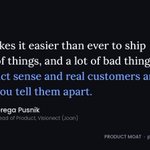







This week on Product Moat: Grega Pusnik, Head of Product at Joan, on why AI makes it easier than ever to ship a lot of things, and a lot of bad things.

3/ Designers and engineers at Joan write skills a PM can use. With them, a PM builds an 80% prototype, ships it behind a feature flag, and real customers try it before the full design, engineering and QA review.
4/ His take on where this goes: "the AI we use today is the worst it will ever be."
Full interview: productmoat.com/interview/pr…


So here I am with a working product that might lighten your day. Try it, share it with people you care about, and give me your honest feedback. Would love reasons to improve it. caroluma.com
Building with AI didn't just help me ship faster. It keeps pulling me deeper into engineering than I planned, and that's the real education, still very much in progress.
Net effect: I spend more time hardening and optimizing than writing new features, and I care more about technical quality than I expected going in.
Cost optimization is becoming a real discipline too. How the database is set up and how much traffic it handles hits the bill directly, so I keep learning to make it efficient, not just functional.
Security and privacy are becoming a real design constraint, not an afterthought or a checkbox before launch.
As a PM I already thought in trade-offs and failure modes. What's different is daily hands-on coding: it pulls me into a rabbit hole where I have to understand what's behind a problem, not just describe it.
Skill production is becoming my main productivity lever. Not writing more code faster, but building reusable skills and workflows that compound over time.
Systems thinking keeps growing on me. I pay more attention to how real eng teams produce code and build in QA, and how to compress that into something a one person team can run without dropping the ball.
It's not a one time lesson, it's an ongoing experience. The more I stay in it, the more it pulls me deeper into engineering concepts. A few things I'm noticing:
