

Population, urbanization and development | Head of the Urban Demography Lab @EPFL_en
Lausanne, Switzerland
Joined August 2018
- Tweets36
- Following272
- Followers196
- Likes318




Interested in population geography and digital twin cities?
The Urban Demography Lab at @EPFL_en seeks to hire a 1-year postdoc.
More information and how to apply: epfl.ch/labs/urbdemo/urbdemo…

Mathias Lerch retweeted

Don't miss this opportunity to work on the upcoming World Population Prospects @UNDESA producing population estimates and projections for low- and middle-income countries. Deadline: 24 May! 👉
careers.un.org/lbw/jobdetail…
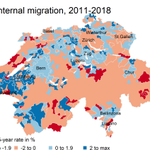
Stopping urban sprawl may improve population and environmental health. Yet in Switzerland, internal migration of the working age population has intensified since the 1980s. Recent migratory movements also head again towards the urban periphery. doi.org/10.1002/psp.2621

Mathias Lerch retweeted

.@aezeh from @DrexelUniv gives an Online Talk that is part of our Suessmilch Lecture Series next Tuesday. Register to join! demogr.mpg.de/en/news_events…

Mathias Lerch retweeted

Do inclusive policies work ?
In this new paper published on @BMC_series, Philippe Wanner and I show that expanding access to health services leads to better outcomes for undocumented migrants.
#migration #publichealth
tinyurl.com/8uymsw9u

Mathias Lerch retweeted
Are you interested in demography, families, generational processes, death and loss, kinship, genealogies, etc? Check out this fully-funded PhD position at the Research Group on Kinship Inequalities @MPIDRnews. Deadline May 13. Reach out w/ questions! Info: demogr.mpg.de/en/career_6122…
Mathias Lerch retweeted

#MOOC - Geographical Information Systems (parts 1 and 2) on Courseware ! #GIS
go.epfl.ch/moocsig.enrol
Interactive forum here: facebook.com/groups/mooc.gis…
@epflENAC @EPFL_en @LASIG_
Mathias Lerch retweeted

Job alert!
The @MPIDRnews currently offers a PhD student position on #mortality #inequalities, co-supervised by @NIDI_KNAW colleague Fanny Janssen and @ugobas @ezagheni C.G. Camarda @InedFr
Application deadline: 20 March 2022
demogr.mpg.de/en/career_6122…
Mathias Lerch retweeted

📢PAPER ALERT!📢
I'm very excited to share my new @PLOSONE paper "The interplay of migration and cultural similarity between countries: Evidence from Facebook data on food and drink interests" w/ @s_lohmann_ @ezagheni @pedroolmo @fbenevenuto @filipenrib
👩💻journals.plos.org/plosone/ar…

Mathias Lerch retweeted

Asylum-related migration is complex and volatile. Still, it can be forecast effectively! Our new #openaccess article on Nature @SciReports with @iacus & @teddy_wilkin introduces a novel #datadriven approach to forecasting social processes. A🧵1/6
nature.com/articles/s41598-0…

Mathias Lerch retweeted

Our colleagues @ashiratamar & @BrunoMasquelier conducted an analysis of #rural-#urban gaps in #mortality in 53 low- and middle-income countries & they could find a decreasing urban advantage in adult mortality with age.
#poptwitter
pubmed.ncbi.nlm.nih.gov/3507…
Mathias Lerch retweeted

Human Fertility After Disaster: A Systematic Literature Review / Feb 1, 2022 Tuesday 1pm CEST
Please join my talk on research in progress, and help improve this review project! @MPIDRnews
More info & Registration 👇
demogr.mpg.de/en/news_events…

Mathias Lerch retweeted

Doing serious research with #FaecalRemains from #SedimentCores? Sounds strange. But now a study by @Ostseeforschung & @MPIDRnews shows that these are actually highly exciting #proxies for the reconstruction of historical #PopulationDevelopment: https://xitter.gq/t.co/mFvQe1mxWT

How to grasp population-environment interactions over the long-term? Human fecal lipids preserved over centuries in sediment cores (picture ©IOW) are reliable indicators of anthropogenic sewage pollution & correlate strongly with population growth. See doi.org/10.1016/j.envres.202…

ALT Sediment core from the Baltic Sea (©IOW)
Mathias Lerch retweeted

One week left to apply for our 3-year Postdoc position in our Individual and Societal Ageing lab - #ageing of the #babyboomers from a longitudinal perspective (applications in English are very welcome) https://xitter.gq/t.co/90Fx5PKxXM @bib_bund
@PopulationEU
@EAPS_pop
Zurich's population grew mainly through migration (rather than natural increase) during the industrial revolution, with dramatic changes in the domestic versus international sources of migrants over time. Full-text available for free until 07/02 on : cairn-int.info/tap-qtbayv13e…

Et voici encore l'accès gratuit (jusqu'au 19/02) à la version française de l'article: Migrations internationales et croissance de la ville de Zurich entre 1836 et 1949, cairn.info/tap-13uk33l34ep57
3
Mathias Lerch retweeted

#SequenceAnalysis Multistate Model now in TraMineRextras dev version (@SocMethod article: doi.org/10.1177/008117501774…)!
Installation: r-forge.r-project.org/R/?gro…
library(TraMineRextras)
?seqsamm
Step by step guide in the example section.
@EmStruffolino @AFasang

Mathias Lerch retweeted

Une nouvelle étude @EPFL @Hopitaux_unige caractérise l’empreinte géographique des inégalités à l’espérance de vie à Genève @AnaisLadoy @iguessous @daderidd @silviast9 @stephanejoost @gira_ph #géolocalisation #inégalité #santépublique hug.ch/actualite/ou-vit-plus…
