

From the Mediterranean to the Atlantic. Strategic intelligence and analysis on politics, security and the global economy. https://xitter.gq/t.co/9YjYcQBkdD
- Tweets206
- Following108
- Followers151
- Likes244
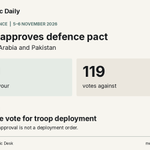




ALT Original MedAtlantic Daily explanatory graphic about Turkish parliamentary approval of the defence pact with Saudi Arabia and Pakistan, dated 5–6 November 2026. Two panels show 279 votes in favour and 119 against. The next-decision panel says a separate vote is required for troop deployment, with the qualification that parliamentary approval of the pact is not a deployment order. This is a text-and-number graphic, not a map or photograph.

ALT Original MedAtlantic Daily project-status graphic for Qatar’s Maydan Mahzam redevelopment, dated 5 November 2026. Aker Solutions received a letter of award from PTSC M&C. The company-defined contract value bracket is NOK 0.5 to 1.5 billion. Detail-design scope includes 3 offshore topsides, 4 support jackets and tie-ins to existing facilities. Final contract signing remains required. No photo, map or technical engineering schematic.

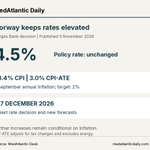
ALT Original MedAtlantic Daily monetary-policy graphic. Norges Bank kept its policy rate unchanged at 4.5%, announced 5 November 2026. September annual CPI inflation was 3.4%; CPI-ATE, adjusted for tax changes and excluding energy, was 3.0%; the inflation target is 2%. The next rate decision and new forecasts are due 17 December 2026. Further increases remain conditional on inflation. No photograph or map.

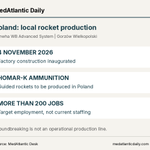
ALT Original MedAtlantic Daily milestone graphic for the Hanwha WB Advanced System factory in Gorzów Wielkopolski, Poland. Three boxes state: 4 November 2026, factory construction inaugurated; HOMAR-K ammunition, guided rockets to be produced in Poland; more than 200 jobs, target employment rather than current staffing. The bottom note says groundbreaking is not an operational production line. No photograph, weapon schematic or map.

ALT Original MedAtlantic Daily financing graphic. Six Saudi Fund for Development concessional loan agreements signed with Syria on 4 November 2026 total more than US$403 million. Allocations: civil defence $105 million; health facilities $100 million; Aleppo power plant $90 million; housing repairs $60 million; water meters $30 million; finance digitisation more than $18 million. Bars compare allocations; the final bar uses the $18 million lower bound. The graphic states that loan agreements do not prove disbursement or completion. No photo or map.

ALT Original MedAtlantic Daily explanatory graphic dated 5 November 2026. UKMTO reports a tanker struck by 2 unidentified projectiles 50 nautical miles north of Madinat ash Shamal, Qatar. Crew status, vessel damage and environmental impact are explicitly labelled unconfirmed. UKMTO advises cautious transit while authorities investigate. This is a text-and-number graphic, not a photograph or a map; no perpetrator is identified.

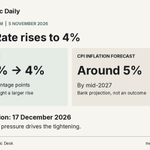
ALT Original MedAtlantic Daily graphic dated 5 November 2026. Bank of England policy rate rises from 3.75% to 4%, a 0.25 percentage-point increase supported by 8 policymakers; 1 wanted a larger increase. A second panel shows the Bank's projection of CPI inflation around 5% by mid-2027, clearly labelled a forecast rather than an outcome. The next decision is 17 December 2026. Energy-price pressure is identified as the driver. No photograph or map.

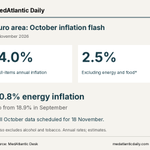
ALT Original MedAtlantic Daily graphic dated 4 November 2026 showing Eurostat’s October euro-area inflation flash estimates. All-items annual inflation is 4.0%; inflation excluding energy, food, alcohol and tobacco is 2.5%; energy inflation is 20.8%, up from 18.9% in September. The graphic identifies all figures as annual-rate estimates and says full October data are scheduled for 18 November. No photograph or map.

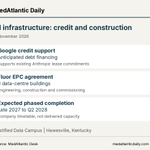
ALT Original MedAtlantic Daily graphic dated 4 November 2026. Three panels show Google credit support for anticipated debt financing supporting existing Anthropic leases at TeraWulf’s Justified Data Campus; a Fluor engineering, procurement and construction agreement for 3 buildings; and company-expected phased completion from late 2027 to Q2 2028. The site is Hawesville, Kentucky. The timetable is labelled expected, not delivered capacity. No photograph or map.

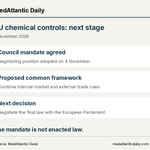
ALT Original MedAtlantic Daily graphic on the EU Council’s 4 November 2026 negotiating mandate for drug-precursor controls. It shows the proposed merger of internal-market and external-trade rules and identifies talks with the European Parliament as the next step. The graphic states that the mandate is not enacted law. No map or photograph.

ALT Original MedAtlantic Daily graphic showing that Montenegro has provisionally closed 21 EU accession chapters, according to the Commission’s 4 November 2026 assessment. Closure of the remaining chapters by the end of 2026 is conditional on member-state agreement and sustained reforms. The graphic does not claim a confirmed accession date. No map or photograph.
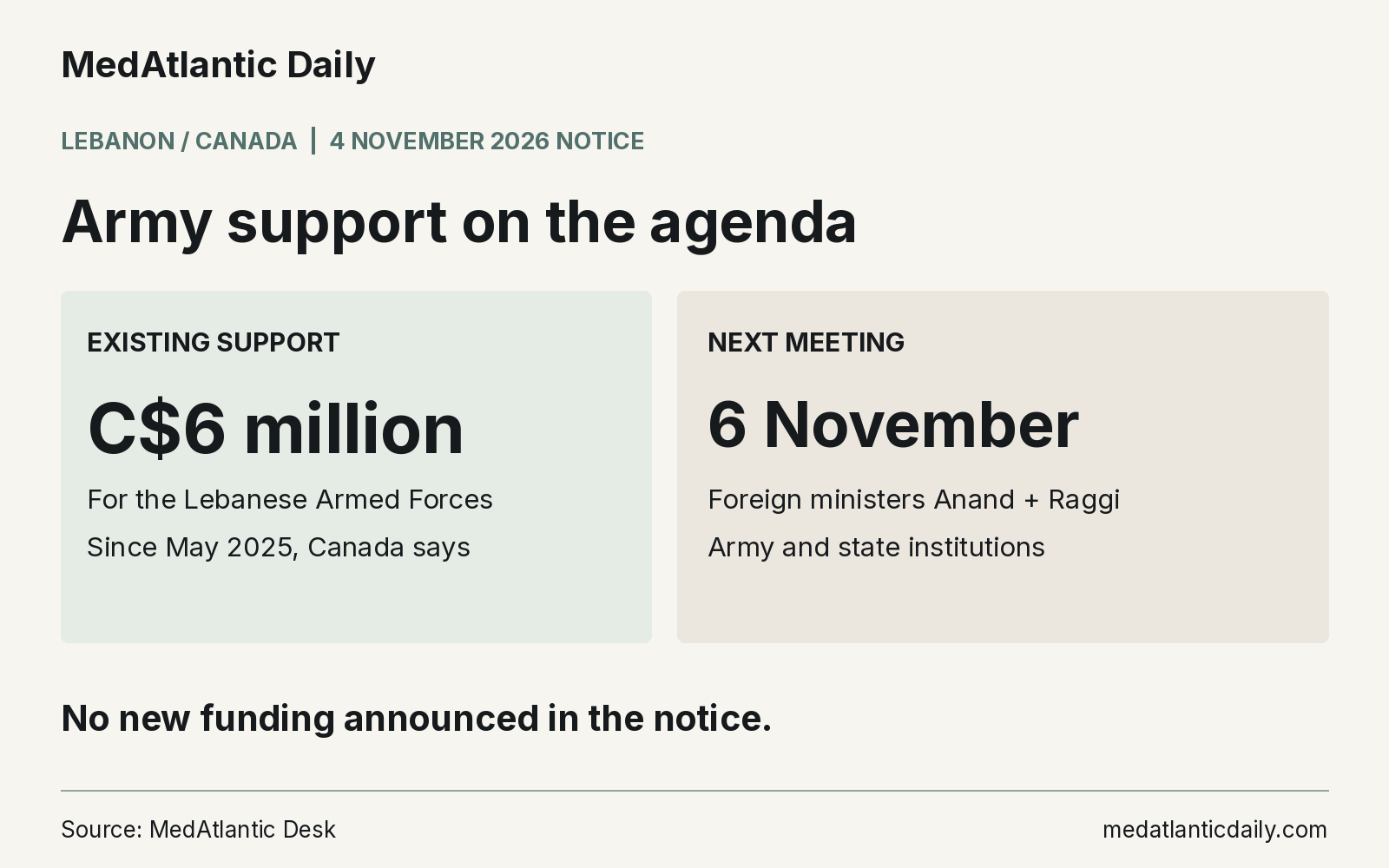
ALT Original MedAtlantic Daily graphic based on Canada's 4 November 2026 notice. Two panels distinguish existing support from the next meeting: Canada says it has provided C$6 million for the Lebanese Armed Forces since May 2025; foreign ministers Anita Anand and Youssef Raggi are scheduled to meet on 6 November to discuss the army and other state institutions. The graphic states that the notice announces no new funding. No photograph or map.

ALT Original MedAtlantic Daily graphic on Swiss measures announced on 4 November 2026. It shows a new reporting requirement for sales or other ownership transfers of LNG tankers to third countries, with sectoral measures effective 5 November. The stated purpose is to reduce sanctions circumvention. Enforcement remains the test of practical effect. No photograph or map.

ALT Original MedAtlantic Daily graphic on US September 2026 construction spending, released on 2 November. Total spending fell 1.9% from revised August. Two panels show private residential spending down 5.5% and private nonresidential spending up 1.1%, both month-on-month estimates. The bottom lists total spending at 2,186.1 billion US dollars versus revised August at 2,227.4 billion, labelled seasonally adjusted annual rates in current dollars, not real volumes. Black bold Inter wordmark top left and required desk-source and website footer. No photograph or map.

ALT Original MedAtlantic Daily graphic explaining the proposed Marvell–Lumentum transaction announced on 2 November 2026. It shows 4.5 Marvell shares for each Lumentum share, an implied enterprise value of 115 billion US dollars based on 28 October share prices, and expected closing in the first half of 2028 subject to approvals. A line describes the proposed combination of chips, lasers and optical connections. Black bold Inter wordmark top left, desk-source footer left and website footer right. No photograph or map.

ALT Original MedAtlantic Daily graphic dated 3 November 2026 titled Decisions to watch. Five panels show US congressional election day on 3 November; an announced Israeli opposition meeting; a Lebanese food-safety inspection plan attributed to Salam; Iraq’s announced 3,000-dollar traveller allowance starting 3 November; and US-announced Ukraine–Russia talks in Abu Dhabi on 10–11 November. A note distinguishes announced plans from completed outcomes. Black bold Inter wordmark top left, Source: MedAtlantic Desk footer left and medatlanticdaily.com right. No photograph or map.

ALT Original MedAtlantic Daily explanatory graphic on the 2 November 2026 electricity statement in Lebanon. Three numbered rows show part-payment of outstanding bills, a written monthly instalment plan for the balance, and the continuing obligation to pay current bills and instalments. EDL says missed commitments would trigger renewed cuts. A note says reconnection terms do not establish that all arrears are paid. Black bold Inter wordmark at top left, Source: MedAtlantic Desk at bottom left and medatlanticdaily.com at bottom right. No photograph or map.

ALT Original MedAtlantic Daily graphic on the Energy Community Regulatory Board’s 2 November 2026 endorsement of broader gas-network rules. It highlights 23 November 2026 as the adoption date requested by the board, not a confirmed enactment date. Panels describe proposed coverage of Energy Community borders including those with the EU, and the required decision by the Permanent High Level Group. A note explains network codes and distinguishes endorsement from adoption or guaranteed lower prices. Black bold Inter wordmark top left and required footer. No map or photograph.

ALT Original MedAtlantic Daily graphic on the 2 November 2026 opening of Belfast’s Resurgent fabrication hall. It shows 5,000 square metres of additional fabrication space, three planned Fleet Solid Support ships for the Royal Fleet Auxiliary, and the government’s early-2030s service timetable. A line lists new cranes, robotic cutting and a mechanised panel line. The graphic distinguishes an opened production hall from a delivered fleet. Black bold Inter wordmark top left and required desk-source and website footer. No photograph or map.