

Medis Medical Imaging develops, markets and supports powerful and innovative, DL-based software solutions for cardiovascular imaging.
Leiden
Joined March 2014
- Tweets891
- Following116
- Followers379
- Likes95



PIONEER IV final results at #TCT2026: 2,130 patients.
Per-protocol: ADP (incl. Medis QFR®) met non-inferiority (5.3% vs 5.5%).
Intention-to-treat: non-inferiority not met (7.4% vs 6.1%).
The lesson? Trust physiology, apply it consistently, and act on the results.

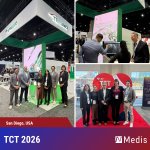
Still at TCT 2026? There’s still time to meet the Medis team. Let’s talk about the P4 trial, CT-guided PCI and QGuideCT®, turning coronary CTA into a 3D view of the coronary tree and its plaque.
Message us to arrange a meeting or QGuideCT demo.

Thank you, Dr. @yadersandoval, for sharing your expertise on CT-guided PCI at our educational dinner. In P4 (1,105 patients), 12-month target-vessel failure was 4.1% with CT guidance vs 4.6% with IVUS. The trial met its noninferiority endpoint.

Book a demo now: medisimaging.com/contact/req…
QGuideCT® 1.0 has US FDA market clearance. CE certification pending; not for clinical use in the EU.
From diagnosis to intervention: launched at TCT 2026, QGuideCT® 1.0 turns coronary CTA into a 3D view of vessels and plaque. We envision it as the clinical successor to QAngio CT Research Edition.
In P4’s CT-guided arm, Medis QAngio CT Research Edition analyzed plaque, including calcium, planned stent landing zones on CT and brought 3D reconstructions synchronized with the C-arm angle into the cath lab.
Compared with IVUS guidance, CT-guided procedures were about 17 minutes shorter (median 46 vs 63) and used 20 mL less contrast (150 vs 170 mL), with similar radiation dose.
Medis Imaging retweeted

Dr. Carlos Collet and Dr. C. Michael Gibson discuss the P4 Trial: Comprehensive CCTA-guided PCI strategy was associated with a lower rate of target vessel failure at 12 months compared to IVUS-guided PCI (4.1% vs. 4.8%) among patients with chronic coronary syndrome or stabilized acute coronary syndrome, supporting procedural safety and non-inferiority.
Watch video here: clinicaltrialresults.org/wp-…
Congratulations to the P4 investigators. We are proud that Medis QAngio CT RE was used in the trial to analyse plaque and calcium on CT and bring 3D CT reconstruction into the cath lab, synchronised with the C-arm, connecting pre-procedural planning with procedural practice.

🆕🔥🔥🔥The P4 randomised clinical trial evaluates whether a comprehensive CCTA-guided PCI strategy is non-inferior to IVUS-guided PCI for 12-month target vessel failure.
The CCTA strategy integrates anatomical and plaque assessment, FFRCT, virtual PCI planning, and intraprocedural CT-fluoroscopy co-registration.
🔗eurointervention.pcronline.c…
@bouissetfred @belmontemarta1 @ziadalinyc @SimoneBiscaglia @engstr_thomas @RajMakkarMD
@TheLADoctor @DrPeterOKane @divaka_perera @gpontone1 @yadersandoval @gmincione96 @GGStefanini @Eric_Van_Belle @DMunhoz @KoshiroSakai_MD @sbrugaletta @AIhdayhid @JonathonLeipsic @BernardBruyne @Ganeev @DAndreiniMD @ColletCarlos

Medis Imaging retweeted

Yesterday I posted eight questions TCT would answer. Here is the first.
P4, in NEJM today: CT angiography-guided PCI vs IVUS-guided, 1,105 patients, open-label, noninferiority.
Target-vessel failure at 12 months: 4.1% vs 4.6%. Risk difference -0.42 points.

What do interventional cardiologists want from CT before PCI? In P4, operators in a trial comparing CT-guided and IVUS-guided PCI were asked which CT insights help them plan and guide an intervention. Their answers point to three steps.

Survey: Stalikas N, et al. Int J Cardiovasc Imaging (2026): link.springer.com/article/10…
P4 results: nejm.org/doi/full/10.1056/NE…

Medis QAngio CT supported plaque analysis and in-lab CT guidance in P4. For more than 35 years, Medis has worked to make cardiovascular imaging actionable, from angiography and QFR to CT.
In P4, the CT-planned strategy was noninferior to IVUS for 12-month target-vessel failure, with shorter procedures and less contrast.
3. Bring the plan into the cath lab: Finding the optimal projection ranked highest among in-lab CT applications (2.59/3).
1. Understand the lesion: Plaque composition, including calcium, ranked as the most useful CT insight for planning (6.13/7).
Medis Imaging retweeted

P4 is out in the NEJM—a provocative step forward for CT-guided PCI!
Sharing this insightful interview by Dr. C. Michael Gibson with Dr. Carlos Collet, the trial’s principal investigator and a fellow Venezuelan who makes us proud! 🇻🇪👏
CT-guided planning offers an opportunity to support shared decision-making and prepare before entering the cath lab—from guide catheter selection and lesion modification to stent sizing.
Beyond planning how to perform PCI, this information may help the Heart Team decide whether surgery would better serve an individual patient.
An exciting addition to our armamentarium, with the potential to make coronary intervention more thoughtful, precise, and patient-centered.
#TCT2026 #P4Trial #CardiacCT #PCI

Dr. Carlos Collet and Dr. C. Michael Gibson discuss the P4 Trial: Comprehensive CCTA-guided PCI strategy was associated with a lower rate of target vessel failure at 12 months compared to IVUS-guided PCI (4.1% vs. 4.8%) among patients with chronic coronary syndrome or stabilized acute coronary syndrome, supporting procedural safety and non-inferiority.
Watch video here: clinicaltrialresults.org/wp-…
Medis Imaging retweeted
P4 is out! CT-planned vs IVUS-guided PCI—a potential paradigm shift in interventional cardiology. I see the future in combining these complementary approaches. An exciting new tool in our armamentarium! #TCT2026 #PCI @ColletCarlos @crfheart


Medis Imaging retweeted

THE P4 TRIAL — PART 1/4
For decades, we have been planning coronary interventions AFTER entering the coronary arteries.
Perhaps it is time to question that habit.
For a long time, invasive coronary angiography was the undisputed reference for coronary artery disease. We looked at the lumen, estimated stenosis severity, and decided what to treat.
There was just one problem.
Coronary artery disease is a disease of the vessel wall. Not simply a narrowing of the lumen.
IVUS and OCT changed the game by allowing us to look beyond the angiographic silhouette: plaque burden, vessel dimensions, calcium distribution, lesion length, and stent expansion.
Physiological assessment with FFR and related techniques added another essential dimension: not every anatomical stenosis produces significant flow limitation.
Meanwhile, something else was happening.
Coronary CT Angiography was evolving from a predominantly anatomical diagnostic examination into a comprehensive assessment of coronary atherosclerosis.
First came increasingly reliable coronary anatomy.
Then plaque characterization, quantitative analysis, and improved visualization of calcification.
Then CT-derived physiology.
And eventually, virtual PCI planning: the possibility of estimating the physiological consequences of treating a lesion before actually treating it.
Studies such as SYNTAX III REVOLUTION helped establish the feasibility of using CCTA for complex revascularization decision-making. The P4 development program and early CT-guided PCI experiences progressively explored whether CT information could also guide the intervention itself.
And this brings us to a rather uncomfortable question.
Why should we wait until the patient is on the catheterization table to understand the disease, choose the strategy, and anticipate procedural complexity?
Think about other major interventions.
Surgeons plan operations. Structural interventionalists extensively plan TAVI. Complex procedures routinely rely on preprocedural cross-sectional imaging.
Yet much of coronary PCI has traditionally remained an exercise in real-time decision-making.
Not because interventional cardiologists cannot plan.
But because the information required for comprehensive planning was historically unavailable before the procedure.
That limitation is disappearing.
Published in the NEJM on November 1, 2026, the P4 trial is the first large randomized clinical-outcome test of a comprehensive CCTA-guided PCI strategy against IVUS-guided PCI.
This is not merely another validation of coronary CT.
It is a challenge to the traditional sequence of coronary care.
Diagnosis first. Planning later. Treatment immediately afterward.
What if diagnosis and planning could become parts of the same process?
P4 may be remembered not for changing how we place stents, but for changing when we start thinking about placing them.
Next: What did P4 actually demonstrate?
#P4Trial #CCTA #CardiacCT #PCI #CoronaryArteryDisease #CardiovascularImaging
