

Keeping the human in the loop
Joined February 2022
- Tweets12.4K
- Following218
- Followers350
- Likes6.6K






Mega Evolved Frog retweeted

Trending repository of the day 📈
ai-job-search
The job search that runs on your machine. AI job application framework built on Claude Code: evaluate postings, tailor CVs, write cover letters, prep interviews. For...
Last 24h: 2,213 ⭐
Total: 51,413 ⭐️
github.com/MadsLorentzen/ai-…


Mega Evolved Frog retweeted

For people who keep asking what to build in AI Engineering.
➣ Build your own Context Assembler
(token-budgeted memory + retrieval + tools)
➣ Build your own Retrieval Stack
(chunker + BM25 + dense search + reranker)
➣ Build your own Model Router
(cost/latency/quality routing + fallbacks)
➣ Build your own Semantic Cache
(embedding similarity + hit-rate tracking)
➣ Build your own Agent Orchestrator
(deterministic state machine, no LangChain)
➣ Build your own MCP Server and Client
(raw JSON-RPC, no SDK)
➣ Build your own Multi-Agent Consensus
(weighted voting + judge + escalation)
➣ Build your own Sandboxed Tool Executor
(isolated execution + resource limits)
➣ Build your own Guardrails Middleware
(injection detection + PII redaction)
➣ Build your own Durable Workflow Engine
(checkpoint/resume, mini-Temporal)
➣ Build your own Streaming Proxy
(SSE + TTFT and ITL metrics)
➣ Build your own LLM Tracer
(OpenTelemetry-style spans for every hop)
➣ Build your own Eval Harness
(trajectory grading + CI regression gates)
➣ Build your own Prompt Registry
(versioning + A/B routing + rollback)
➣ Build your own Data Flywheel
(feedback → synthetic data → LoRA loop)
Pick 3. Build them from scratch. Document every decision.
Most people import libraries.
Builders understand what happens underneath.
Bookmark this. You'll need it.
Mega Evolved Frog retweeted

Who's gonna tell vibe coders about...
> Rate Limiting
> Caching
> Load Balancing
> Reverse Proxies
> API Gateways
> CI/CD
> Docker
> Kubernetes
> Service Discovery
> Circuit Breakers
> Timeouts
> Retries
> Exponential Backoff
> Idempotency
> Message Queues
> Pub/Sub
> Event-Driven Architecture
> Distributed Transactions
> Saga Pattern
> Dead Letter Queues
> Cron Jobs
> WebSockets
> Long Polling
> Server-Sent Events
> Database Indexing
> Query Optimization
> N+1 Queries
> Connection Pooling
> Read Replicas
> Sharding
> Partitioning
> Replication
> Leader Election
> CAP Theorem
> Eventual Consistency
> Optimistic Locking
> Pessimistic Locking
> Distributed Locks
> Race Conditions
> Deadlocks
> Memory Leaks
> Garbage Collection
> Thread Safety
> Backpressure
> Autoscaling
> Horizontal Scaling
> Vertical Scaling
> CDN
> Edge Caching
> Cache Invalidation
> Feature Flags
> Blue-Green Deployments
> Canary Releases
> Rolling Deployments
> Rollbacks
> Health Checks
> Liveness & Readiness Probes
> Monitoring
> Logging
> Distributed Tracing
> Metrics
> Alerting
> SLOs
> SLIs
> Error Budgets
> Observability
> Secrets Management
> IAM
> OAuth
> JWT Rotation
> TLS
> Encryption at Rest
> Encryption in Transit
> WAF
> DDoS Protection
> CORS
> CSRF
> SQL Injection
> XSS
> SSRF
> Database Migrations
> Schema Versioning
> Disaster Recovery
> Backups
> Failover
> Multi-Region Deployments
> Chaos Engineering
> Cost Optimization
> Cold Starts
> Serverless Limits
> Latency
> Throughput
> P99 Latency
> Tail Latency
> Network Partitions
> Clock Skew
> DNS
> TCP vs UDP
> HTTP/2 & HTTP/3
> gRPC
> Webhooks
> API Versioning
> Semantic Versioning
> Infrastructure as Code
> Terraform
> Helm Charts
> Build Caching
> Dependency Hell
> Production Incidents
> On-call
> Postmortems
...until the app gets its first million users.
Mega Evolved Frog retweeted

CLAUDE + OBSIDIAN + LOOP ENGINEERING = A VAULT THAT RUNS ITSELF
the core idea: the vault is the loop's state, not the chat window
everything Claude knows lives in a .md file
the loop:
> capture - a thought lands in 00-inbox
> context - claude pulls links, tags, and neighbouring notes
> draft - edits happen inside a git worktree, never the live vault
> review - a critic agent checks the diff before anything ships
> commit - appended to the vault, nothing gets rewritten
the key insight: frontmatter fields like supports, contradicts, and supersedes are graph edges, not metadata - the note format is the write API
start with a plain loop, it runs about 2-4x the cost of one direct call
> only move to a full graph once state has to outlive the session, several agents need to coordinate, or you have to explain what changed - that jump can run 10-50x
one review assistant climbed from 55% to 72% to 84% just by moving through these shapes in order


Mega Evolved Frog retweeted

Google just showed how AI engineers are moving from simple "RAG" to "graphs", memory and multimodal agents
• 15:32 - setting up the production agent stack
• 28:00 - turning disconnected data into a knowledge graph
• 41:00 - Graph RAG with semantic + hybrid search
• 58:00 - extracting graph context from images, text and video
• 1:09:00 - orchestrating specialized agents with ADK
• 1:20:00 - giving agents persistent memory across sessions
94-minute Google Cloud workshop, and it’s one of the clearest hands-on examples of the shift from ->
RAG → Graph RAG → Memory → Multimodal Agent Graphs.
The workshop uses Spanner Graph, Gemini, ADK and Memory Bank to build that stack.
Watch it today, then read the full “From RAG to Context Graphs” roadmap below.


Mega Evolved Frog retweeted

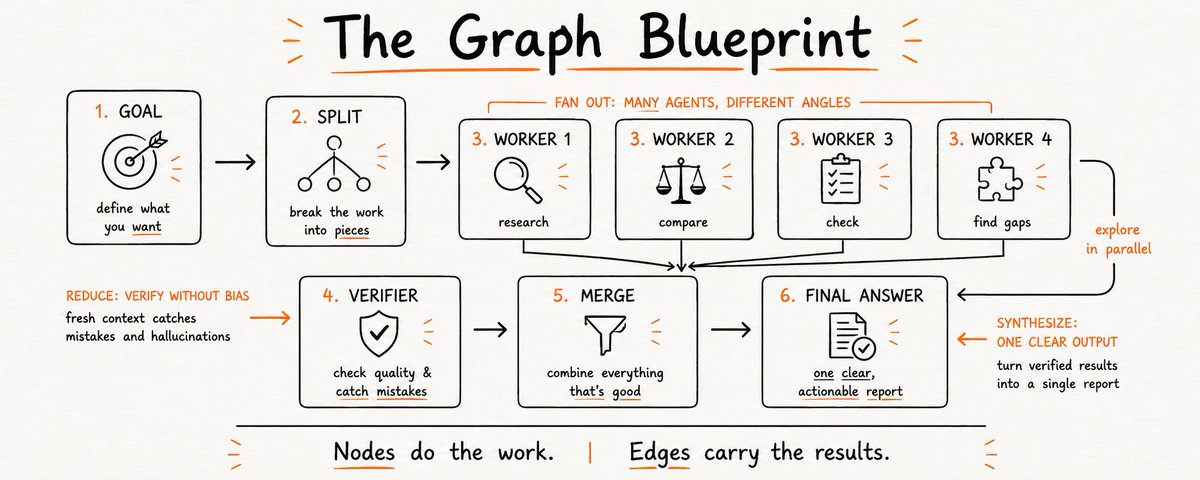
Anthropic engineer: “90% of our engineers were using self-improving loops. Now everyone has shifted to building agentic Graphs.”
“No more prompting.”
In just 10 minutes, she builds her entire Claude Code setup and workflow live from a blank terminal.
This is more valuable than most $1,000 agentic courses.
Watch this video, then save the article below if you want to become a graph architect before everyone else catches up.


Mega Evolved Frog retweeted

Anthropic engineer:
"The fastest way to make an agent better isn't a smarter model, it's the right loop and graph around it."
In 60 minutes she breaks down how Anthropic engineers use Claude Code, build agents that catch their own mistakes and improve with every run.
This beats any $500 agentic engineering course you can find.
Watch it, then read the full guide on loops and graphs below.

Mega Evolved Frog retweeted

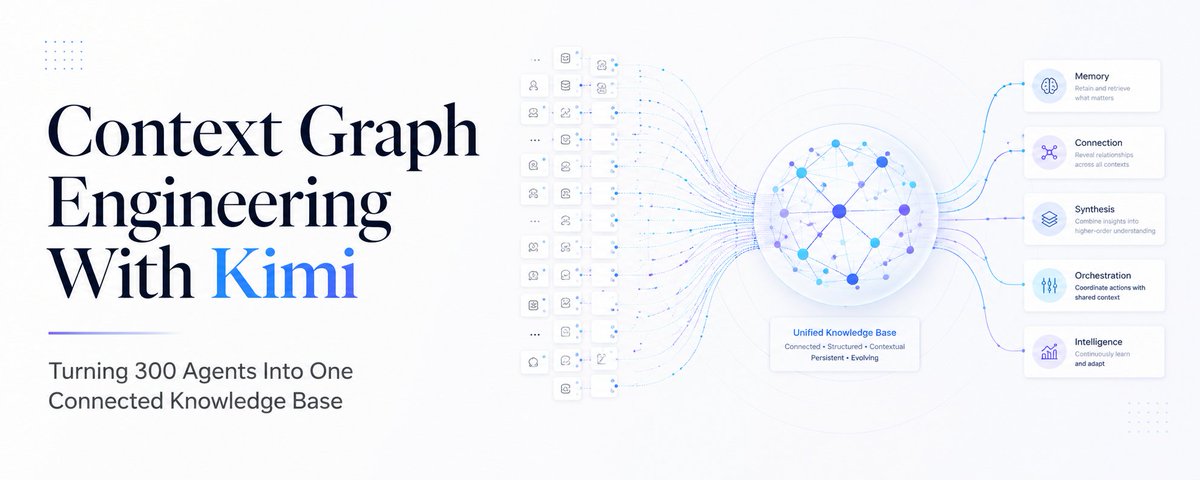
300 agents just finished your research in 40 minutes. congrats, now go read 300 documents.
that's what a swarm gives you. a pile.
the useful part isn't in any single one of them. it's in how they link up. 100 assets have 4,950 possible connections between them.
nobody holds that in their head.
kimi agent swarm keeps the links. 300 agents in one launch, up to 4,000 steps. every asset and every wallet an agent touches becomes a node. two agents hit the same counterparty, it draws an edge between them.
you don't get 300 answers. you get one map.
point it at your own trading portfolio and the picture gets uncomfortable. positions you thought were unrelated land in the same cluster, because the same market maker quotes all of them.
one bridge lights up as the hub half your holdings route through. that's your single point of failure, and nobody asked for it in the prompt.
Renaissance hedge fund keeps around a hundred PhDs on staff to catch things like that.
it also doesn't die when you close the tab. next launch adds to the same graph.
that's the gap opening right now. one guy re-reads 300 docs every week. the other one has a base that gets smarter every run.
my friend broke down the full framework and wrote the guide in the article below. read it, then go look at what your last agent run left you with.
🤝 Paid partnership

Mega Evolved Frog retweeted

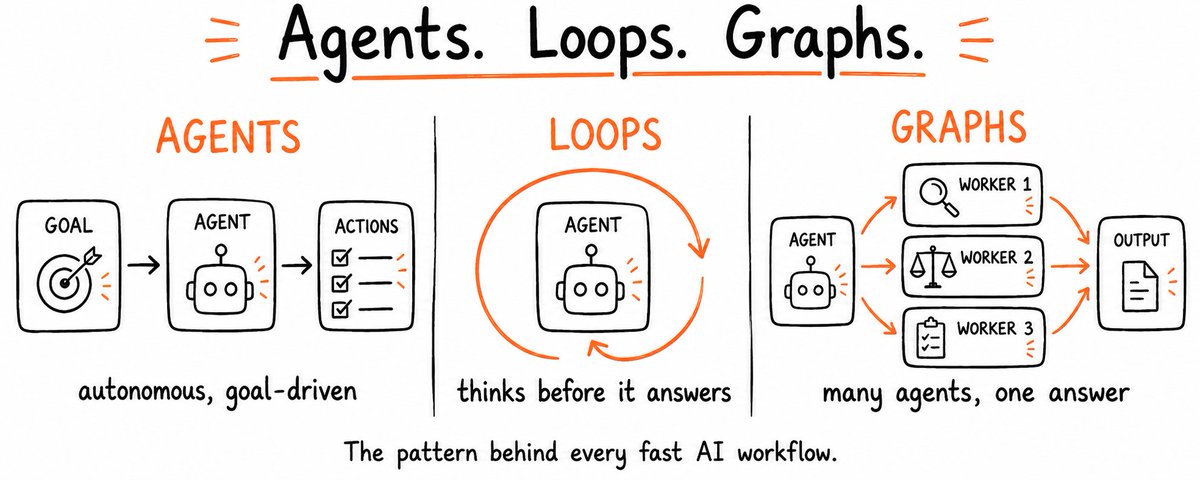
Andrew Ng just dropped a 2-hour course on Graph Engineering: from Loops to full automation
9:14 - Your first agent
33:11 - Loop engineering
1:02:46 - Graph engineering
1:30:15 - Agents that rewrite themselves
1:49:05 - Full graph system
Free, the best thing on graph engineering I've come across
Watch it, then build your first graph with the guide below

Mega Evolved Frog retweeted

Gm, anon!
I have 50 INVITE CODES for @SentientAGI.
And I also have written one of my most detailed investment memos covering it.
I'll dm you the report link if you:
1️⃣ Follow @stacy_muur, @green_but_red, and @SentientAGI
2️⃣ RT this post
3️⃣ Reply with any comment

Mega Evolved Frog retweeted

To those who compare us with the Temu of perp DEX - we appreciate the compliment. 🫡
We welcome all feedback to improve Aster here: asterdex.com/en/feedback
Rome was not built in a day. Job's not finished.


Mega Evolved Frog retweeted

Gmet
I’m excited to share the results of my slow and steady @MeteoraAG DLMM strategy over the past 30 days:
💰 +594 SOL (+19.6%)
🟢 100% daily WR
⏱️ 1–2h/day max
At this pace, the strategy compounds to >750% APY.
After months of refining and countless lessons learned, the key has become clear: target small but consistent daily gains, leverage the power of compounding, and protect capital at all costs.
Details below 👇🧵


Mega Evolved Frog retweeted

Ethereum si Amazon – O poveste in oglinda despre inovatie si infrastructura
* S-a muncit enorm la articolul asta, apreciez un retweet si like.
Cand te uiti la cum a evoluat Ethereum in Web3, e greu sa nu te gandesti la parcursul Amazon din anii ’90. De la o librarie online la o forta tehnologica de trilioane de dolari, Amazon a fost un pionier al internetului. Ethereum, lansat in 2015, pare sa urmeze un drum asemanator – dar in lumea blockchain-ului. Sunt paralele clare in felul in care au crescut, cum s-au pozitionat tehnologic si cum si-au construit ecosistemele.
Paralele financiare – modele de venituri, adoptare si evaluare
La inceput, Amazon nu facea profit – tot ce castiga reinvestea in crestere. Intre 1996 si 1999, veniturile au crescut de la 15 milioane la 1,6 miliarde de dolari. Ethereum, desi nu e o companie, genereaza valoare economica prin taxele de tranzactie (gas fees). In perioada de boom DeFi din 2021, aceste taxe au ajuns la un ritm anualizat de peste 8 miliarde de dolari – comparabil cu ce producea AWS in 2015. Dupa upgrade-ul din 2022, o parte din aceste taxe sunt "arse", asemanator cu un buyback de actiuni.
Cresterea adoptarii e si ea similara. Amazon a avut 1,5 milioane de clienti in doar trei ani. Ethereum a avut peste 600.000 de adrese active zilnic in 2021 si a securizat active de peste 140 miliarde de dolari in DeFi pana in 2024. Valoarea de piata a ambelor a fost extrem de volatila: Amazon a pierdut 90% din pretul actiunii dupa bula dot-com, Ethereum a pierdut peste 70% in bear market-ul din 2022. In 2024, ETH ajunsese la o capitalizare de peste 300 miliarde de dolari, doar o mica fractiune din Amazon – dar cu potential clar de crestere.
Un aspect adesea uitat este ca in anul 2000, multi analisti considerau Amazon un esec garantat. Se spunea ca nu are sanse reale impotriva eBay (care domina licitatiile online), Yahoo (liderul cautarilor si stirilor) sau chiar Barnes & Noble (gigantul traditional de carte). Se punea sub semnul intrebarii daca Amazon ar putea sa devina profitabil vreodata, sau daca era doar o moda a erei dot-com. Dar Amazon a dovedit ca valoarea vine nu din perceptia momentului, ci din capacitatea de a construi infrastructura pe termen lung.
Astazi, Ethereum se confrunta cu acelasi tip de scepticism.
Sunt multe voci care spun ca Ethereum e prea lent, prea scump sau “demodat” comparativ cu retele precum Solana, Sui, Aptos sau Avalanche – care promit viteze superioare, costuri mai mici si o experienta de utilizator mai fluida. Asa cum Amazon era perceput ca "inferior" fata de rivalii sai in anii 2000, si Ethereum e vazut uneori ca fiind depasit tehnologic. Insa aceasta analiza ignora exact ce ignora si atunci: efectele de retea, ecosistemul construit in jurul platformei si capacitatea de adaptare. Amazon nu a devenit lider pentru ca era cel mai rapid – ci pentru ca era cel mai robust. La fel si Ethereum: desi alte retele pot fi mai rapide, niciuna nu are acelasi nivel de securitate, lichiditate, adoptare si infrastructura matura.
Roluri tehnologice – infrastructura de baza pentru doua lumi
Ethereum joaca acum rolul unei "masini virtuale globale", unde orice aplicatie poate rula pe o retea descentralizata. De la DeFi si NFT-uri pana la jocuri si identitate digitala, Ethereum e fundatia Web3. Amazon a facut ceva similar in Web2 – pornind de la retail si ajungand la AWS, care ofera servicii de stocare si computing pentru mii de companii. Diferenta e ca Ethereum e descentralizat, dar rolul in ecosistem e acelasi: ofera o platforma pe care altii construiesc.
Un punct cheie in aceasta paralela este comparatia dintre AWS si EVM. Amazon Web Services a devenit coloana vertebrala pentru mii de aplicatii Web2 – un sistem robust, scalabil, modular, care le permite dezvoltatorilor sa lanseze produse fara sa-si construiasca propria infrastructura. Ethereum, prin Ethereum Virtual Machine (EVM), joaca acelasi rol in Web3. Este mediul standardizat in care se executa toate aplicatiile inteligente (smart contracts), oferind un set comun de reguli si instrumente pentru dezvoltatori. La fel cum companiile Web2 aleg AWS pentru ca “functioneaza din prima”, dezvoltatorii Web3 aleg EVM pentru ca e deja compatibil cu tot ecosistemul – de la walleturi la L2-uri. Adoptarea EVM de catre alte lanturi (Arbitrum, Optimism, Base, Polygon etc.) transforma Ethereum intr-un fel de “standard tehnologic” pentru viitorul internetului descentralizat – la fel cum AWS a devenit standardul de facto pentru infrastructura cloud
Ecosisteme si dezvoltatori – forta retelei Amazon a incurajat de la inceput integrari cu terti, oferind API-uri si infrastructura care a permis cresterea Marketplace-ului si a AWS. Ethereum a fost open-source din prima zi. Oricine poate crea un smart contract sau un token. EVM-ul a devenit un standard copiat de alte retele. Ethereum are mii de dezvoltatori activi lunar – mult mai multi decat orice alta retea blockchain, ceea ce o face cel mai dezvoltat ecosistem din crypto.
Raspuns la sceptici – De ce Ethereum nu e un nou Nokia sau BlackBerry
Unii critici compara Ethereum cu Nokia si BlackBerry – branduri care pareau invincibile, dar au fost rapid inghitite de valul noilor tehnologii. Suna bine ca avertisment, insa aceasta comparatie nu rezista la o analiza serioasa.
In primul rand, Nokia si BlackBerry erau companii inchise, cu ecosisteme controlate si incapabile sa se adapteze rapid. Cand Apple si Google au introdus platforme deschise si orientate spre dezvoltatori, aceste branduri au ramas in urma. Aplicatiile si dezvoltatorii au migrat acolo unde aveau libertate si flexibilitate. Ethereum, in contrast, nu este un produs inchis, ci o infrastructura deschisa si evolutiva. Oricine poate construi pe Ethereum, iar inovatiile vin “din margini”, nu dintr-un centru de comanda. Este un protocol viu, care se adapteaza constant prin upgrade-uri si propuneri comunitare.
In al doilea rand, Ethereum beneficiaza de efecte puternice de retea – fiecare noua aplicatie, wallet, L2 sau protocol adaugat pe Ethereum il face mai valoros pentru toti ceilalti. BlackBerry si Nokia nu aveau acest efect cumulativ. EVM-ul este deja un standard acceptat in industria Web3, iar companii importante – de la fonduri de investitii la banci – aleg sa construiasca direct pe Ethereum. Acest tip de inertie si integrare profunda nu poate fi replicat usor de un “Ethereum killer”.
In plus, Ethereum evolueaza constant: The Merge, EIP-1559, L2 rollups, staking, account abstraction – toate sunt dovezi ca reteaua nu doar ca se mentine relevanta, dar devine tot mai eficienta si accesibila. Iar spre deosebire de brandurile mentionate, Ethereum nu se bazeaza pe branding sau pe un segment de consumatori, ci pe utilitate reala si pe adaptabilitate structurala.
Concluzie
Ethereum si Amazon sunt doua povesti paralele, desi din lumi diferite. Ambele au trecut prin perioade de scepticism, au fost percepute ca supraevaluate, dar au continuat sa construiasca infrastructura fundamentala pentru viitor. Amazon a redefinit comertul si cloud-ul. Ethereum redefineste finantele, arta si relatia dintre utilizator si internet. Comparatiile cu Nokia sau BlackBerry nu pornesc din analiza. Spre deosebire de acele branduri, Ethereum nu e un produs singular, ci un ecosistem viu, deschis si in continua expansiune. Iar daca ne uitam la traiectoria sa, la adoptarea EVM si la integrarea institutionala, e clar ca Ethereum nu e o moda trecatoare, ci o fundatie solida pentru economia digitala a urmatorilor ani.
(un like, un retweet si parerea voastra in comentarii este foarte apreciata)
Mega Evolved Frog retweeted

Projects (Pre-TGE) Funding on Kaito 💵 :
Which ones are you max yapping?
▫️@0G_labs▫️$359M▫️
▫️@Somnia_Network▫️$270M▫️
▫️@monad_xyz▫️$244M▫️
▫️@MaplestoryU▫️$100M▫️
▫️@sophon▫️$76.6M▫️
▫️@infinex_app▫️$65.29M▫️
▫️@EclipseFND▫️$65M▫️
▫️@EspressoSys▫️$60M▫️
▫️@soon_svm▫️$60M
▫️@megaeth▫️$57.73M▫️
▫️@SuccinctLabs▫️$55M▫️
▫️@Humanityprot▫️$50M▫️
▫️@Tabichain▫️$36.76M▫️
▫️@AlloraNetwork▫️$33.75M▫️
▫️@campnetworkxyz▫️$30M ▫️
▫️@Polymer_Labs▫️$26.6M▫️
▫️@Calderaxyz ▫️24M▫️
▫️@hyperbolic_labs▫️$19.73M▫️
▫️@Lombard_Finance▫️$17M▫️
▫️@union_build▫️$16M▫️
▫️@FogoChain▫️$13.5M▫️
▫️@TheoriqAI▫️$10.2M▫️
▫️@OpenledgerHQ▫️$8M▫️
▫️@satlayer▫️$8M▫️
▫️@MitosisOrg▫️$7M▫️
▫️@defiapp▫️$6M▫️
▫️@skate_chain▫️$4.75M▫️
▫️@Novastro_xyz▫️$1.2M▫️
▫️@Sidekick_Labs ▫️Undisclosed▫️
▫️@multiplifi▫️Undisclosed▫️
▫️@paradex▫️Undisclosed▫️
▫️@thriveprotocol▫️??▫️
Mega Evolved Frog retweeted
I choose GoFundMeme.
🌄 I'm backing the Solana OG founders that built the most rewarding launchpad & made this tech available to everyone before the major players
🌄 I'm supporting the vision of a tokenization protocol by the people, for the people
🌄 I'm going all in on a better future for regular trenchers
from Day One, GoFundMeme was built to reward the community.
100% rewards distributed to creators, traders, stakers.
it’s still Day One for GoFundMeme.
it always will be.

Mega Evolved Frog retweeted

If you are a creator or founder and want to launch a token here is why $GFM @GoFundMemes is the best platform to do (meme/utility)
1- No snipers
Right now since the platform does not have integration with majority of the bots most of the tokens launched on GFM does not get sniped.
2- Tokenomics
Unlike pumpfun, you can go either for bonding curve or have your own custom tokenomics set on the platform.
3- Pre-Baked community
Launching on GFM means your project will get support from 12K holders of GFM token. Since the incentives of GFM token holders and your project doing good is aligned, if you have built something good, the community will support your project hands down.
4- Chances of Bonding
On GFM the average bonding percentage is 4 to 5% compare to pumpfun where it is around 1%
5- Holding incentive
Since GFM is built in a way that all revenue from the platform and 100% of the trading fee is distributed back to token holders, there is always an incentive to hold your tokens.
