

Founder of the Microstory Journey, a 3-Minute Story Blueprint to engage, connect, & grow your business.
Reno, NV
Joined May 2022
- Tweets505
- Following208
- Followers220
- Likes317





Pinned Tweet
Interested in Microstories, Communication, or Positioning?
Over the next 30 days, I'll be writing 30 Atomic Essays.
Follow my Social Blog on @typeshare_co:
typeshare.co/mikehays

Small talk kills business deals.
Most people open with dead words.
The memorable ones open with a micro-story.
Not a long pitch.
Just one short, visual moment that makes people lean in and ask the next question.
A story bank beats small talk every time.
Peace comes from a different goal.
I’m not trying to beat everyone else.
I’m trying to become more clear, more disciplined, and more effective than I was yesterday.
Comparison scatters your focus.
Self-mastery compounds it.
I’m not trying to be better than other people.
I’m trying to be better than the version of me that used dead words, hid behind jargon, and forgot that our brains take words and transmit them into pictures.
That’s the only race worth running.
Comparison doesn’t motivate you. It distracts you.
The moment you measure your path against theirs, you stop noticing your own progress.
The only comparison that actually helps:
Who I was yesterday.
Who I am today.
Who I’m becoming next.
If you can’t lead yourself, you can’t lead anyone else.
Great leadership doesn’t start with status, titles, or charisma.
It starts with self-mastery.
The first person you’re called to influence is the person in the mirror.
The more you watch their path, the more you forget your own.
Comparison doesn’t just steal joy.
It steals clarity.
Keep looking sideways and you’ll miss the only work that matters: becoming better than who you were yesterday.
You don’t have a consistency problem. You might have a clarity problem.
Last month, a coach I worked with cut her posting in half and doubled her inbound.
She didn’t post more.
She made her message easier to see.
Your content plan should do 3 jobs at once:
teach
prove
capture
If a post only gets attention, it’s incomplete.
I want every post to demonstrate the method, attract the right people, and open a conversation.
That’s how content becomes a pipeline.
The leaders people trust most aren’t the loudest.
They’re the ones with a quiet, relentless commitment to 3 things:
growth
integrity
learning
That’s what self-mastery looks like.
And that’s what people follow.
If you’re stuck on how to create a brand message, copy this:
\[Power verb\] + \[ideal client\] + to + \[visible outcome\] + so + \[what they do next\]
Simple beats clever. Clear words create visual moments. Visual moments make people lean in.
The fastest way to lose a buyer is to use dead words.
If your words don’t create a picture, your audience can’t see the value.
Our brains take words and transmit them into pictures.
No picture, no attention.
No attention, no sale.
If your marketing sounds smart but nobody buys, this is probably why:
jargon creates dead words
And dead words create no picture.
Our brains take words and turn them into images.
If people can’t see it, they won’t feel it.
If they don’t feel it, they won’t act.
The best brand message is not the one that sounds most impressive.
It’s the one your customer understands fastest.
Clever gets praised.
Clear gets remembered.
Clear gets action.
If that makes sense, choose visual words over dead words every time.
I used to freeze on stage trying to remember the “right” way to tell a story.
Name the enemy.
Enter the cave.
Find the lesson.
Too much structure made me worse.
So I simplified storytelling into 3 parts.
Clear beats clever every time.
The fastest way to lose a buyer is to use dead words.
If your words don’t create pictures, your audience checks out.
Better messaging:
Cut jargon
Replace abstract words with visual words
Turn the point into a micro story
Clarity makes people lean in.
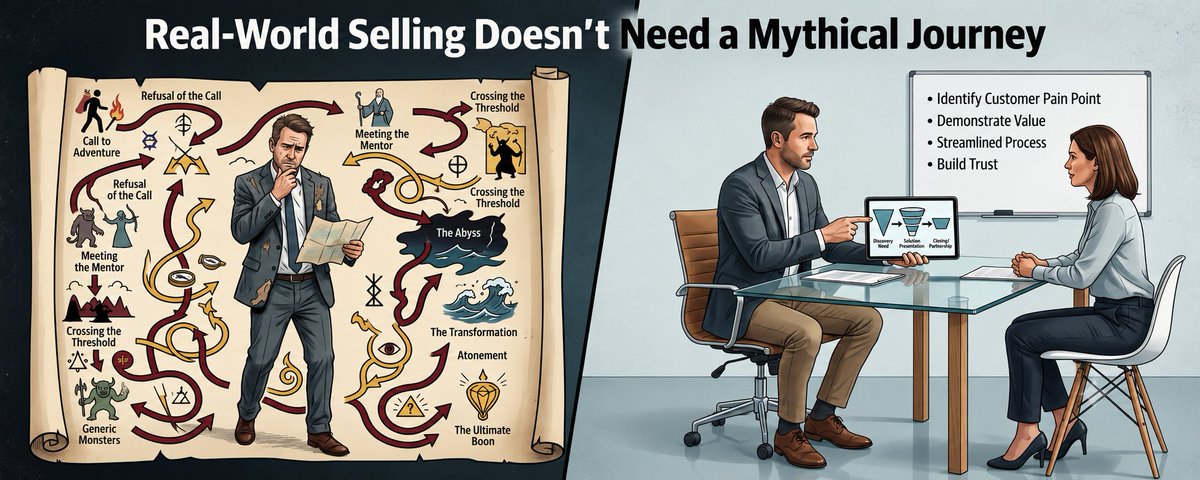
Unpopular opinion: the hero’s journey ruins more business storytelling than it helps.
When you’re selling live, you don’t need caves, enemies, and epic arcs.
You need a micro story your audience can picture in 30 seconds.
Simple sells. Complex performs badly.
You don’t need a long story to make people lean in.
You need a 30-second visual moment.
Our brains take words and turn them into pictures.
If your message is full of dead words, people tune out.
If it creates a quick 3-part micro story, they pay attention.
If people can’t picture what you mean, they won’t care what you say.
Your brain doesn’t buy words. It buys pictures.
Stop using dead words.
Start using visual words.
The clearer the image, the faster the message lands.
Hey @lindseyvonn, critics:
Critiquing from your couch is easy.
Choosing to compete again when you’ve already proven everything is not.
That’s what courage looks like.
That’s what real competitors respect.