
Labor, Public, Applied Econometrics | AP @ClarkUniversity | PhD @UWMadison | https://xitter.gq/t.co/NBn2L4k6qz
Worcester, MA
Joined April 2010
- Tweets609
- Following910
- Followers362
- Likes2.7K




Pinned Tweet
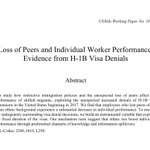
Very happy that my PhD JMP has found an incredible home. This is special as it was part of the process of discovering my interest to understand the equilibrium of unequal outcomes.
From the very inception of the idea, I can only recall tremendous support from everyone at grad school with whom I spoke, who came to my presentations and stayed back to chat more, hours of discussions with my best buddies and my committee members. Many thanks to you all and I hope to pay it forward! ❤️ #EconTwitter

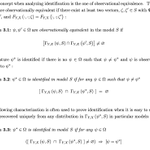
Under incomplete info, preferences and beliefs both drive choices. Varying info and eliciting compensating differentials identifies both, circumventing non-innocuous variance normalizations as a dollar's value is invariant across info. @MoshiAlam et al.
econometricsociety.org/publi…

Moshi Alam retweeted

What do parametric assumptions add to a model's empirical content? We answer this question for ordered random utility models, from nonparametric foundations to ordered logit, with applications to risk and altruism.
econometricsociety.org/publi…

Moshi Alam retweeted

Very glad to hear that Germany plans to nominate @MarkusEconomist for the @ecb's Executive Board to become the next Chief Economist. He is not only a fantastic macroeconomist but also a convinced European.
Moshi Alam retweeted

New working paper with the brilliant Michal Kolesár:
Shrink Responsibly: Empirical Bayes in Economics
We review the ins and outs of eB "shrinkage," as applied in econ settings, and illustrate them with an application to public school value-added
Some takeaways:
- Conventional normal-normal shrinkage, perhaps with an adjustment for precision dependence, can work pretty well -- even when misspecified (like OLS!)
- Plenty of interesting questions should not be (but often are) answered with shrinkage; we give alternative estimators for some cases
- Elementary and middle schools in Charlotte-Mecklenberg vary widely in value-added, which appears causal. More popular schools are not reliably better, but better schools seem to have higher-achieving peers
Link below!

Moshi Alam retweeted

Economics has incorporated insights on behavioral consumers (or individuals) for some time; it has been slower in thinking about "behavioral firms," but that has been changing too of late, partly as imperfect competition has become more of an acceptable benchmark in product and labor markets.
Market power mitigates size of losses in profit from optimization error, so more easily allows a lot of "clunky" behavior to survive in a competitive equilibrium. [Examples from labor market: aeaweb.org/articles?id=10.12…; nber.org/system/files/workin…]

Thanks so much @sndurlauf for the great summary! It was my great opportunity to interact with Steven in my early years at UW Madison. He was instrumental in helping many like me to think about inequality, especially in his social interactions class. Even beyond the classroom Steven helped me tremendously to become a better writer.

This is a wonderful paper by Moshi Alam
@MoshiAlam (who I had the great opportunity to interact with at UW Madison), Mehreen Mookerjee, and Sanket Roy. The paper studies preferences and beliefs in determining hypothetical choices over mentors, with a focus on distinguishing the roles of beliefs about managers’ mentoring ability versus preferences over mentor gender. The experimental/survey context generates data that, by manipulating information sets allows preferences and beliefs to be disentangled as determinants of choices. Substantively, the analysis finds that evidence that female mentors are incorrectly believed to be less able mentors than men. Biased beliefs are less likely for better educated. This produces a set of valuable insights in the complex ways that discrimination is manifested in modern society.
1
9
520
Very happy to see it in print! :-)
Quantitative Economics Volume 17, Issue 4 (November 2026) is now online
econometricsociety.org/publi…

Moshi Alam retweeted

Excited to share this new paper, co-authored with Max Mihm & Lucas Siga. We study a lemon's problem in organizations and politics that arises when one side has better info about which policies are viable and what they entail. Comments welcome!
Link here: sites.psu.edu/nageebali/file…

Moshi Alam retweeted

Can police attitudes toward gender-based violence be changed? We ran a three-day arts-based training with ~2,500 officers across 417 stations in Bihar. A year later, treated officers were 15pp less likely to blame victims and registration delays fell 41%. See the @nberpubs WP!

Partnering with Indian police stations from Bihar to evaluate an intervention designed to change police responses to gender-based violence, from @sofiafamaral, Girija Borker, @Prof_Nishith_P, and @micasviatschi nber.org/papers/w35986

Moshi Alam retweeted

Happy to share this @vox_dev article based on our JDE paper with @muneer1200. We show how a rural liquidity shock triggered by microfinance regulation reduced investments in children’s education and caused persistent learning losses.
Thread: xitter.gq/sohamsahoo/status/2039…
@iimb_official

🆕 When microfinance credit contracted in India, children’s education suffered
Today on VoxDev, @muneer1200 (@themastersunion) & @sohamsahoo (@iimb_official) discuss their research on credit contraction in Andhra Pradesh:
voxdev.org/topic/education/w…

Moshi Alam retweeted

The dominant model people use to think about AI's effect on the labor market is automation. But perhaps commoditization is a better model. Automation implies job apocalypse. Commoditization implies plentiful jobs with low wages. 1/
Moshi Alam retweeted

Fantastic initiative. I took the “Little Red Schoolhouse” course and it was one of the highest value courses I’ve ever taken. I still go back to my notes.
If you are @UChicago, I cannot recommend enough taking their writing classes.

UChicago has launched the Chicago Center for Writing, a new hub for writing across campus. It will anchor a new Core requirement, the first major change to the College’s writing curriculum in over 30 years, built for the era of AI.
Learn more: ms.spr.ly/6014afKGC

Moshi Alam retweeted
I forbade Dylan from writing about the minimum wage, as my advisors once forbade me. He defied me, and I'm very glad of it.
An awesome project using incredible firm-level data to understand how wage, employment, and price effects of MW changes connect to theory.

Why do min wage studies disagree?
New data shows firms just below the new min add jobs and cut prices. Those at the old one do the reverse. That's new evidence of monopsony.
Firm mixes—not models—differ by hike.
Read Dylan’s paper: economics.uchicago.edu/direc…
#EconJobMarket #minwage

ALT Graphic promoting University of Chicago Kenneth C. Griffin Department of Economics job market candidate Dylan Balla-Elliott. His job market paper is "The many effects of the minimum wage: new evidence on employment and prices", and his research focuses are labor and econometrics.
Moshi Alam retweeted

There are many thoughtful critiques of this line of work. This is not one of them. Sad to see @margrev engage in this. Only upside is that the post clearly illustrates the need to have humans in the loop in social science...at least for now :)

Errors in the research of Emmanuel Saez and Gabriel Zucman marginalrevolution.com/margi…

Moshi Alam retweeted
Can AI conduct qualitative interviews with thousands of people? In a new REStud paper, Friedrich Geiecke and @XJaravel develop an open-source approach that combines the depth of qualitative interviews with the scale of surveys.
1/6

Moshi Alam retweeted
Looking forward to co-hosting this IDEA session. We hope to have an engaging discussion on writing papers and navigating the publication process. If you are interested in joining, please register and share a question you would like the editors to address.
idea.devecon.org/career-skil…

Writing Papers and Responding to Reviewers — the session early-career researchers keep asking for.
Mon, Nov 30 · 11 AM ET · Virtual
@EdmondsEric, James Fenske, Randi Hjalmarsson, @aprajitmahajan
Free: idea.devecon.org/career-skil…
@deanyang @willafriedman @sohamsahoo @ideadevecon

Moshi Alam retweeted

I have an economics paper about this, and I suspect that AI is making it worse:academic.oup.com/qje/article…

Moshi Alam retweeted

strong endorse of this. So far at least, AI writing on academic economics, and AI summaries, are not great in terms of prioritizing what is and isn't important, or how to write academic econ well.

A signature feature of academic AI writing is (currently) that it is has bad judgment on what is important and what is not important, even refine.ink.
This is one of the most damaging AI "tells", b/c it reflects bad judgment on the part of the author as well. 1/
Moshi Alam retweeted

I've considered that thought experiment


Consider this thought experiment: "University X has seen graduation, retention rates increase after new adopting policy of giving all students As, regardless of how they perform -- and whether they even come to class."
Not far from reality in many cases.
calmatters.org/education/hig…

Moshi Alam retweeted

🚨Understanding Migration Responses to Local Shocks
New version of paper with @borusyak and Brian Kovak!
1/6 Many papers find that local labor demand shocks have sizable effects on wages and employment, but surprisingly small or imprecise effects on local population.

Moshi Alam retweeted
Ok, this is in progress! Here's a preview
(Top-5 pubs from the last ten years with a simple TWFE specification + replication data; matched samples between TWFE, Callaway-Sant'Anna, and Borusyak-Jaravel-Spiess)
with thanks to Astra, Kevin Chen, & Jon Roth

