
Assistant Headteacher : QOE, ECT Lead, Former Curriculum Leader of PE
Joined November 2022
- Tweets503
- Following449
- Followers296
- Likes4.9K




Ben Rodgers retweeted

Carl Hendrick came to Direct Instruction through cognitive science. Beginners need knowledge before they can think like experts. His line in today's Sold a Story: "You can't really connect the dots if you haven't got any dots." 👇
Ben Rodgers retweeted

Skills statements are making a comeback in England.
This approach to assessment is one of the major differences between a knowledge-based and a skills-based curriculum.
It’s a clear sign that the current government are unpicking the successful education reforms of the last 15 years.
substack.nomoremarking.com/p…

Ben Rodgers retweeted

There is going to be an explosion of CPD on "oracy" over the coming months.
My advice to senior leaders procuring training or to teachers experiencing such training is to ask for videos of the strategies being proposed.
Oracy is a big, nebulous idea. It can mean lots of things to lots of people. So if someone wants you to "do oracy" then you need to know exactly what they mean by the term: what specifically do you want me to do in the classroom?
The best way for them to answer that question is through a video: this is what I want you to do in the classroom.
A video will allow you to establish if you think it was a good use of time in that classroom, and then what it might look like in yours.
This is broadly true of all CPD and teaching strategies, but it's especially true of well-defined ones.
Ask to see what it looks like. Great CPD isn't merely about raising awareness of ideas. It's about changing classroom practice, and you can't do that if you don't know what it looks like.

Ben Rodgers retweeted

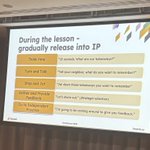
3. FLMOP. Front Load the Method of Participation. Every time you ask pupils to do something or give an answer, tell them how you want them to answer FIRST.
“By writing on your mini-whiteboard…”
“Say it together on 3…. 1, 2…”
“By raising your hand.”
“In silence…”
Ben Rodgers retweeted

Direct instruction is joyful & leads pupils to success. Here is a *clip* where I use high frequency & high participation questioning in 3 phases:
1. Check for listening
2. Rehearsal
3. Check for understanding
Established routines: all hands up, turn & talk, SLANT & ruler reading
Ben Rodgers retweeted

I take a look and writing frames - and provide a possible writing frame for different types of geographical questions drawing on thinking from @ClareSealy and drawing on work from @greeborunner @LesleySullivan and @Matea_Marcinko
enserm.substack.com/p/how-sc…
2/2
Ben Rodgers retweeted

💡 NEW POST 💡
'The problem with reading ages'
"Reading ages are seemingly intuitive and straight-forward, but they can be prone to being misread or more likely over-interpreted."
alexquigley.co.uk/the-proble…

Ben Rodgers retweeted

The Education Endowment Foundation has conducted two Oracy trials using School 21 and its approach as the basis. This must be the evidence that has convinced @LucyMPowell of the case for a renewed focus.


Ben Rodgers retweeted
You can only speak eloquently about things you know well. Honing speaking skills is about as useful as attempting to teach reading comprehension skills: there are a small number of useful strategies, but by far the best way is to teach subject knowledge exceptionally well. 1/

We’re hardwiring oracy into the revised National Curriculum, so speaking, listening, and communicating will light up every classroom.
Read @LucyMPowell's speech in full: gov.uk/government/speeches/e…

ALT Oracy to be given equal status to reading and writing - as a brand new strand of the English curriculum. A photograph shows a teenage boy and girl wearing school uniform speaking to a class of pupils.
Ben Rodgers retweeted

🗣️ ORACY! This edition, I break down oracy: what it actually is, why it matters, and exactly how to build purposeful talk into your classroom. Plus, it includes a FREE planning tool.
newsletter.jamieleeclark.com…

Ben Rodgers retweeted
I am interested in learning from a secondary school that currently embeds an "oracy" programme which is the type we are supposed to emulate.
What exactly do they do?
How do they assess it?
What are their general outcomes as a school?
Which demographic do they serve?
I think this will be the last post I do on oracy for the minute. It's important that if, as a profession, we are going to implement something we know exactly what it looks like and where it works.
Please share widely 🙏🙏
Ben Rodgers retweeted
There are lots of views about how to improve our education system. Not enough of them focus on the classroom. We pursue big structural solutions, when we should be looking at how to create calm, quiet, peaceful classrooms.
New post, please share!
carouselteachlearnlead.subst…

Ben Rodgers retweeted

A new post on how to atomize in early science instruction! Atomization is one of the best concepts I've learned in this SOL journey.
omullins.substack.com/p/atom…

Ben Rodgers retweeted

We should be judging the *impact* of those efforts.
If a school with lots of advantages is coasting along, that needs calling out. Those pupils deserve better.
If a school with loads of challenges is breaking the mould for schools with similar contexts - celebrate and share.
Ben Rodgers retweeted

Behaviour is the key to almost every element of school improvement. The number of people who don’t get this staggers me.
Ben Rodgers retweeted

Criticisms I hear of booklets are often around rigidity/one size. Today, I created a sentence stem writing frame in response to yesterday's misconceptions to scaffold for struggling students for them to stick in their booklets. Simple tweak for a large impact👊Booklet = Basis 💭


Ben Rodgers retweeted

***POOR PROXIES FOR LEARNING***
We need to be cautious when observing lessons and own biases and not allow our own feelings about how a lesson feels rather than what pupils were actually learning.
A lesson might appear quiet, understated or lacking obvious enthusiasm and still involve substantial cognitive work. Equally, a lesson can feel energetic, exciting while pupils learn relatively little. This is what Professor Rob Coe discussed when referring to poor proxies for learning.
A quiet classroom is not necessarily a passive classroom. Pupils might be retrieving knowledge, grappling with a difficult question, reading closely, practising independently or carefully constructing an answer. None of these necessarily produces an energetic looking lesson to the observer.
The aim is not to create classrooms that look busy. It is to create classrooms in which everyone is encouraged and supported to think hard. Therefore, we shouldn’t be thinking about the energy in the room. We should be considering the thinking taking place.
#TheLongdendaleLegacy
Ben Rodgers retweeted

Intention changes everything...
Why this task?
Why this scaffold?
Why this question?
Why this grouping?
Why this feedback?
If we can’t explain how a decision supports learning, we should probably reconsider the decision.
That’s designing learning.
Ben Rodgers retweeted

Why you need a lesson observation methodology
mrnickhart.substack.com/p/wh…