

Sharing facts on places of historical Islamic interest from around the world.
Joined May 2011
- Tweets4.7K
- Following459
- Followers33.7K
- Likes2.4K




Pinned Tweet
Here's the link to my visual presentation on the 'Development of the Ka'bah Through History' which I delivered in Jamea Masjid, Preston, UK.
It covers the period before creation through to modern day, with a glimpse of what will happen in the future.
youtube.com/watch?v=EV8OXEOj…
📍 Masjid al-Haram, Makkah — the mountain beneath the King Abdullah Expansion
Today, I had the opportunity to pray Jumu'ah in the King Abdullah Expansion (📸 1). Few of the worshippers around me would have known that a mountain from the Seerah once stood here.
⛰️ Jabal Qu'ayqi'an (جبل قعيقعان) rose north-west of the Ka'bah, and the old Shamiyya quarter was built across its slopes. Part of it was later known as Jabal Hindi. In 1429 AH / 2008 CE much of the hillside was cut away for the expansion. 📸 2 shows the ground being cleared, with the Abraj al-Bait towers still under construction behind.
🕋 Dhu al-Qa'dah 7 AH / c. March 629 CE: the Prophet ﷺ came to Makkah for 'Umrat al-Qada'. Quraysh said the Muslims had been weakened by the fever of Yathrib, so they climbed Qu'ayqi'an to watch.
The Prophet ﷺ told the Companions to do raml, walking briskly for the first three circuits of tawaf.
Ibn 'Abbas رضي الله عنهما said: "So that the polytheists would see their strength, and the polytheists were on the side of Qu'ayqi'an."
(Sahih al-Bukhari)
The mountain has gone, but raml is still Sunnah. Every pilgrim who does it repeats the show of strength first put on for the men watching from Qu'ayqi'an.


📍 Masjid al-Haram, Makkah | The Virtue of Prayer in the Sacred Mosque
Masjid al-Haram carries virtues found nowhere else on earth. It surrounds the Ka'bah, the qiblah of every Muslim, and Allah describes it as the first House established for mankind:
إِنَّ أَوَّلَ بَيْتٍ وُضِعَ لِلنَّاسِ لَلَّذِي بِبَكَّةَ مُبَارَكًا وَهُدًى لِّلْعَالَمِينَ
*Inna awwala baytin wuḍiʿa lin-nāsi lalladhī bi-Bakkata mubārakan wa hudan lil-ʿālamīn*
"Indeed, the first House established for mankind was that at Bakkah, blessed and a guidance for the worlds." (Āl ʿImrān 3:96)
The Prophet ﷺ said:
"A prayer in my mosque is better than a thousand prayers elsewhere, except al-Masjid al-Haram, and a prayer in al-Masjid al-Haram is better than one hundred thousand prayers elsewhere."
📚 Sunan Ibn Mājah
What this means in practice:
🕋 1 salah in the Haram = 100,000 salah elsewhere
🕋 5 daily salah in the Haram in one day = 500,000 salah
🕋 That is the same as praying all five daily prayers every day for 100,000 days.
That's roughly 273 years, 9 months and 15 days (in solar years).
One day of prayer in the Haram is worth more than 270 years of prayer elsewhere.
[Note: This multiplication is of reward. Scholars are clear that it does not make up for obligatory prayers someone has missed.]
May Allah grant us all the ability to pray in Masjid al-Haram again and again. Ameen.

📍 Masjid an-Nabawi, Madinah — Al-Qubbah al-Khaḍrāʾ (The Green Dome)
For more than six and a half centuries after the Prophet ﷺ passed away, there was no dome over his blessed resting place in the room of ʿĀʾishah رضي الله عنها.
🏗️ The first dome
In 678 AH / 1279 CE the Mamluk Sultan al-Manṣūr Qalāwūn built a wooden cupola over the ḥujrah. It was covered with lead sheets and left unpainted, so its original colour was the natural colour of the wood.
🔥 Fire and rebuilding
In 886 AH / 1481 CE lightning set the Masjid on fire and destroyed the dome. Sultan Qāytbāy rebuilt it in brick, and it was completed around 892 AH / 1487 CE. He also added a smaller inner dome directly over the graves. That inner dome is still there, hidden beneath the outer one you see today.
🎨 Changing colours
Over the centuries the dome went from the colour of bare wood to white, and then to blue. It was known by those colours, as al-Qubbah al-Bayḍāʾ (the White Dome) and al-Qubbah al-Zarqāʾ (the Blue Dome).
🕌 The dome today
The Ottoman Sultan Mahmud II rebuilt the outer dome in 1233 AH / 1818 CE. In 1253 AH / 1837 CE it was painted green for the first time, and it has been called "the Green Dome" ever since. The green has been renewed whenever needed.

📍 Madinah al-Munawwarah | The City of the Prophet ﷺ
Alhamdulillah I'm currently in Madinah as part of my Umrah trip. A bit of background about this blessed city.
When the Prophet ﷺ arrived in Rabīʿ al-Awwal 1 AH / September 622 CE, Madinah was not like a conventional city. Yathrib, as it was previously called, was a fertile oasis of palm groves, wells and farming hamlets, ringed by black lava fields, with Mount Uḥud to the north and Mount ʿAyr to the south.
🏘️ Layout and people
Settlements were scattered across the oasis, each clan clustered around its own fortified towers. The Arab tribes of Aws and Khazraj lived alongside the Jewish tribes of Qaynuqāʿ, al-Naḍīr and Qurayẓah.
Most Muhājirūn first settled at Qubā', among Banū ʿAmr ibn ʿAwf. Once the Prophet's ﷺ masjid was built in the quarter of Banū al-Najjār, plots around it were allocated to the Muhājirūn. Their houses pressed so close that some had houses where their doors opened onto the masjid, until all were closed except Abū Bakr's رضي الله عنه
🏙️ Compared with today
The heart of the Prophet's ﷺ city now lies roughly within the white marble plazas of al-Masjid al-Nabawī. That heart covered the masjid, the wives' rooms and the Companions' houses. Its exact boundaries are unknown. The
wider oasis stretched for kilometres beyond, to Qubā', the southern tribes and the market in the west.
Today Madinah is a city of around 1.4 million (2022 census).

📍 Masjid al-Ḥarām, Makkah — 100 Years Anniversary of One Imam leading salah
Today, 27 October 2026, marks 100 years since ṣalāh in Masjid al-Ḥarām began to be led by a single imam.
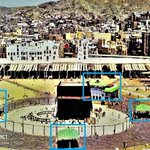
📸 1 — Before 1926, four prayer stations stood around the Kaʿbah, one for each Sunni madhhab:
🟦 Left, Maqām Ḥanafī: north of the Kaʿbah, facing the Ḥijr Ismāʿīl. It was the largest of the four and the only free-standing one with two storeys.
🟦 Bottom centre, Maqām Mālikī: west of the Kaʿbah, between the Yemeni and western corners.
🟦 Top right, Maqām Shāfiʿī: east of the Kaʿbah, on the upper level of the Zamzam well building. The chief muezzin also called the adhān from here.
🟦 Right, Maqām Ḥanbalī: on the south side of the Kaʿbah.
🔹 Each school's imam led his own jamāʿah, usually one after another. Ibn Jubayr رحمه الله, an eyewitness in Ramaḍān 579 AH / 1183–84 CE, recorded that the Shāfiʿī prayed first. The order of the others varied over the centuries and isn't consistently recorded.
🔹 The practice probably began in the 4th–5th century AH (10th–11th century CE). The Ḥanbalī maqām is mentioned as early as 529 AH / 1134–35 CE.
🔹 After the Hejaz came under his rule, King ʿAbd al-ʿAzīz gathered the scholars of Makkah and ordered that every prayer be led by one imam. This is dated to 27 October 1926, though the exact day is unconfirmed. The structures themselves were cleared later, during the expansions from 1375 AH / 1955–56 CE.
📸 2 — Today there is one imam and one congregation. Here Shaykh ʿAbd al-Raḥmān al-Sudais leads Ṣalāt al-ʿIshāʾ near the Maqām Ibrāhīm.


📍 Jerusalem | Rare footage of the Dome of the Rock, guarded by Muslim troops of the British Indian Army, filmed in 1917 during the First World War.
At the heart of Masjid al-Aqsa stands the Dome of the Rock (قبة الصخرة, Qubbat al-Sakhrah). Its dome, golden today, was then covered in lead and would have appeared dark grey; the gold-coloured covering was added only during restoration in the late 1950s and early 1960s
The film captures the open stone-paved courtyard, the building's distinctive octagonal structure and dome, its entrances, and people moving through the sacred precinct. It offers a rare glimpse of the site’s appearance and atmosphere more than a century ago.
🔹 Who are the men walking inside?
The Imperial War Museums catalogue identifies Indian infantry regiments changing guard at the shrine, one probably the 58th (Vaughan’s) Rifles. The original film caption states that the site was guarded by Muslim troops of the British Indian Army, showing how soldiers from the Indian subcontinent took part in guarding one of Islam’s most sacred places. Other individuals in the footage cannot be identified from the film alone.
🔹 Who ruled Jerusalem in 1917?
Jerusalem had been under Ottoman rule for around four centuries. During the First World War, the Ottoman Empire fought against Britain and its allies. British forces under General Sir Edmund Allenby captured the city in December 1917, and Allenby formally entered Jerusalem on 11 December. The city then came under British military administration, ending Ottoman rule.
🔹 A moment of transition
This footage records the Haram al-Sharif’s historic Islamic architecture and sacred spaces, with Muslim Indian soldiers on guard, at the close of the Ottoman era and the beginning of British military rule in Jerusalem.
📚 Source: Imperial War Museum
♦️ *REMINDER* ♦️
*Special programme tonight*
*The Holy Ka'bah 🕋 Through History: Origins, Rebuilds and Renewals*
Join us for *_a special unique visual presentation_* on the remarkable story of the Ka'bah.
📅 *Sunday 18th October, after Isha (8:00 PM) UK time*
📍 *Jamea Masjid, 18 Clarendon Street, Preston PR1 3YN*
*Refreshments 🍕🍟provided after the programme.*
Listen live 🔊on
*jameamasjid.co.uk/livestream…*

Muslim Landmarks Explored retweeted

🕋 THE HOLY KABAH THROUGH HISTORY
Join us for a special visual presentation by Hafiz Ashraf Chohan on the remarkable story of the Holy Ka'bah from origin to modern day.
📅 Sunday 18th October, after Isha (8 PM)
📍 @jameamasjid Preston PR1 3YN
🍟 Refreshments provided

📍 Makkah | The Kaʿbah Behind White Boarding
A rare sight in history: the Kaʿbah clad in white boarding during restoration work in the 1990s, filmed during Jummah salah (Friday prayer) at al-Masjid al-Ḥarām.
The Kaʿbah’s walls were repaired in 1414–15 AH (1993–4) before King Fahd’s major restoration of 1417 AH (1996).
Insha'Allah i'll be giving a visual presentation on the development of the Ka'bah this Sunday around 8:20pm UK time. See pinned tweet for further details. A live link will be shared closer to the time.
*The Holy Ka'bah Through History: Origins, Rebuilds and Renewals*
Join me for a special visual presentation on the remarkable story of the Holy Ka'bah.
Using historic images, illustrations and reconstructions, we'll trace how the House of Allah has developed through the ages: from the earliest traditions of its origins at the beginning of creation, through its raising by Prophet Ibrahim (as) and Prophet Isma'il (as), the many rebuilds and renewals across the centuries, right up to the Ka'bah we see today.
This programme will be of particular interest to anyone preparing for Umrah, offering a deeper appreciation of the sacred site before you stand before it yourself.
📅 Sunday 18th October, after Isha (8:00 PM)
📍 Jamea Masjid, 18 Clarendon Street, Preston PR1 3YN
Refreshments provided after the programme. All welcome.
A live YouTube link will also be provided closer to the time Insha'Allah.

📍 Makkah | The Day the Ka’bah Collapsed (1039 AH / 1630 CE)
In 1630, most of the Ka’bah collapsed as a result of floodwater.
For years, a crack had been spreading through its northern wall. Sultan Ahmad I wanted to demolish and rebuild it. Ottoman scholars advised against it, so a gilded metal band was wrapped around the walls instead. It held for about 19 years.
On Wednesday 19 Sha’ban 1039 AH (3 April 1630 CE), a violent storm hit Makkah. A dam near Jabal al-Nur burst and floodwater surged into the Masjid al-Haram, rising above the Ka’bah’s door.
The next afternoon, the walls gave way. The northern wall fell completely, along with the eastern wall up to the door, much of the western wall, and the roof. Only the southern (Yemeni) wall survived largely intact.
Sultan Murad IV, son of Ahmad I, ordered the rebuild. The site was screened with palm trunks and green cloth. It was rebuilt to the same dimensions, and this is essentially the Ka’bah we see today. It was the last time the Ka’bah was completely rebuilt.
Image 1: AI-generated illustration, not a historical depiction.
Image 2: Sultan Murad IV (later portrait).
These are images from my upcoming presentation on the development of the Kab'ah through history. Insha'Allah details will be released this week.


📍 Al-Quds | On This Day: The First Jumuʿah in Masjid al-Aqsa after liberation from the Crusaders in 1187 CE.
Salahuddin (رحمه الله) entered Jerusalem on Friday, 2 October 1187 (27 Rajab 583 AH), the night traditionally marked as the anniversary of the Prophet’s ﷺ Miʿrāj.
The Friday prayer could not be held that day. It took place a week later, on 4 Shaʿbān: Friday, 9 October 1187, 839 years ago today. It was the first Jumuʿah in al-Aqsa in 88 years.
Many scholars had prepared sermons hoping for the honour. Salahuddin chose Qāḍī Muḥyī al-Dīn Abū al-Maʿālī Muḥammad ibn ʿAlī, known as Ibn al-Zakī, a Shāfiʿī jurist and judge of Damascus.
The historian Ibn Khallikān preserved the khutbah:
🕌 The opening. Before saying a word of his own, he recited al-Fātiḥa in full, then al-Anʿām 6:45. He followed it with the verses that open with “al-ḥamdu lillāh” (6:1, 17:111, 18:1–3, 27:59, 34:1 and 35:1), gathering together the Qur’an’s praises of Allah.
🕌 The sanctity of the land. He reminded the congregation that this was the land of Ebrahim (عليه السلام) and the place from which the Prophet ﷺ ascended. It was the qibla of the early Muslims, a land where prophets lived, messengers were buried and revelation descended, and the land of the gathering and resurrection. He called al-Aqsa the first qibla, the second mosque and the third sanctuary.
🕌 ʿĪsā (عليه السلام). He spoke of ʿĪsā as Allah’s servant, messenger and Word, cast into Maryam. He recited 4:172 and 23:91, then al-Māʾida from verse 17 to the end of the sūrah.
🕌 The army. He told the soldiers they had revived the days of Badr, Qādisiyya, Yarmūk and Khaybar, and the campaigns of Khālid ibn al-Walīd (رضي الله عنه).
🕌 The warning. He told them not to let Satan convince them that victory came from their swords and horses: “Victory is only from Allah.” He said the blessing carried a debt of gratitude, to be guarded through taqwā and by avoiding sin, so they would not undo it like a woman unravelling the thread she had spun strong.
🕌 The close. He ended the first khutbah with the opening of Sūrat al-Ḥashr. In the second, he prayed for the caliph al-Nāṣir and for Salahuddin.
May Allah (swt) bless us with seeing the liberation of Masjid al-Aqsa in our lifetime, Ameen.
Khutbah credit: @sulayman_Kindi

📍 Makkah | The Kaʿbah built by Prophet Ebrahim (عليه السلام)
This is what the Holy Ka'bah may have looked like when it was first raised by Ebrahim and his son Ismāʿīl (عليهما السلام).
Ismāʿīl (عليه السلام) carried the stones and Ebrahim (عليه السلام) laid them, standing on the stone we now call Maqām Ebrahim as the walls rose. As they built, they prayed: "Our Lord! Accept this from us." (Quran: 2:127)
What the sources describe about the structure:
▪️ Rough stone walls about 9 cubits (≈4.5m) high
▪️ An rectangular plan, longer than a cube
▪️ No roof, open to the sky
▪️ Two doors at ground level, one facing east and one facing west
The second image places this outline over today's Kaʿbah. The structure built by Ebrahim (عليه السلام) was far lower, but it stretched further along one side, enclosed by the curved wall of the Ḥaṭīm today.
These images are from my upcoming presentation on the development of the Ka'bah through history. Insha'Allah details will be provided soon.


📍 Al-Quds, Palestine: The Dome of the Rock after Salahuddin Ayyubi رحمه الله conquered Jerusalem.
On 27 Rajab 583 AH / 2 October 1187 CE, Jerusalem surrendered to Salahuddin Ayyubi رحمه الله after 88 years of Crusader rule. The date fell on the traditional anniversary of the Isra' wal-Mi'raj.
Under the Crusaders, the Dome of the Rock had been turned into a church called the Templum Domini. A gilded cross stood on the dome, and the Rock was paved over with marble, with an altar built on top. Images and statues filled the interior, and priests sold chips of the Rock to pilgrims as relics.
Salahuddin's first act was to have the cross taken down while crowds of Muslims and Frankish (Crusader) Christians watched. The marble, altar and images were removed, the Rock was uncovered again, and the building was washed with rosewater. An imam was appointed, and Qur'ans, lamps and carpets were provided.
Sources: Imad al-Din al-Isfahani, Ibn al-Athir, Ibn Shaddad.

📍 Al-Muwājaha al-Sharīfa, Masjid an-Nabawī, Madinah: the opening that faces the Prophet ﷺ
On the qibla side of the Ḥujra is a gilded brass grille known as al-Muwājaha al-Sharīfa, "the Noble Facing." It has three circular openings. The largest, on the visitor's left, lines up with the blessed face of the Prophet ﷺ, who was laid on his right side facing the qibla. The two openings to its right line up with Abū Bakr and ʿUmar رضي الله عنهما.
The grille was installed by the Mamluk Sultan al-Ashraf Qāytbāy رحمه الله. The second great fire of the Masjid, in 886 AH / 1481 CE, destroyed the earlier enclosure. In 888 AH / 1483 CE he sent replacement grilles: brass on the qibla side, and green-painted iron on the other three.
More than five centuries later, it still stands. The brass rims around the openings have been polished, regilded and refitted many times since.
Through the opening you do not see the grave, only the embroidered curtain covering the next wall inward. Behind it are a five-sided wall built by ʿUmar ibn ʿAbd al-ʿAzīz رحمه الله and then ʿĀʾisha's original room رضي الله عنها, sealed with no door or window. Inside that room lie the Prophet ﷺ, Abū Bakr and ʿUmar رضي الله عنهما.

📍 Şırnak, Turkey | Mount Judi (Cudi Dağı), Resting Place of the Ark of Nuh (عليه السلام).
The Cudi range in south-east Turkey, near the Syrian and Iraqi borders, is traditionally identified as the place where the Ark came to rest. Allah (swt) mentions in the Qur'an:
وَٱسْتَوَتْ عَلَى ٱلْجُودِيِّ
"And it came to rest upon al-Jūdī." (Hūd 11:44)
This is the only verse that names where the Ark came to rest. Al-Ṭabarī and Ibn Kathīr placed al-Jūdī in al-Jazīra, upper Mesopotamia, and it is commonly identified today with Cudi Dağı.
A report from the Tābiʿī Mujāhid, recorded by al-Ṭabarī, says the mountains rose up during the flood while al-Judi humbled itself, and so the Ark rested upon it.
The later tradition of Mount Ararat, 300 km to the north-east, comes from medieval Christianity. Earlier Syriac and Jewish sources, like the Islamic tradition, pointed to Judi.
