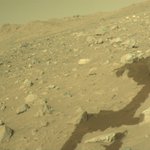
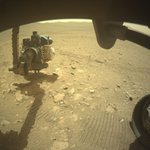
Still making tracks and doing science!
Since breaking the all-time off-world driving distance record on Oct. 11, Perseverance has continued work on the Red Planet. ½
Follow along with Perseverance as it continues its deep dive into the story of Mars, exploring some of the oldest rocks ever encountered on Mars or Earth. science.nasa.gov/mission/mar…
NASA Mars retweeted
Have a research idea that could advance NASA science? 🔬
NASA plans to release ROSES-27 by January 2027, with over 50 research opportunities spanning astrophysics, Earth science, planetary science, heliophysics, space biology and more.
Start planning: go.nasa.gov/489ZKqw
NASA is also providing MMX with communication and navigation support via NASA's Deep Space Network. The station in Madrid is receiving information from the spacecraft right now! eyes.nasa.gov/apps/dsn-now/d…
Reimagining Mars helicopter blades 🚁
NASA engineers are testing new rotorcraft blade designs using computer simulations and wind tunnels. This innovation could help future Mars flyers travel higher and farther, while carrying out science missions.
Learn more: go.nasa.gov/4z0Wn0Y
The MMX spacecraft carries two pieces of NASA hardware: The MEGANE instrument will be key to revealing the origin of Mars’s moons by measuring their elemental composition.
The P-Sampler demonstration will advance capabilities for surface material acquisition in low gravity. ½
This will help inform future discoveries ⏤ and perhaps even crewed missions to the Red Planet. go.nasa.gov/3TJPvWF
NASA is also providing MMX with communication and navigation support via NASA's Deep Space Network. The station in Madrid is receiving information from the spacecraft right now! eyes.nasa.gov/apps/dsn-now/d…
Congrats to @JAXA_En on MMX! By returning samples from Phobos, Mars’ larger moon, the mission will add to decades of Mars exploration and help shape future discoveries and potential crewed missions to the Red Planet.
[Press Release]
Launch result of the Martian Moons eXploration (MMX) spacecraft aboard H3 Launch Vehicle flight No.10
global.jaxa.jp/press/2026/10…
We've studied the moons of Mars from Earth, from orbit, and even in the sky as seen from the surface. (This view comes from the Curiosity rover.) Now, the @JAXA_en MMX mission will see them up close, and even bring a sample home. NASA will be assisting each step of the way. 1/2
Go MMX! 🚀
Ready for today's launch of @JAXA_En's mission to the moons of Mars? Liftoff is slated for 3:41 p.m. EDT.
Watch live at: youtube.com/live/Fn6gzuGa-6c
NASA will be riding along (literally). Learn about our science and communications contributions to this audacious expedition: science.nasa.gov/mission/mmx
Today, @JAXA_en is scheduled to launch its Martian Moons eXploration (MMX) mission. Aboard is MEGANE, an instrument built by Johns Hopkins APL for @NASA that will study Phobos' elemental composition to help uncover the origins of Mars' moons.

ALT As MMX makes repeated passes over Phobos, MEGANE will collect measurements that scientists can use to map the moon’s elemental composition. This illustration shows what a map of Phobos’ elemental composition could look like based on MEGANE’s future measurements. These maps could provide important clues about how Phobos formed.
NASA Mars retweeted
NASA has been studying Phobos and Deimos at Mars for decades.
See what we've discovered so far, and learn about the many mysteries that remain: science.nasa.gov/mars/facts/…
Go MMX! 🚀
Ready for today's launch of @JAXA_En's mission to the moons of Mars? Liftoff is slated for 3:41 p.m. EDT.
Watch live at: youtube.com/live/Fn6gzuGa-6c
NASA Mars retweeted
Explore Phobos and Deimos yourself with our real-time solar system simulator based on real NASA data: eyes.nasa.gov/apps/solar-sys…
RT @NASAJohnson: A year “on” Mars! 🔴
Our CHAPEA crew has spent 365 days living & working like astronauts inside their simulated Mars habit…
LIVE: Tune in as agency leaders and partners discuss NASA's contributions to @JAXA_en's Martian Moons eXploration (MMX) mission, scheduled to lift off on Monday, Oct. 19. youtu.be/3k2mpWrOD1s
We've studied the moons of Mars from Earth, from orbit, and even in the sky as seen from the surface. (This view comes from the Curiosity rover.) Now, the @JAXA_en MMX mission will see them up close, and even bring a sample home. NASA will be assisting each step of the way. 1/2
Learn about the agency's contributions to the @mmx_jaxa_en mission, including a science instrument, a sampling mechanism, science analysis, as well as navigation and communication support: go.nasa.gov/3TJPvWF