

AI tips, technical tutorials, guides, and workflows for the modern AI era.
Nerdy Place
Joined February 2017
- Tweets5.1K
- Following401
- Followers2.4K
- Likes8.9K
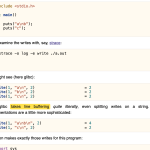





glibc line buffering does one write() per line: puts("a\nb") becomes two system calls.
Chris Wellons' fix: flush when the buffer has sat idle for about 100 ms, like Nagle's algorithm. Lines still reach the terminal promptly.
Timer or newline?
nullprogram.com/blog/2026/11…

25
Nerd Level Tech retweeted

Kimi K3.1 Pro scores 65.7 on Terminal-Bench 4.0 in its own lab's table: ahead of GPT-6 Astra (58.2) and Claude Fable 5.1 (57.9), 0.7 behind Opus 5.5 (66.4). Open weights, 2.8T MoE, 104B active.
Moonshot's table, where it leads:
- Terminal-Bench 4.0: 65.7 vs 58.2 GPT-6 Astra, 57.9 Fable 5.1
- SWE Marathon v1.1: 51.7 vs 46.3 Opus 5.5
- BrowseComp: 92.1 vs 91.5 GPT-6 Astra
- HLE-Full with tools: 70.0 vs 67.7 Opus 5.5
Where it trails:
- Program Bench: 31.5 vs 65.0 Opus 5.5
- Terminal-Bench-Science 0.1: 38.1 vs 68.1 GPT-6 Astra
- HLE-Diamond: 39.4 vs 65.8 GPT-6 Astra
- ExploitBench: 74.7 vs 100 GPT-6 Astra
Fine print: Moonshot ran its own model with the Claude Code harness; the rival scores are the highest from those labs' blogs or public leaderboards. Not an outside test.
Licence: free to use and fine-tune, but a company selling model-as-a-service with over $20M in 12 months needs a separate deal (section 2). Not OSI. No Ollama page for K3.1 (checked today), and at 2.8T it is rented, not run at home.
For agent work: the open model with the published table, or the closed one that wins on Program Bench and the science test?
huggingface.co/moonshotai/Ki…

Nerd Level Tech retweeted
SenseNova released SenseNova-Loop-9B-Preview (30 Oct), an open-weights 9B model that runs the same block of layers twice: 32 layers stored, 56 layer-steps per answer.
In the lab's own chart:
- BIRD-Dev 71.38, next model listed 69.84
- WorkBuddy 66.89 vs 61.98
- TeamBench 48.89 vs 44.44
- AutomationBench 13.72 vs 10.17
It trails on Terminal Bench 2.1 (40.45 vs 49.44 for Nanbeige 4.2-3B and 47.19 for Qwen3.5 27B) and tau3-Banking (18.56 vs 19.59). The comparison set is the lab's pick.
Apache 2.0 weights, marked Preview, tech report TBD, no Ollama page (checked today). Runs through Transformers with custom code.
Which is better depends on the job: the looped small model looks stronger on SQL, spreadsheet and team-task benchmarks, the bigger models on terminal work.
huggingface.co/sensenova/Sen…

Nerd Level Tech retweeted
DiffuSpace released Clover-35B-A3B-Preview (28 Oct), an open-weights 35B model (about 3B active) that writes blocks of text in parallel, a diffusion model, instead of one token at a time.
In the lab's own table, against Qwen3.6 35B-A3B:
- SWE-bench Verified 73.6 vs 65.8
- Terminal-Bench 2.1 51.7 vs 43.1
- SWE-Pro 46.5 vs 42.7
- ZebraLogic 95.8 vs 89.2
It trails on HLE text-only (12.8 vs 21.2) and AIME 2026 (83.3 vs 90.4). The baselines are the lab's pick, and the 680 tokens/s speed claim is its own test on a GB300.
Apache 2.0 weights, marked Preview, custom code required, about 69 GB in BF16, no Ollama page (checked today). SGLang and llama.cpp backends are in the repo.
Coding agent or hard maths: which one do you pick, the faster diffusion model that wins on SWE-bench, or the standard one that wins on AIME?
huggingface.co/Diffuspace/Cl…

Nerd Level Tech retweeted
Baidu released Unlimited-OCR 2, an open-weights model that reads a 100-page document in one pass.
By the paper's own tables:
- MarathonDocBench (100+ pages): 77.06, next model listed (Kimi-K3) 33.74
- MPDocBench (tens of pages): 84.59 vs 78.30 for Qwen3.8-Max
- Peak KV cache while reading: 1.77 GB vs 47.00 GB with standard decoding
It trails page by page: on OmniDocBench v1.6 it scores 94.02, behind TeleOCR (96.91, 1.2B) and OvisOCR2 (96.47, 0.8B). MarathonDocBench is also Baidu's own new benchmark.
3B parameters, 0.5B active, MIT licence. No Ollama page yet (checked today); the repo targets SGLang on an 80 GB A800.
For parsing long documents locally, would you pick the one built for 100+ pages, or a small specialist that scores higher page by page?
huggingface.co/baidu/Unlimit…

Nerd Level Tech retweeted
If you’ve been meaning to try @prisma Postgres and Prisma Compute, this walkthrough is a practical place to start.
You go from an empty folder to a deployed TypeScript API with Prisma 8: scaffold the project, define the data contract, run Prisma Postgres locally, seed and test the API, then deploy to Prisma Compute.
It’s deliberately a production baseline, not much UI, no much auth, no extra product features. The walkthrough includes real terminal output and screenshots, and it runs on the Free plan without a card.
nerdleveltech.com/guides/pri…
🤖 Made with AI

Nerd Level Tech retweeted
Microsoft released Mage-VL-Cowork: a 4B open-weights model that operates a computer by clicking the screen and by running terminal commands.
On OSWorld-Verified (50-step budget), by Microsoft's own table:
- Overall: 66.0, level with Muse Glimmer-30B (65.9) and ahead of Qwen3.6-27B (63.9)
- OS tasks: 87.5 vs 79.2 for ScaleCUA-Qwen3.5-9B
- Multi-app workflows: 62.7 vs 48.1 for that same 9B
It trails that 9B overall (68.7) and on professional tasks (66.3 vs 89.5). GPT-5.4-mini scores 69.6.
Weights are 9.5 GB in BF16, Apache 2.0 licence. No Ollama page yet (checked today).
For a local computer-use agent, would you take the 4B that mixes clicking and code, or the 9B that scores higher on office and professional tasks?
huggingface.co/microsoft/Mag…

Nerd Level Tech retweeted
Recursive released Flint: an open-weights coding model with 39.8B total parameters and about 2.5B active per token, built to run on a laptop.
By Recursive's own chart, it beats Qwen 3.6 (a similar-size MoE, 3B active) on:
- Terminal-Bench 2.1: 54.9 vs 44.9
- SWE-bench Pro v2: 89.7 vs 73.8
- IFBench: 89.2 vs 67.9
It trails the dense Qwen 3.8 (27-31B) on:
- Terminal-Bench 2.1: 54.9 vs 73.0
- SWE-bench Pro v2: 89.7 vs 94.9
- LiveCodeBench v6: 80.3 vs 90.3
Recursive claims more than 5x the speed of dense models with similar coding scores. On Ollama: ollama run flint (23 GB download, 256K context).
Licence: Apache 2.0.
For a local coding agent, would you take the fast small-active model or the dense one that scores higher on the hard tests?
recursive.com/updates/introd…

Nerd Level Tech retweeted
Liquid AI released LFM3-1.7B: an open-weights text model for local agents that fits in about 1 GB at 4-bit.
By Liquid's own table, it beats Qwen3.5 9B (a model about 5.7x larger) on:
- tool use: BFCL V4 71.4 vs 62.8
- coding: LiveCodeBench v6 73.5 vs 69.9
- instruction following: IFEval 96.7 vs 92.1
It trails on knowledge and long context:
- GPQA Diamond 63.4 vs 80.4
- RULER 128K 65.6 vs 87.1
256K context window. On Ollama: ollama run lfm3 (the default download there is 1.7 GB).
Licence: LFM Open License v1.0, not an OSI open-source licence. Commercial use is covered only for organisations under $10M annual revenue.
For a local agent, would you take the small model that is good with tools or the big one that knows more?
liquid.ai/blog/lfm3
Ghostty 1.4.0 fixes 10 security advisories. On 1.3.0 or 1.3.1, malicious terminal output could crash the app via tmux control mode (two advisories). Also fixed: a paste that could run a command without confirmation. CVEs not yet assigned.
ghostty.org/docs/install/rel…

2
46
Nerd Level Tech retweeted
Sebastian Raschka just published a video course on building a reasoning model from the ground up: eight videos, over 11 hours of coding, in Python and PyTorch.
You start from a pre-trained LLM and add the pieces in order:
- evaluating the model
- inference-time scaling (spending more compute while it answers)
- reinforcement learning
- distillation
It is the sequel to his 'Coding LLMs from the Ground Up' course, but he says you can watch it without that one.
Limit: it is 11 hours of hands-on coding, not a quick overview.
What would you want to build first, the evaluation or the training loop?
magazine.sebastianraschka.co…

A $2 ESP32-S3 chip can run a FAST corner detector on a 320x240 frame in about 6 ms. The author hand-wrote assembly for the chip's 128-bit SIMD (16 pixels per register) and reports roughly double the reference implementation's speed. His own measurement.
shraiwi.com/blog/simd-fast-e…

40
Nerd Level Tech retweeted
Moonshot's Kimi K3.1 Pro is live in its app and API: a 3T-class open-weight model with a 1M-token context window. The weights themselves are promised by Nov 4.
What they report (their numbers, not independent ones):
- Terminal-Bench 4.0: 65.7%, against 58.2% for GPT-6 Astra and 66.4% for Claude Opus 5.5
- Kimi Code Bench 3.0 Long-horizon, their internal benchmark: 61.2%, up from 55.95% for K3
- A factual-accuracy stress test: claim-level hallucination rate down from 23.4% to 8.3%. They say it does not represent everyday error rates
The part worth reading: for the open-weight release they removed cyber-related data from both mid-training and the RL stage. On their in-house exploit benchmark, the checkpoint without that removal solves 90.5% of problems at pass@3, the final model 81.0%. Removal lowered it, and stronger general coding still raised it over K3.
Can't run it locally yet: no weights, and the page names no licence, so no ollama line until they land. Would you run it yourself once they do?
kimi.ai/blog/kimi-k3-1-pro

تحديث في سياسة خصوصية Google: لا إعلانات مخصّصة من محتوى Drive وGmail وPhotos، إلا إذا اخترت إتاحته لخدمات تدعم الإعلانات. إن ربطتها بـPersonal Intelligence قد يتأثر ما تراه. للتحكم: افصلها من الميزة أو أوقف التوصيات المخصّصة.
policies.google.com/privacy

1
33
Update Node.js today: a Brotli decoder bug (CVE-2026-111497, 9.2 Critical per GitHub) lets crafted data corrupt memory. Fixed in 22.23.4, 24.22.1 and 26.12.1. PyPI Brotli: 1.2.1. Restart after upgrading.
nodejs.org/en/blog/vulnerabi…

