

Believe in God. Believe in truth. Guarding the ideas behind CKB: facts over narratives, verification over trust, and open rules for a better world.
Joined November 2023
- Tweets424
- Following27
- Followers260
- Likes222




Books That Explain CKB #7: The Innovator’s Dilemma — When Success Becomes a Constraint
Why do successful technologies sometimes fail to lead the next technological revolution?
Not because their engineers are stupid.
Not because they stop innovating.
Sometimes, they fail precisely because they are doing everything their existing users ask them to do.
Clayton Christensen called this:
The Innovator’s Dilemma.
In The Innovator’s Dilemma, Christensen showed that great companies often become trapped by their own success.
They listen to their best customers.
They improve their most profitable products.
They invest where returns are clearest.
All of this sounds rational.
And it is.
But then something strange happens.
A new technology appears at the edge.
At first, it often looks worse.
Smaller market.
Lower performance.
Fewer users.
Less revenue.
The incumbent has little reason to care.
But the new technology improves.
Slowly, it finds its own users.
Its limitations become strengths in new markets.
Its architecture evolves around assumptions the old system was never designed for.
And eventually, the question changes from:
“Why would anyone use this?”
to:
“Why can’t the old system do this?”
This is an important lesson for blockchain.
Successful blockchains accumulate more than users.
They accumulate constraints.
Applications depend on existing behavior.
Billions of dollars depend on compatibility.
Developers depend on familiar tools.
Infrastructure depends on existing assumptions.
Governance becomes cautious because breaking something is expensive.
Success creates gravity.
This does not mean old systems are bad.
Quite the opposite.
Their constraints often exist because they succeeded.
But every architectural decision creates a path.
And the further a system travels down that path, the harder it becomes to redesign the road underneath it.
Legacy is not failure.
Legacy is success that became a constraint.
This is why some fundamental innovations are easier to build from the edge.
Instead of asking:
“How do we improve the existing architecture?”
A new system can ask:
“If we were starting again, what assumptions would we change?”
That question can lead to very different designs.
CKB began with several unusual questions.
What if blockchain state were modeled as independently owned objects?
What if ownership were explicit at the lowest level?
What if the VM used a real instruction set instead of a blockchain-specific virtual machine?
What if new cryptography could often arrive as software?
What if the base layer focused on verification and ownership, while higher layers handled more experimentation?
These questions produced:
Cell Model
RISC-V VM
State Capacity
Layered Architecture
None of these ideas automatically make CKB superior.
And being different does not make something disruptive.
Most new architectures fail.
Disruption is only visible in hindsight.
But the value of a new architecture is that it can explore design spaces that mature systems may find increasingly expensive to enter.
Think about the Cell Model.
Most smart-contract platforms evolved around accounts and global state.
CKB starts from cells:
Independent pieces of state with explicit ownership and programmable rules.
That changes the mental model.
Instead of asking only:
“What program controls this account?”
we can also ask:
“What is this object, who owns it, and under what conditions can it change?”
A different primitive creates different possibilities.
The same is true for RISC-V.
A mature blockchain may add new cryptographic primitives through protocol upgrades.
CKB asks whether more of that evolution can happen through software running on a stable instruction set.
Again, the important point is not:
“This is automatically better.”
The point is:
A different architecture makes different trade-offs possible.
Christensen's deeper insight was not that incumbents are stupid.
It was almost the opposite.
Good organizations are optimized for the world that made them successful.
That optimization can make radical change difficult.
The same can happen to protocols.
Developers build around them.
Capital builds around them.
Users build expectations around them.
Eventually, architecture becomes institution.
This leads to an uncomfortable question:
Can a successful blockchain fundamentally reinvent itself without breaking the ecosystem that made it successful?
Sometimes yes.
Sometimes no.
But the larger the installed base becomes, the more expensive radical change usually becomes.
That creates room for new architectures.
Not because they are guaranteed to win.
But because they are free to ask questions incumbents may no longer be able to ask cheaply.
CKB may be one of those experiments.
It does not need to replace another blockchain to be interesting.
Its value may come from exploring a different branch of the design tree:
Explicit ownership.
Object-like state.
General-purpose verification.
Open cryptography.
Layered execution.
And perhaps, eventually, digital infrastructure for humans and autonomous agents that was difficult to imagine when earlier blockchain architectures were created.
The Innovator’s Dilemma was written about companies, not blockchains.
But its central lesson travels surprisingly well:
The architecture that wins one era may become the constraint of the next.
And sometimes the future begins somewhere that initially looks too small to matter.
Success creates gravity.
Innovation needs room to escape it.
#CKB #Nervos #Blockchain #Innovation #RISCV

Books That Explain CKB #6: The Sovereign Individual — Who Owns You in the Digital World?
For most of human history, ownership was physical.
Land.
Gold.
Houses.
Machines.
But as more of life moves into the digital world, a new question appears:
What does it actually mean to own something digital?
In The Sovereign Individual, James Dale Davidson and William Rees-Mogg argued that information technology would weaken many traditional forms of control and give individuals greater economic autonomy.
Some of their predictions were extreme.
Some were wrong.
But one question they raised has become increasingly important:
What happens when individuals can control wealth, identity, and economic relationships directly through technology?
Today, much of our digital life is not truly ours.
Your account can be suspended.
Your balance can be frozen.
Your digital item may exist only inside one company's database.
Your identity may depend on a platform deciding that you are still allowed to use it.
We often call this “ownership.”
But technically, much of it is closer to:
permissioned access.
Blockchain introduced a very different idea.
Instead of asking a company:
“Do I still own this?”
You can ask the network:
“Can I prove ownership?”
That distinction is fundamental.
Permission is granted by an authority.
Ownership is enforced by rules.
Bitcoin demonstrated this with money.
If you control the private key, you can independently prove the right to spend the asset.
No bank needs to maintain your account.
No administrator needs to approve your balance.
The ownership relationship exists at the protocol level.
But the digital world needs more than money.
It needs:
• Assets
• Identity
• Credentials
• Data rights
• Access rights
• Reputation
• Programmable agreements
And increasingly, these things may belong not only to humans.
They may also belong to AI Agents.
Imagine an autonomous AI Agent that earns money.
It buys computing resources.
Pays for data.
Negotiates with other agents.
Maintains a reputation.
Holds credentials.
Controls access to certain information.
At that point, a difficult question appears:
Who actually owns the Agent's assets and state?
The company running the server?
The developer?
The user?
The Agent itself?
Or whoever controls the database?
This is where blockchain becomes more interesting than “digital money.”
A neutral protocol can make ownership explicit.
Assets do not have to exist as entries in a company's private database.
Identity does not have to depend entirely on one platform.
Authorization can be expressed as verifiable rules.
State can become something that has an identifiable owner.
CKB's Cell Model is particularly interesting from this perspective.
A Cell is not simply a database record.
It combines:
Capacity
Data
Lock
Type
The Lock defines who can use the Cell.
The Type defines what rules govern it.
The Data carries information.
The Capacity represents the state resource being occupied.
Ownership is not an afterthought.
It is part of the structure itself.
This creates an unusual design space.
A digital asset can carry its own rules.
A credential can have explicit authorization conditions.
A piece of state can have a clearly defined owner.
Different cryptographic systems can define what “ownership” means without requiring the base protocol to understand every future use case.
CKB does not need to predict every form of digital property.
It provides primitives that allow new forms of ownership to be expressed.
That may matter enormously in an AI economy.
AI Agents will need more than intelligence.
They will need agency.
And agency requires the ability to answer questions such as:
What am I allowed to access?
What resources do I control?
What can I spend?
What commitments have I made?
How can another Agent verify those claims?
These are questions of ownership and authorization.
Not intelligence.
This suggests a deeper stack for the machine economy:
Intelligence decides what to do.
Identity defines who is acting.
Authorization defines what it may do.
Ownership defines what it controls.
Payment settles economic exchange.
Verification allows others to trust the result without trusting the actor.
AI may provide the intelligence.
But intelligence alone does not create an economy.
The Sovereign Individual was written long before Bitcoin, CKB, or modern AI Agents.
Its predictions should not be treated as prophecy.
But one of its central questions has become more relevant than ever:
How much of our digital life can we truly own?
CKB offers one possible answer:
Make ownership explicit.
Make rules verifiable.
And make digital state something users can control rather than merely rent from a platform.
The Internet gave individuals access to information.
Blockchain gave individuals control over digital assets.
AI may give software the ability to act autonomously.
The next question may be:
Can humans and machines become genuine economic actors without asking a central platform for permission?
That is where digital sovereignty becomes more than philosophy.
It becomes infrastructure.
Don't just give users accounts.
Give them ownership.
#CKB #Nervos #Blockchain #AI #AIAgents

Books That Explain CKB #5: Governing the Commons — Who Pays for What Everyone Shares?
What happens when everyone can use a resource, but no one wants to pay for maintaining it?
A forest.
A fishery.
An irrigation system.
Or a blockchain.
This is the problem of the commons.
And Elinor Ostrom spent her life studying how humans can solve it.
For a long time, the dominant assumption was simple:
Shared resources will eventually be overused.
If everyone benefits individually from consuming more, while the cost is shared by everyone, rational behavior can destroy the resource itself.
This is the famous:
Tragedy of the Commons.
But Ostrom showed that tragedy is not inevitable.
Communities around the world have successfully managed shared resources for generations.
How?
Not through goodwill alone.
Through rules.
Successful commons tend to make several things clear:
Who can use the resource.
What they are allowed to do.
What costs they must bear.
How abuse is detected.
How rules are enforced.
And how participants can adapt those rules over time.
The lesson is powerful:
Shared resources do not fail because they are shared.
They fail when the rules governing them fail.
Blockchain faces the same problem.
A blockchain is a shared infrastructure.
Its participants collectively depend on:
• Blockspace
• State
• Storage
• Bandwidth
• Verification
• Network security
But these resources are not infinite.
If one user can consume a resource while pushing its long-term cost onto everyone else, the system creates the wrong incentive.
State is one of the clearest examples.
Creating state may happen once.
But storing and verifying that state can impose costs on full nodes for years.
If users pay only when state is created, while everyone else carries its future cost indefinitely, something strange happens:
Private benefit.
Socialized cost.
Over time, state grows.
Hardware requirements rise.
Running a full node becomes harder.
And decentralization can slowly become more expensive.
CKB takes a different approach.
It treats on-chain state as a scarce economic resource.
To occupy state, you must occupy CKB capacity.
More state requires more capacity.
And keeping that state means continuing to commit that capacity.
In other words:
State is not free.
The protocol connects the right to use a scarce resource with an economic cost.
This is deeper than storage pricing.
It is institutional design.
The question is not:
“How do we stop people from using state?”
The question is:
How do we let people use state while making its long-term cost visible?
That is exactly the kind of problem Ostrom studied in the physical world.
CKB brings a similar question into digital infrastructure.
The Cell Model strengthens this idea.
A Cell does not merely contain data.
It represents an explicitly owned piece of state.
Capacity.
Data.
Lock.
Type.
Ownership and resource consumption become visible parts of the same object.
Instead of treating global state as an invisible pool that everyone can endlessly expand, CKB turns state into something economically accountable.
And now this question may become much bigger.
Because the future users of blockchains may not only be humans.
They may be AI Agents.
Imagine millions of autonomous agents:
Creating accounts.
Requesting data.
Making payments.
Opening channels.
Updating state.
Buying services.
Negotiating with other agents.
Operating continuously, 24/7.
Humans are slow.
Agents are not.
A badly designed shared resource can be abused by machines at machine speed.
So the AI economy will need more than payments.
It will need rules governing:
Identity.
Authorization.
Scarce resources.
State.
Reputation.
Economic responsibility.
Who is allowed to do what?
Who pays when an agent consumes a resource?
Who is responsible for persistent state?
How can one agent verify another without trusting a central gatekeeper?
These are not merely AI questions.
They are institutional questions.
This may be where blockchain becomes especially important.
Not because blockchain can “control AI.”
But because autonomous agents will need neutral environments in which rules can be:
Transparent.
Machine-readable.
Economically enforceable.
And independently verifiable.
CKB may eventually have an interesting role in that world.
CKB can provide scarce, verifiable state and ownership.
Higher layers can handle fast interaction.
Payment networks such as Fiber can support frequent economic activity.
Identity and authorization systems can define what agents are permitted to access.
Different layers can specialize.
But underneath them all lies the same principle:
Resources must have rules.
Rights must have costs.
Actions must have consequences.
Ostrom studied farmers, fishermen, forests, and irrigation systems.
She was not writing about blockchain.
And certainly not about AI Agents.
But the question she studied may become even more important in a machine economy:
How can independent actors share scarce resources without destroying the system they depend on?
That question connects villages thousands of years old with networks that may one day contain billions of autonomous machines.
And the answer begins in the same place:
Not with trust.
Not with good intentions.
But with well-designed rules.
The commons needs governance.
The machine economy will too.
#CKB #Nervos #Blockchain #AI #AIAgents

Books That Explain CKB #4: Antifragile — Built to Survive, Not Just to Perform
Most systems are designed for one question:
How well does it perform today?
But Nassim Nicholas Taleb asks a different question:
What happens when the unexpected arrives?
That question matters enormously for blockchain.
In Antifragile, Taleb separates systems into three broad categories.
Fragile systems break under stress.
Robust systems resist stress and remain largely unchanged.
Antifragile systems can actually benefit from disorder, volatility, and experimentation.
Think about muscles.
Stress them appropriately, and they rebuild stronger.
Complex systems can sometimes work the same way.
This changes how we should think about blockchain design.
A blockchain is not built for one year.
Its real test comes after:
• Market crashes
• Attacks
• New cryptography
• New applications
• Hardware changes
• Regulatory pressure
• Developers coming and going
• Decades of accumulated state
A protocol that looks efficient today may become tomorrow's burden.
This is why maximizing performance is not the same as maximizing survival.
Every optimization has a cost.
Every new feature adds assumptions.
Every dependency creates another possible point of failure.
And every permanent piece of state becomes something future participants may have to carry.
Complexity accumulates.
A long-lived blockchain therefore needs something surprisingly difficult:
Restraint.
The base layer should not try to predict every future application.
It should provide a small number of powerful primitives and allow innovation to happen around them.
When the world changes, the entire foundation should not need to be rebuilt.
This is where CKB's architecture becomes interesting.
Cell Model
State is broken into independent cells rather than hidden inside one giant global state machine.
Cells behave like building blocks: applications can combine them in ways the original protocol designers did not need to predict.
State Cost
On-chain state consumes scarce capacity.
Keeping state forever therefore has an economic cost.
The system does not pretend storage is free.
RISC-V
Instead of hard-coding every future cryptographic primitive into the protocol, CKB provides a general-purpose instruction set.
New cryptography can often arrive as software rather than requiring the base protocol itself to change.
Layered Architecture
L1 does not need to execute every activity in the ecosystem.
Higher layers can experiment, fail, improve, and evolve while the foundation remains relatively stable.
This creates an important separation:
Keep the foundation conservative.
Let the edges experiment.
Failures at the edges can remain local.
Successful ideas can spread.
The entire system does not need to change every time the world changes.
That is how biological systems, markets, and the Internet often evolve.
Not through one perfect master plan.
But through variation, failure, selection, and adaptation.
This does not mean CKB is magically “antifragile.”
No blockchain is guaranteed to survive.
Architecture cannot eliminate uncertainty.
But it can decide how a system meets uncertainty.
Does every new problem require another patch to the foundation?
Or can the system absorb change without constantly rewriting itself?
That difference may matter more over 30 years than today's TPS.
Taleb's deeper lesson is not simply:
“Be strong.”
It is:
Build systems that do not require the future to behave exactly as you predicted.
That is a powerful way to think about blockchain.
Because nobody knows what cryptography, hardware, applications, markets, or even the Internet itself will look like decades from now.
The best architecture may therefore be the one that makes the fewest unnecessary promises about the future.
CKB is not interesting because it claims to predict that future.
It is interesting because much of its architecture asks:
How can we remain useful when our predictions are wrong?
That is a very different design philosophy.
Don't optimize only for today.
Build for the unknown.
#CKB #Nervos #Blockchain #Bitcoin #Antifragile

A blockchain should not survive by putting patch on top of patch.
Think of a house.
If the foundation is good, you can build many things on top of it.
If the foundation is wrong, you keep adding walls, pipes, supports and fixes just to keep the house standing.
Each fix may solve one problem.
But the whole house becomes more complicated and fragile.
Blockchains are even harder, because their history cannot simply be deleted and restarted.
That is why a good blockchain should be designed more like hardware than ordinary software:
Keep the foundation simple and stable.
Let innovation happen on top.
Change the base layer only when absolutely necessary.
The best public blockchain may not be the one that upgrades the most.
It may be the one that was designed well enough to need the fewest patches.


Bitcoiners deserve a lot of credit for pioneering many of these ideas (see Utreexo).
But yes, this is what the current proposed Ethereum scaling strategy looks like in action.
We want Ethereum to have the best of UTXO-style state, dynamic state, and everything in between, allowing the great majority of Ethereum's activity to be hyperscaled without sacrifice to decentralization, ease of node running and censorship resistance.
firefly.social/post/x/208898…

Books That Explain CKB #3: The Road to Serfdom — Why Power Must Be Limited
What happens when a system depends on one authority making the right decisions?
At first, central control can look efficient.
Decisions are faster.
Coordination is easier.
There is less disagreement.
But Friedrich Hayek warned of a deeper problem:
The more power we concentrate, the more the system depends on whoever controls that power.
In The Road to Serfdom, Hayek argued against the growing concentration of economic decision-making in the state.
His concern was not simply that governments make mistakes.
It was more fundamental:
No central authority can fully understand the needs, preferences, and knowledge distributed across millions of individuals.
And once too much power is concentrated in one place, individual choices increasingly depend on decisions made from above.
This gives us an important lesson for blockchain.
Decentralization is not about assuming that central authorities are evil.
It is about asking:
Why should the system require them to remain good forever?
A system that works only when its leaders are wise, honest, and competent is ultimately dependent on those leaders.
A stronger system tries to reduce that dependency.
This is why blockchain matters.
Instead of asking:
Who should we trust?
Blockchain asks:
How much trust can we remove from the system?
Ownership can be enforced by cryptography.
Transactions can be verified by anyone.
Consensus can be maintained by independent participants.
Rules can be made transparent.
Trust moves from people toward verifiable rules.
But decentralization is not achieved simply by putting something “on-chain.”
A blockchain can still become highly dependent on:
• A small validator set
• A privileged foundation
• A few infrastructure providers
• Governance controlled by insiders
• Protocol rules that ordinary users cannot independently verify
Decentralization is therefore not a label.
It is an architectural property.
This is where CKB becomes interesting.
CKB tries to keep the foundation open and independently verifiable.
Proof of Work
Anyone can compete to produce blocks. Security is not assigned to a fixed group of privileged validators.
Cell Model
Assets and state are represented as cells with explicit ownership rules.
RISC-V
The virtual machine is based on an open instruction set, allowing logic and cryptography to evolve without making the base protocol responsible for every future application.
Layered Architecture
The base layer focuses on verification and ownership, while higher layers are free to experiment.
The goal is not to make L1 control everything.
It is to make L1 something everyone else can build upon.
This leads to a deeper principle:
The strongest decentralized system is not the one with the best ruler.
It is the one that needs rulers the least.
Bitcoin demonstrated this idea with money.
CKB extends the experiment toward programmable digital assets and state.
Not by asking us to trust a better authority.
But by asking whether we can build better rules.
Hayek was writing about political economy, not blockchain.
CKB did not come from The Road to Serfdom.
But the question behind both is worth thinking about:
How do we build systems that remain open even when we cannot control who will hold power tomorrow?
That may be one of the deepest reasons decentralization matters.
Good leaders are temporary.
Good rules can outlive them.
#CKB #Nervos #Blockchain #Bitcoin #Decentralization

AI is getting more powerful.
But perhaps we're asking the wrong question.
The future isn't only about how intelligent AI becomes.
It's also about:
Who owns the assets?
Who writes the rules?
Who controls the state?
And can ordinary people still choose to exit?
If AI becomes the infrastructure of civilization, decentralization may matter far more than it does today.
This is where the cypherpunk idea — and perhaps CKB — becomes interesting again.
Not as another “AI + crypto” narrative.
But as a question of ownership, rules, and freedom.
My latest thoughts 👇
xitter.gq/NervosGuardian/status/…


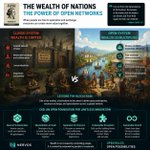
Books That Explain CKB #2: The Wealth of Nations — The Power of Open Networks
Why can millions of individuals create something greater than themselves?
In 1776, Adam Smith published The Wealth of Nations and explored a fundamental question:
How does human cooperation create prosperity?
His answer changed economics forever:
Specialization and voluntary exchange unlock human potential.
A farmer does not need to build his own tools.
A builder does not need to grow his own food.
A programmer does not need to create every component from scratch.
Through open exchange, everyone can focus on what they do best.
The result?
A society becomes far more productive than any individual could achieve alone.
But this only works when the system allows cooperation.
People need:
• Clear ownership
• Freedom to exchange
• Open access to markets
• Rules that protect voluntary cooperation
Without these foundations, specialization breaks down.
This idea is surprisingly close to blockchain.
A blockchain is not valuable because it forces everyone to follow one central authority.
It is valuable because it creates a shared environment where strangers can coordinate without needing permission.
The best networks do not tell everyone what to build.
They create a foundation where anyone can build.
Like an open economy:
The protocol provides the rules.
Developers create applications.
Users create demand.
The ecosystem evolves through countless interactions.
This is why architecture matters.
A blockchain that only optimizes one specific use case may become limited by its original design.
A more flexible foundation allows future generations to create applications that we cannot predict today.
CKB follows this philosophy:
The base layer focuses on:
• Ownership
• Verification
• Universal assets
• Open participation
Higher layers can experiment, innovate, and evolve.
The foundation stays simple.
The ecosystem stays open.
Adam Smith showed us:
The power of a market comes from coordination among millions of people.
Blockchain asks a similar question:
Can we build a digital system where millions of people can coordinate without a central controller?
Great systems do not create value by controlling every action.
They create value by enabling more possibilities.
Open rules create open innovation.
#CKB #Nervos #Blockchain #Bitcoin #UTXO


Books That Explain CKB #1: Why Nations Fail
Why do some nations become wealthy while others remain trapped in poverty?
Is it geography?
Natural resources?
Culture?
Or something deeper?
In Why Nations Fail, Daron Acemoglu and James Robinson argue that the key difference is not what a country has.
It is the institutions it builds.
A good institution creates the right incentives.
When people know their property is protected, their efforts will be rewarded, and innovation will not be destroyed by those in power, they are willing to build for the future.
A bad institution does the opposite.
It extracts value instead of creating it.
People stop investing.
People stop innovating.
The system slowly loses its energy.
This idea applies beyond nations.
It applies to every complex system.
Including blockchain.
A blockchain is not only code.
It is a set of rules that defines:
Who can participate.
Who bears the cost.
Who receives the rewards.
How the system evolves over time.
The strongest systems do not depend on everyone being honest.
They are designed so that individual incentives can align with the long-term health of the network.
This is the essence of mechanism design:
Don’t trust intentions.
Design better rules.
This is why architecture matters.
A protocol is not just a collection of features.
It is an institution written in code.
Its decisions about:
• State growth
• Ownership
• Verification
• Consensus
• Incentives
shape what kind of ecosystem can exist decades later.
CKB is built around this question:
How do we create a decentralized system that can survive long-term?
Not only faster today.
Not only popular today.
But sustainable when attention disappears.
Great systems are not created by adding more complexity.
They are created by choosing better foundations.
Because in the end:
Rules shape behavior.
Behavior shapes systems.
Systems shape the future.
#CKB #Nervos #Blockchain #Bitcoin #UTXO

PoW Does Not Eliminate Power. It Makes Power Contestable.
Most explanations of Proof of Work are misleading.
They say PoW is decentralized because “no one is in control.”
But that is not fully true.
Mining pools, ASIC makers, large miners, capital, and cheap energy all matter.
Power still exists in PoW.
The real question is:
Can that power be challenged and replaced?
Every System Has a Winning Coalition
Governments, companies, and even blockchains all have groups that hold influence.
PoW is no different.
But its key feature is this:
the coalition is not fixed.
Mining Pools Don’t Fully Own Hash Power
Pools coordinate miners, but do not own them.
Miners can switch pools whenever incentives change.
So pool power is temporary, not absolute.
PoW Turns Power Into Cost
Instead of identity or authority, PoW relies on work.
The network only checks:
Did you do the work?
Not who you are.
But mining is still unequal in the real world due to energy, capital, and hardware access.
PoW does not remove inequality—it standardizes verification.
Power Must Be Continuously Paid For
Mining power is not permanent.
It requires constant spending on:
electricity
hardware
maintenance
infrastructure
Stop paying, and power disappears.
Miners Are Not Sovereign
Miners propose blocks, but full nodes enforce rules.
Invalid blocks are rejected no matter how expensive they are to produce.
Power is split:
miners produce blocks
nodes validate rules
markets decide value
Decentralization Means Replaceability
Decentralization is not “no power.”
It means:
no one can keep power without competition.
Participants must be replaceable, and exit must be possible.
Why This Matters for CKB
CKB uses PoW because it avoids permanent control by any fixed group.
It still has challenges like mining concentration and hardware dependence.
But PoW ensures one key property:
no actor is irreplaceable.
That is the core idea.
Decentralization is not the absence of power.
It is the inability to permanently own it.
#CKB #Nervos #ProofOfWork #PoW #Bitcoin #Decentralization #Blockchain

The next stage of CKB’s growth may not come from the protocol itself.
We’ve spent years improving the internal infrastructure:
• Cell Model
• RISC-V VM
• RGB++
• Fiber
• Better developer tools
But there is another layer of infrastructure that the industry is only beginning to build.
Clear regulation.
Institutional custody.
ETF frameworks.
Legal certainty.
Capital market access.
These don’t make CKB more decentralized.
They make it easier for the real world to adopt a decentralized network.
The Internet didn’t become mainstream because TCP/IP suddenly got better.
It became mainstream because browsers, payment systems, logistics, and legal frameworks matured around it.
Maybe blockchains will follow the same path.
Protocol evolution is only half of the story.
Ecosystem and institutional evolution may be the other half.
Perhaps this is also a stage of CKB’s growth—one that happens outside the chain.
🤖 Made with AI

CKB does not lack application ideas.
What it still lacks is the circulation layer that can turn secure digital ownership into continuous economic activity.
CKB already provides a decentralized foundation for storing and verifying programmable assets and states.
But storage alone does not create an economy.
Value must also be able to move:
• instantly
• cheaply
• frequently
• without overloading L1
• between users, merchants, applications, and AI agents
This is why Fiber matters.
Fiber is not merely another feature added to CKB. It is the missing circulation system connecting CKB’s secure ownership layer with real payments and applications.
Not every CKB application must wait for Fiber.
Developers can already build prototypes, test ownership models, and explore new use cases.
But the applications most likely to generate continuous economic activity—stablecoin payments, machine-to-machine transactions, digital commerce, and AI agent payments—need a mature payment layer.
CKB stores and verifies value.
Fiber allows that value to circulate.
When Fiber becomes reliable, liquid, and easy to integrate, CKB may finally move from infrastructure construction into real application discovery.
The application era does not begin when another dApp launches.
It begins when people and machines repeatedly use CKB to exchange real value—even when there is no token reward.
#CKB #Nervos #FiberNetwork #Bitcoin #UTXO #Stablecoins #AIAgents

Imagine filing your taxes.
Everyone keeps records differently.
Some people use Excel.
Some use accounting software.
Some even calculate everything by hand.
Different methods.
Same tax return format.
The government doesn't verify how you calculated your taxes.
It verifies whether the submitted tax return follows the same rules.
Blockchain should work the same way.
Applications can compute however they want.
But every result must be transformed into a standardized state transition that every decentralized node can verify.
Different computation.
Identical verification.
Compute once.
Verify millions of times.
That's the philosophy behind CKB RFC 0002.
Don't make every node redo your work.
Let every node simply verify it.
#CKB #Nervos #Bitcoin #UTXO #Layer2 #AI

THE MONEY MOVES ONLY IF THE TICKET MOVES
Would you send $10,000 to a stranger—and simply trust that a real Super Bowl ticket will arrive?
What if the money could refuse to move unless the genuine ticket moved at exactly the same time?
That is programmable money.
Imagine both the payment and the Super Bowl ticket are represented as Cells on CKB.
The transaction takes two inputs:
- The buyer’s payment Cell
- The seller’s ticket Cell
And creates two new outputs:
- The seller receives the money
- The buyer receives the ticket
The transaction has only two possible outcomes:
Both transfers succeed.
Or neither happens.
The seller cannot take the money and keep the ticket.
The buyer cannot take the ticket and keep the money.
Neither side needs to trust the other to go first.
But how does the blockchain know that the transaction is legitimate?
The buyer’s Lock Script confirms that the buyer authorized the payment.
The seller’s Lock Script confirms that the seller authorized the ticket transfer.
The ticket’s Type Script verifies that:
- It is an authentic ticket
- It belongs to the correct event and seat
- It has not been duplicated
- It has not been changed from a regular ticket into a VIP ticket
- Its state follows the rules defined by the issuer
When the ticket is used at the stadium, its Cell can be consumed or updated so that the same ticket cannot be used again.
The ticket can change owners.
But it cannot secretly change its identity.
Traditional money asks:
How much should move, and to whom?
Programmable money can also ask:
Under what conditions should it move?
Money is no longer merely a passive number in a database.
It becomes part of the agreement itself.
#CKB #Nervos #Bitcoin #UTXO #ProgrammableMoney

1
122
A Cell Is Programmable Money — And More
What if money were not just a number in a database, but an independent digital object carrying its own owner, information, and rules?
Most digital money still follows the account model:
Alice has 100.
Bob has 50.
The system updates their balances.
Bitcoin changed this by representing value as independently owned UTXOs.
CKB takes that idea further.
On CKB, value can live inside Cells - programmable digital objects that can carry:
- Value
- An owner
- Data
- Rules governing how they can be used or changed
A Cell does not merely say:
“Alice owns 100.”
It can say:
“This asset is controlled by Alice, represents this particular value, follows these rules, and can only be transformed when those conditions are satisfied.”
That means a Cell can represent much more than native currency:
A token.
A bond.
A ticket.
A domain name.
A credential.
Or a claim linked to a real-world asset.
A bank account tells you how much money you have.
A Cell lets value carry its own ownership, identity, information, and rules.
Programmable money is the easiest way to understand it.
Programmable ownership is the real breakthrough.
#CKB #Nervos #Bitcoin #UTXO #Blockchain

Permanent State Needs a Permanent Cost
Imagine buying a piece of Manhattan for $100—
then requiring every future resident to maintain it forever.
Absurd?
That is surprisingly close to how many blockchains price persistent state.
A user pays gas once.
But as long as that state exists, future nodes must continue to store, synchronize, and validate it.
The transaction is temporary.
The burden is permanent.
When permanent state has only a one-time price, today’s users are consuming tomorrow’s node resources.
CKB takes a different approach.
On CKB, state is not free-floating data. It occupies capacity:
1 CKByte represents the right to occupy one byte of on-chain state.
To keep data, assets, or rules inside a Cell, the corresponding CKBytes must remain occupied.
Those CKBytes cannot simultaneously enter the Nervos DAO and receive compensation for secondary issuance.
In other words, persistent state carries an ongoing opportunity cost.
Not a monthly bill.
Not an arbitrary tax.
It is the continuing economic cost of occupying a scarce, persistent resource.
This does not automatically remove useless state. But it creates the right incentive:
— Valuable state can justify remaining on-chain.
— Obsolete state has a reason to be released.
— Freed capacity can return to circulation and be reused.
A successful on-chain economy should make state valuable.
A sustainable blockchain must also make state accountable.
Economic activity gives state its value.
Permanent cost makes that value sustainable.
