
Gene regulatory networks and genome evolution. How do single cells make up their minds? @NimwegenLab@mstdn.science
Basel City, Switzerland
Joined February 2014
- Tweets4.8K
- Following182
- Followers3.6K
- Likes947




NimwegenLab retweeted

How much has China subverted human rights?
Well, Navi Pillay just got the Nobel Peace Prize.
The same Navi Pillay who was High Commissioner when I first reported the UN handing names of dissidents to China.
Her response? Bring her a different chair, she was uncomfortable.
Although the Dutch student club I attended was quite different from US 'fraternities', it was immensely useful preparation for understanding this dynamics of being coerced to stand for 'the group' rather than for what's right, that I encounter every day in academia.

unpopular opinion: I really don't see the appeal of fraternities / sororities.
why you would waste your time immersing yourself in greek life during college years is beyond me.
Groups like frats are premised on groupthink and group solidarity. The whole point of initiation and hazing is to create this bond. In fact, it's a kind of social communism. The moment you join you cease being a sovereign individual and instead, resemble more of a cell in an organism.
People who go against the group, people who stand up for “what’s right” rather than stand with the group simply don’t last long in these environments because the selection pressure runs the other way.
So the expectation that frat boys would risk social ostracism to police the egregious stuff that is a recurring feature of these environments has always struck me as naive. Anyone walking into one of these parties, let alone pledging, has a pretty clear picture of the trade-offs.
Don't let your son/daughter join these things!
NimwegenLab retweeted


A universal predictive model of the cell would dramatically accelerate science, allowing biologists to perform experiments digitally. Today we’re announcing a major partnership with the DOE and NIH. The goal of this partnership is to generate the data that will be needed to build an accurate model of the cell with artificial intelligence.
Isomorphic, Google DeepMind, and Meta are joining us as founding partners in the Virtual Biology Initiative. This is the beginning of a large scale coordinated effort to map cellular biology to power the development of digital models of life. Other leading scientific institutions and consortia including the Allen Institute, Broad Institute, Gladstone Institutes, the Human Cell Atlas, the Human Protein Atlas, the Wellcome Sanger Institute, as well as NVIDIA, are working together as part of this international scientific project.
Creating a predictive model of the cell is one of the most important challenges for the next decade of science. The insights that come from this could unlock a far greater understanding of disease, and open new paths for cures.
We invite the worldwide scientific community and other funders to join us in this effort.
This might be an unpopular take but to me this sounds like complete pie in the sky.
Imagine someone says they are building a 'universal predictive model of the city' and are getting funds to make one. Would this make sense to you?
Which city? Predict what? Based on what data?
A universal predictive model of the cell would dramatically accelerate science, allowing biologists to perform experiments digitally. Today we’re announcing a major partnership with the DOE and NIH. The goal of this partnership is to generate the data that will be needed to build an accurate model of the cell with artificial intelligence.
Isomorphic, Google DeepMind, and Meta are joining us as founding partners in the Virtual Biology Initiative. This is the beginning of a large scale coordinated effort to map cellular biology to power the development of digital models of life. Other leading scientific institutions and consortia including the Allen Institute, Broad Institute, Gladstone Institutes, the Human Cell Atlas, the Human Protein Atlas, the Wellcome Sanger Institute, as well as NVIDIA, are working together as part of this international scientific project.
Creating a predictive model of the cell is one of the most important challenges for the next decade of science. The insights that come from this could unlock a far greater understanding of disease, and open new paths for cures.
We invite the worldwide scientific community and other funders to join us in this effort.
NimwegenLab retweeted

1/3
Steve, I agree with your main point: a ranking against a uniform field of strategies and the outcome of evolutionary dynamics are different objects. But there is more to say, both about what Wolfram's post leaves out and about what the field has established since Nowak & Sigmund. The second part matters more, because much of it is proved rather than simulated. I also ran the experiment you propose on Wolfram's own finite-state machines; results at the end.
I. What Wolfram's post leaves out
1/ Finite automata as strategies for the repeated Prisoner's Dilemma are a forty-year literature: Rubinstein, Binmore & Samuelson and others started this in the 1980s. Linster (1992) studied the evolutionary dynamics of all 26 one- and two-state finite-state (Moore) machines, which is exactly Wolfram's 2-state space.
2/ Axelrod ran Wolfram's adaptive-evolution experiment in 1987, with a genetic algorithm (in Davis, Genetic Algorithms and Simulated Annealing). Evolving against a fixed field of eight strategies from his second tournament, 11 of 40 runs produced rules that scored substantially higher than TFT. Those rules defected on the first move and exploited one member of the field. When the rules evolved against each other instead, reciprocating rules eventually spread.
3/ The experiment you propose, iterating the tournament, has also been run on Wolfram's whole class of strategies. van Veelen (2012) evolved populations drawn from every strategy that can be encoded by a finite-state automaton. The populations showed perpetual oscillation between cooperation and defection, through neutral mutants that allow other mutants to invade.
4/ Without errors, 20 of Wolfram's 22 two-state machines are deterministic memory-one strategies. TFT, Grim and WSLS are three such machines. His 2-state ranking is therefore a ranking of corners of the memory-one strategy space, the four-dimensional cube of cooperation probabilities that Nowak & Sigmund studied in full.
5/ Wolfram's play has no errors, or trembling hand. Without errors, Grim never enters permanent defection against an opponent that does not defect first. Errors are the reason WSLS and generous strategies are favored in the Nowak–Sigmund work, and errors really change the outcome in Wolfram's setting too (see below)
6/ Wolfram writes that it will be difficult to "prove a theorem" about which strategy is best. Theorems about which strategies resist invasion do in fact exist, and they are what I would most add to your thread.

For my thoughts, criticisms, and suggestions re Wolfram's work, as cited by @nntaleb below, see: xitter.cf/stevenstrogatz/status/…
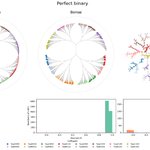
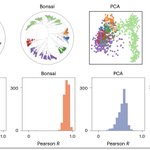
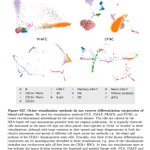
Hey, I heard about Bonsai, but now I heard there is another method called MILK that also visualizes scRNA-seq on trees. And it is much faster! Should I just use that then? A tree is a tree, right?
TLDR: No. #methodsmatter
On synthetic data MILK performs worse than UMAP. 1/n

of methods that apply complex, ad hoc, and completely opaque transformations to the data, and cannot be relied upon for almost anything. These extremely valuable datasets are often obtained at great costs and deserve that we take their analysis extremely seriously. 13/n
I find this revolting. Dripping with unbelievably blind entitlement. It's like a dog trainer, whose pitbull just mauled three toddlers to death, asks us for understanding on how challenging it is to train pitbulls.
No. If your f*cking system breaks the f*cking law, it's on you.

