

Bharat
Joined January 2011
- Tweets7.8K
- Following8
- Followers9.4K
- Likes374

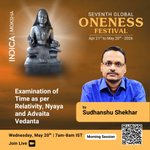
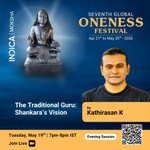


RT @IndicaOrg: Self-knowledge is not something we acquire. It is what remains when everything that obscures it is removed.**
In his discou…

Global Oneness Festival retweeted

Bhagavad Gita for Modern Minds
A 2 Day Retreat on the Timeless Wisdom of the Bhagavad Gita
By Sri Gokulmuthu Narayanaswamy
Date: 24–26 July 2026
Venue: INDICA Gurukulam @Ritambhara, Bengaluru
The Ramakrishna Order sees the Bhagavad Gita not as philosophy alone, but as a way of living. Sri Ramakrishna’s call - “First God, then the world”—and Swami Vivekananda’s “Arise, awake, and stop not till the goal is reached” embody the Gita in action: rooted inwardly, engaged outwardly.
Join Sri Gokulmuthu Narayanaswamy - devotee of Sri Ramakrishna, founder of the Vivekananda Study Circle at IIT Madras, mentor to student communities at IISc and Ramakrishna Math, and a long-time teacher of Vedanta, Bhagavad Gita, and Vivekananda’s thought.
Drawing from his experience teaching the Gita across more than fifteen student batches and from his book Essence of the Bhagavad Gita for Modern Minds, this retreat offers a reflective and practical immersion into the Gita for contemporary life.
Register now: indica.events/event/bhagavad…
@YogaIndica @advaitaacademy

Global Oneness Festival retweeted
The Master Class on Tantrayukti will be held in New Delhi between June 13 and 14 by Professor Jayaraman M, by INDICA in collaboration with @CentralSanskrit University.
Tantrayukti is, at its core, a strikingly elegant way of thinking about how knowledge comes into form. What makes it intellectually beautiful is not only its technical sophistication, but the way it refuses to separate clarity from creativity, or structure from insight. It treats writing not as the passive recording of ideas, but as a disciplined craft in which thought is continuously shaped, refined, and made intelligible through carefully designed intellectual “devices.”
Prof Jayaraman has written a book on Tantrayukti published by INDICA. In a article on the same published in Samvadasamgrahah brought out by the IKS division of the Ministry of Education, he writes at the heart of it lies a simple but profound intuition: ideas do not arrive fully formed. They need architecture.
The pairing of Tantra and Yukti already carries this sensibility. Tantra is expansion - the unfolding of a field of knowledge in its fullness. Yukti is the intelligent act of holding that expansion together without letting it collapse into confusion. One gives breadth, the other gives coherence. Together, they create a balance between openness and rigor that feels remarkably modern in its sensibility.
What is intellectually remarkable is how systematically this was developed across traditions for over a millennium and a half. Whether in the philosophical debates of Sanskrit texts, the precision of Ayurvedic treatises, the grammatical discipline of Tamil literature, or the analytical structures of Buddhist scholastic writing, Tantrayukti functions as a shared cognitive grammar. It is less a “theory” in the abstract sense and more a lived intellectual practice - something that shapes how thought is generated, organised, and communicated.
The Carakasaṃhitā captures this beautifully through metaphor when it compares Tantrayukti to a lamp in a dark room or sunlight opening a field of flowers. The image is not ornamental. It is epistemological. These devices do not add meaning from outside; they allow what is already present but unarticulated to become visible.
What is particularly sophisticated is the way Tantrayukti does not privilege one mode of reasoning. It includes doubt (saṃśaya) as a generative tool, not a flaw; it builds space for objection and response (pūrvapakṣa and uttarapakṣa) as part of the structure of thought itself; it allows for omission, implication, analogy, and invention as legitimate linguistic strategies. Knowledge here is not linear exposition but layered articulation.
Even uncertainty is methodised. Doubt is not the opposite of knowledge—it is its starting point.
Seen this way, Kauṭilya’s enumeration of 32 yuktis is less a rigid taxonomy and more a map of intellectual dexterity. Content generation, structural design, and linguistic refinement are not separate stages of writing; they are interwoven movements within thinking itself. A text is not assembled after thought; it is thought taking shape through structured articulation.
What makes the system quietly extraordinary is its psychological depth. It recognises that clarity is not natural - it is constructed. It requires restraint, selection, sequencing, and a sensitivity to how meaning unfolds in time. It also recognises that excessive rigidity can suffocate insight, and so builds in flexibility through exceptions, alternatives, and interpretive openings.
In that sense, Tantrayukti is not just a methodology of writing. It is a philosophy of cognition.
There is something deeply contemporary in this. In an age overwhelmed by fragmented information, rapid interpretation, and unstructured assertion, Tantrayukti offers a reminder that intelligence is not merely about having ideas, but about knowing how to hold them together without distortion. It is about giving thought a form that allows it to be shared without losing its depth.
Ultimately, its beauty lies in its restraint. It does not try to dominate thought with a single system. Instead, it offers a set of subtle instruments that help thought become itself—clearer, more articulate, and more alive in its expression.
Wishing all the participants a very fruitful session of enquiry and growth.
🤖 Made with AI

Global Oneness Festival retweeted
Can Advaita Vedanta help reshape global thought?
In this thought-provoking lecture, Professor Sthaneshwar Timalsina ji argues that Advaita Vedanta should not remain confined to monasteries, Sanskrit texts, or private spiritual practice. Instead, he proposes that the rigorous philosophical framework developed by Adi Shankaracharya has the potential to contribute meaningfully to contemporary discussions in philosophy, psychology, cognitive science, consciousness studies, and even social theory.
Drawing from decades of study in traditional gurukulas, monasteries, and academia, he highlights how Shankara's thought developed sophisticated systems of epistemology and ontology that can engage modern debates about consciousness, selfhood, imagination, creativity, virtual reality, and the nature of truth.
A central theme of the talk is the need to move beyond intellectual colonization by actively participating in global philosophical conversations rather than merely preserving inherited knowledge. He argues that Indian philosophical traditions offer powerful alternatives to dominant modern frameworks built on excessive individualism, materialism, and dualistic thinking.
Watch the full video here: youtu.be/aNk58dpe00I?si=_SMj… and do subscribe to our Youtube channel.
Global Oneness Festival retweeted
Why Going Far is the Only Way Home
What if the greatest obstacle to a meaningful life is the belief that we are running out of time?
Filmmaker and seeker Akanksha Damini Joshi, author of the newly published Aalolika, and Co-Founder of the Center for Embodied Knowledge, offers a powerful alternative to the modern obsession with urgency. Drawing from a story in the Vishnu Purana, she reflects on how Lord Vishnu journeys across the world with Garuda, only to return and realize that sometimes one must travel very far to come truly near. The seeker’s path, too, often circles through the world before arriving at the self.
Central to her reflections is what she calls the “Yoga Plan” - the Dharmic understanding that life unfolds across vast stretches of time, not within the confines of a single lifetime. This perspective replaces anxiety with steadiness, encouraging wholehearted effort without attachment to immediate results. Yet this freedom requires Viveka, or discernment, lest patience slip into complacency.
Joshi’s insights emerge not only from scripture but from lived experience. She recalls entering meditative states while dancing in a crowded Delhi discotheque, discovering that meditation is not merely a technique but an inward flowering that can arise anywhere. She also argues that ecological healing begins within. Forests are destroyed outside only after the forests within have been neglected; rivers are dammed outside only after the inner river of bliss has run dry.
Equally profound is her reflection on death. Raised in an army family, she learned early that awareness of mortality does not diminish life - it intensifies it. In the Dharmic tradition, Yama, the Lord of Death, is also a teacher who reveals what truly matters.
For Joshi, India’s wisdom traditions remain alive, not merely in texts or institutions, but in ordinary people whose lives embody timeless insights. The ultimate invitation is to see life as Leela - a divine play - where even struggle becomes part of a larger unfolding story.
Sometimes, the longest journey is simply the journey back to ourselves.
Follow INDICA for more such Quests. Full interview: youtu.be/RIMrqO7fLL4?si=uzl-…
@nkgrock @daminijosh
Global Oneness Festival retweeted
INDICA's Master Class on Tantrayukti commenced with the chanting of the Śrī Veda Vyāsa Stutiḥ by Prof M Jayaraman, the Acharya of the sessions.
Who is Vyāsa?
For Prof. Vishwa Adluri, the answer cannot be found within the familiar categories of modern scholarship. The attempt to identify Vyāsa as merely the historical author of the Mahābhārata already presupposes a framework foreign to the text itself. The Indian tradition does not present Vyāsa simply as an individual writer but as a civilizational intellect, the figure through whom the Vedic vision is gathered, organized, transmitted, and made available to human understanding.
As Adluri notes, "Vyāsa is not just an author but the very breath of Brahman - the ongoing revelation of Dharma." This is a theological claim. Vyāsa belongs to what Adluri describes as Brahmavāda, a textual and intellectual tradition whose authority does not depend upon historical verification but upon its capacity to reveal metaphysical truth. Within this framework, revelation is an ongoing process through which Dharma continues to be disclosed.
Seen in this light, the Mahābhārata is an inquiry into the Veda, a sustained reflection on the meaning of revelation itself. The war, the moral dilemmas, the debates, and the teachings are not merely narrative devices but instruments through which Vedic knowledge is examined, interpreted, and brought into the sphere of human experience.
For Adluri, Vyāsa stands at the centre of this entire enterprise. Vyāsa is the principle that links revelation, textuality, interpretation, and lineage. The tradition of Vyāsa extends beyond the ancient world and continues through teachers who preserve and transmit this vision in every generation. The Mahābhārata therefore remains a living text because Vyāsa remains a living presence within the tradition.
If we approach the Mahābhārata solely as history or mythology, we may fail to see what it understands itself to be: a Mimāṁsā of the Veda and a vehicle of Brahmavāda. In our fixation on the "when" and the "where," we risk overlooking the deeper questions of the "what" and the "why"—the very questions the tradition, through Vyāsa seeks to illuminate.
youtu.be/zAdtKnGWuJc?si=H4EW…
4th Swami Dayananda Saraswati Memorial Lecture
Global Oneness Festival retweeted

If Advaita Vedānta teaches non-duality, then what place does devotion have in it?
In this talk organised by @advaitaacademy as part of GOF26, I explore the profound relationship between knowledge and devotion as expounded by Sankara in his Gita Bhasya.
youtu.be/AmF7L2RppoA?si=8jgF…

Global Oneness Festival retweeted

Shankara as a beacon for India's future tells me to keep India as one. It's not just the metaphysical oneness. It's not the spiritual oneness. They are very very important. But if Shankara has got to be a beacon for India's future, it has to be both for the spiritual metaphysical plane and also for the earthly plane.
As they would say, the three planes where Brahma alone is right — Paramarthika, if I know right — and the next level, which is Vyavaharika. So for the Vyavaharika, we need to keep India as one.
Shankara also tells me and emphasises on principled and disciplined life. He also tells me that, since the eventual realisation is Tat Tvam Asi, and that being true for each one of us, treat all with care, treat one another with care and equal respect.
- Smt @nsitharaman at the Global Oneness Festival (1/n)
Global Oneness Festival retweeted
Watch: Full Video of Smt @nsitharaman's address on “Shankaracharya: The Beacon of India’s Future” at the Global Oneness Festival, organised by Indica Moksha (@advaitaacademy)
youtu.be/QQoMhxZFIac

Global Oneness Festival retweeted
Watch live: Smt @nsitharaman’s address on “Shankaracharya: The Beacon of India’s Future” at the Global Oneness Festival, organised by Indica Moksha (@advaitaacademy)
xitter.gq/i/broadcasts/1wxWjavMl…

Global Oneness Festival retweeted

Delighted to watch the opening session of the 7th #GlobalOnenessFestival.
Thoughtfully curated by @IndicaOrg (@advaitaacademy), as always.
A strong beginning to what promises to be a meaningful festival.

Global Oneness Festival retweeted
We are honoured to have the Hon’ble Finance Minister, @nsitharaman , deliver the Inaugural Address at the Global Oneness Festival 2026.
A month-long journey into Advaita begins April 21.
A civilisational conversation continues.

Global Oneness Festival retweeted

Very excited to curate this Meta-Retreat. Bringing together 15 Upasakas for a weekend of immersive exploration of Srividya & Advaita Vedanta.

We are pleased to share that @IndicaOrg is organizing a 3-day MetaRetreat on Srividya and Advaita, curated by Nithin Sridhar @nkgrock , Director of INDICA Centre for Moksha Studies from March 6-8.
This retreat brings together 15 dedicated upasakas for an immersive, contemplative, and reflective engagement with the profound spiritual and philosophical dimensions of the Srividya tradition and Advaita Vedanta.
Designed as an intimate and intensive gathering, the MetaRetreat aims to facilitate deep dialogue, shared learning, and experiential reflection — moving beyond surface understanding toward lived insight.
We look forward to meaningful deliberations and collective reflection in a space committed to seriousness, depth, and authenticity.
Stay tuned for glimpses and reflections from the retreat.

Global Oneness Festival retweeted
Śrīvidyā & Advaita Vedānta: An Immersive Meta-Retreat
📍 INDICA Gurukulam @ Ritambhara, Bengaluru | March 6–8
Namaste,
The most distinguishing feature of this land of Bharat is its inseperable connection to Sanatana Dharma. And what is it that makes this Dharma Sanatana? What is it which makes this land Sacred? What is it which imparts reality and existence to this otherwise transitory world?
It is the eternal, infinite, birthless, non-dual reality called as Brahman in the Upanishads and worshipped as Shakti, the Divine Mother in the Tantras. She is the originator of the universe who in an act of great blessing has also taken the form of various Devatas and inhabits this geography of Bharat sacralizing every inch of this land by Her very presence.
The Divine Mother. She is Devi, Bhagavati, Mahamaya and Shakti. She is also Durga, Kali, Tripuasundari, Lakshmi, and Saraswati.
People call her various names and She herself takes diverse forms, but in essence She is non-different from Brahman as the Mother Herself says in Devi Atharvashirsha.
It took me more than a decade to arrive at this understanding that Shakta & Advaita are like two faces of the same coin- distinct in form, but non-different in essence.
If you have experienced a similar journey through Bhagawati Upasana and Vedanta Manana, if your personal journey has all the three elements of Karma, Bhakti, and Jnana, if your enquiry into Shakta and Vedanta is beyond academic and has instead shaped how you live life, then the upcoming Meta-Retreat I am curating for INDICA Moksha will speak directly to you.
We plan to bring together a carefully selected, small group of scholar-practitioners for an immersive four-day meta-retreat, from March 6 to 8, dedicated to shared inquiry and contemplative engagement with Srividya and Advaita Vedanta.
Srividya offers a contemplative and ritual language through which non-dual truth is approached, while Advaita Vedanta provides the metaphysical clarity that illuminates Shakti as none other than Brahman. The schedule will include unhurried conversations, philosophical dialogue, contemplative reflection, and guided meditation interwoven with temple visits, allowing insights to mature naturally.
Participation in the retreat is limited to a small group and we have only a few seats available. Those who wish to participate, please write to [email protected] or to [email protected] with a note of no more than 600 words, sharing your background, your interest in Srividya and Advaita Vedanta, and how you sense this retreat may support your journey of study and practice.
Participation is by selection, in keeping with the reflective and immersive nature of the retreat. We look forward to spending these days in shared inquiry with fellow seekers committed to depth, sincerity, and inner growth.
With warm regards,
Nithin Sridhar,
Director, INDICA Moksha (@advaitaacademy)

Global Oneness Festival retweeted
My note on @advaitaacademy's activities in 2025.
I am grateful to have this opportunity to serve Dharma & Bhagavadpada Shankaracharya through our center. 🙏
As we conclude 2025, Nithin Sridhar @nkgrock, Director of the INDICA Center for Moksha Studies @advaitaacademy , shares a heartfelt reflection on a year dedicated to deep inquiry, traditional scholarship, and the enduring wisdom of Advaita Vedanta.
From the month-long Global Festival of Oneness to immersive retreats on Shankara Bhashya and so on, it has been a journey of shared discovery for seekers and scholars alike.
#Advaita #Vedanta #Oneness #INDICAMoksha @Sai_swaroopa @IndicaOrg

Global Oneness Festival retweeted
We had an absolutely wonderful retreat. It was an enlightening weekend to study Adhyasa Bhashya with @SNarasimhananda ji.
Just concluded a deeply reflective retreat on Adhyāsa Bhāṣya by Swami Narasimhananda ji @SNarasimhananda
Immense gratitude for the clarity, depth, and inspiration that unfolded through these sessions on Śaṅkarācārya’s profound introduction to the Brahma Sūtras.
@KozhikodeRkm @nkgrock @IndicaOrg


Global Oneness Festival retweeted
INDICA is pleased to announce the 4th Pujya Swami Dayananda Saraswati Memorial Lecture.
Prof. Vishwa Adluri @VishwaAdluri will explore the Nārāyaṇīya section of the Mahābhārata, discussing its significance in Hindu theology, particularly in relation to saguṇabrahman, bhakti, and mokṣa. Honoring Swami Dayananda Saraswati's legacy of self-knowledge & compassion 🙏📚
📅Date: Sunday, October 26, 2025
🕗Time: 8:00 AM - 9:00 AM (UTC+5.5)
To register: indica.events/event/4th-pujy…
#SwamiDayanandaSaraswati #AdvaitaVedanta @advaitaacademy @nkgrock @dimplekaul_in @Sai_swaroopa

Global Oneness Festival retweeted
Register today to know how ancient Indian Knowledge Systems can enlighten modern Governance, Leadership, and Economic frameworks
The 43rd Online Symposium brings together scholars to explore practical concepts like Danda Niti, Rajanaya, and the idea of a 'Civilizational State' drawn from Tirukkural, Shukraniti, and other seminal Indic works.
If you are a student, researcher, or policy enthusiast, this two-day event is essential for understanding a Dharma-based approach to statecraft.
Don't miss out—register today: indicacademy.zoom.us/webinar…
🗓️ Event: 43rd Online Symposium On STATECRAFT, POLITICAL THOUGHT & GOVERNANCE
🔗 Details & Full Schedule: indica.events/event/43rd-onl…

Global Oneness Festival retweeted
Sashtanga Pranams at the feet of the Guru. 🙏
Founder's Tribute to the Guru
Today is the day Pujya Swami Dayananda Saraswati, one of the greatest exponents of Advaita Vedanta in the 20th century attained mahasamadhi 10 years ago.
It was on 16th September 2015 that I met him for the last time, when he blessed me and asked me to work hard “Bharat Ke Liye”, he said.
My first one-on-one meeting with him was back in 2010. He encouraged me to be a passionate social entrepreneur. For five years I used to meet him regularly and talk about advancing Advaita globally. He always lovingly indulged my naive questions. He also took me on the Board of one of his Trusts
Some important lessons that I learnt from Pujya Swamiji, which I have embodied and which reflect in my work at INDICA, are:
A. Importance of advancing authentic teaching and also providing a structure
B. Tradition must adapt to changing times and we should not be prisoners of the same.
C. Focus on training teachers and allow them to do their own thing to find their path.
Let me elaborate.
He pioneered the systematising of the teachings of Advaita Vedanta into a 3-year course with a specified syllabus and method of unfolding this wisdom. Starting the first course at Sandeepany, Mumbai, he went on to teach several such courses over the course of his life at different locations. He trained more than 300 teachers who carry on the teachings of Adi Shankracharya in a form that it was intended to be disseminated.
Our tradition did not allow for women to become sannyasis. He was the first to ordain several women as sannyasis. In other words, he adapted the tradition to the changing times.
He did not seek to build a holding-subsidiary kind of relationship with his disciple-students who completed their 3-year course. He allowed them to blossom on their own and, should they choose, they could remain loosely affiliated with their parent organisation. This structure is very unique and resonates with me very strongly. He focussed on instilling the teachings and allowing Ishvara to play its role.
I initiated a memorial lecture back in 2019 and could only continue for two more years. I sought to get a very high-profile disciple of his for the fourth year but was unable to do so. Since then, for no specific reason, I was unable to organise his memorial talks in the subsequent years. A great failing of mine.
I remember him with gratitude and reverence. He was a modern day Rishi, who laid a strong foundation for a spiritual Bharat. He also identified and mentored the political leadership that you see today. In other words he left his legacy both spiritually and politically.
If you are a student of Vedanta, do remember him today.
Sri Hari Kiran Vadlamani
