

Historian. Writer. Engineer. Author of The Handle is One of Us - Hitler, Biafra and Benin City
Joined October 2010
- Tweets4K
- Following1.4K
- Followers1.4K
- Likes5.5K


💔 A five-year-old boy sat on his father’s shoulders, unaware he was seeing him for the very last time.
📍 Lagos, Nigeria. January 1966.
A celebration was underway at Brigadier Zakariya Maimalari’s home. Music, laughter, elegant guests. Among them were some of Nigeria’s most powerful military officers.
Years earlier, Maimalari had tragically lost his wife. He was left with two young children.
That evening, his five-year-old son, Abubakar, ran up to him.
His father lifted him onto his shoulders and spoke hopefully about a better Nigeria. A country where his son could grow up without ethnic divisions and hatred.
He had no idea that within hours, his little boy would lose his father too. 💔
Among the guests was Major Emmanuel Ifeajuna.
He had helped organise the celebration. The invitations, the music, the entire evening.
Yet just hours later, he would take part in a military coup and murder the very man whose party he had arranged.
The man who helped organise his celebration was also preparing his death.
We like to believe we can recognise our enemies. That betrayal always comes from the outside.
But sometimes, betrayal sits at our table, smiles at our children, and raises a glass with us. 🥀
📖 This heartbreaking story is told in The Handle Is One of Us – Hitler, Biafra and Benin City by Damola Awoyokun.
Because history isn’t just about wars, politics, and powerful men.
Sometimes, it’s about a little boy who didn’t know he was sitting on his daddy’s shoulders for the very last time. ❤️🩹
#TheHandleIsOneOfUs #UntoldHistory #AfricanHistory #HistoricalStories #BooksWorthReading

If you are riding Elizabeth line today, remember us who built it.
Also remember Renè Tkáčik the Slovakian concrete sprayer who died in the line of duty. 🫶🙏


This quoted post is unavailable.
They believed everything was under control.
But in August 1967, Benin City was about to discover how dangerous false confidence could be.
History is not always what we were told.
Discover the stories behind the headlines in The Handle Is One of Us by Damola Awoyokun.
#TheHandleIsOneOfUs #AfricanHistory #NigerianHistory #Biafra #BeninCity #HistoryUncovered
One poem. One little girl in tears. One poet who never saw his own ending coming. 💔
Christopher Okigbo’s story is a haunting reminder that even the most beautiful words cannot protect us from history. 🕊️
#ChristopherOkigbo #AfricanHistory #Biafra #History #BooksWorthReading
I found this gem in my library.
As we grow older, we evolve.
We laugh at the past
@charliegilmour

Unfortunately true. Without compensating the enslavers, abolition would not have worked. Madam Tinubu tried to assassinate Consul Campbell of Lagos twice over this abolition issue. Then she ordered Governor Glover arrested when she realised he was using one of her runaway slaves as his body guards. All the elites of Lagos got credit facilities and compensations that allowed them to transition to trade in agricultural produces.
Without that British abolition would not have worked.
The slaves got freedom not financial compensation unfortunately. It was the same in Calabar, Ghana all the way to the Caribbean.
Britain was pragmatic.

The state and the missionaries were working hand in hand. Abolition first originated from the CMS and the Quakers before they invited the crown and the state to the cause through Prince Albert. The Canon of Windsor once took Ajayi Crowther to meet the Prince and the Queen Victoria in Windsor Palace. The Queen then asked what he wanted done to this Lagos; Crowther said bomb the place.
The Queen ordered Admiral Francis Baring head of the admiralty to get it done. December 1851, Lagos was bombed and seized.
State and missionaries were working together. Everywhere the British marines and consuls penetrated in West Africa, they always included in the treaty protection and freedom for the missionaries to operate. They were the two faces of the same coin.
Nowhere would you find in this post Britain built this as the first modern university for the slaves they freed. All the good deeds of Britain are normally reported in the passive voice to cut Britain out of the good guys narrative ("It was established on..."), while the relatively few negatives of British rule are put in active sentences where Britain is prominently the subject: (Britain destroyed…Britian took..)
This is the trick that books taught in schools for seventy years have relied on to create the false impression that colonisation and the British Empire were nothing but evil and exploitation.
Freetown was modelled to be the Athens of West Africa, and it was. Lagos was the Liverpool of West Africa, or Venice on the Lagoon. Only Britain Empire in the history of empires could turn freed slaves and their children into pioneers in Engineering, Medicine, Law, Civil Service etc all over Africa.
But you will never read that in any book.
We will fix that.
We will make it normal to say the truth about Britain again.

Samuel Ajayi Crowther became the first pupil to register at Fourah Bay in 1827.
Fourah Bay College is a public university situated in the Mount Aureol district of Freetown, Sierra Leone.
It was established on 18 February 1827, and is regarded as the first Western-style university constructed in Sub-Saharan Africa, and also the first university-level institution on the continent.
Early Nigerian students include:
1. Samuel Ajayi Crowther: He became the first pupil to register at Fourah Bay in 1827.
2. Alexander Babatunde Akinyele: He earned a university degree and founded Ibadan Grammar School in Ibadan, the first secondary school there.
3. Professor Kenneth Onwuka Dike: He became the first Nigerian vice-chancellor of the University of Ibadan.
4. Samuel Osarogie Ighodaro, QC: He served as Minister of Justice and Attorney-General of the Western Region of Nigeria from 1959 to 1963, and later as a Justice of the High Court of the Mid-Western Region from 1968 to 1973.
5. Seth Irunsewe Kale: A Nigerian Anglican bishop who was Principal of CMS Grammar School, Lagos from 1944 to 1950, and Bishop of Lagos from 1963 to 1974.
6. Thomas Babington Macaulay: A Nigerian priest and educator, founder and first principal of CMS Grammar School, Lagos, and father of Nigerian nationalist Herbert Macaulay.
7. Samuel Onunaka Mbakwe, also known as Dee Sam: A Nigerian politician who served as the first executive governor of Imo State from 1 October 1979 until 31 December 1983.
8. Reverend Solomon Odunaiya Odutola: An Anglican clergyman who was bishop of Benin-Ondo Diocese from 1952 to 1960 and bishop of Ibadan Diocese from 1960 to 1970.
9. Isaac Oluwole: A Nigerian bishop of Sierra Leonean and Egba heritage, one of the most prominent Sierra Leone emigrants resident in Lagos during the second half of the nineteenth century, and Principal of the CMS Grammar School, Lagos from 1879 to 1893.
10. Israel Oludotun Ransome-Kuti: A Nigerian teacher, father of musician Fela Kuti, and of physicians Olikoye Ransome-Kuti and Beko Ransome-Kuti.
11. Festus Oluwole Segun, 20 March 1915 to 2024: A Nigerian Anglican bishop.
12. Ladipo Solanke, born around 1886: A political activist born in Nigeria who campaigned on West African issues.
Whenever I think of this school, I always remember my childhood friend Chidi Ogbuagu, whose father was an alumnus of Fourah Bay.


Read my book for individual African stories behind those figures and you will see why Queen Victoria was beloved in West Africa.
There was no one, no one, seeing slavery as bad until Britain intervened.
Even slaves in the coastal cities like Lagos when they bought their freedom entered the business and began to enslave others too.
Ibadan in the hinterland was even weirder because it had a practice never encountered anywhere in history of the world: slaves there had their own slaves while still being slaves. There were perhaps building up their portfolios for when they would buy their freedom and then continue the trade themselves.
Queen Victoria ended all these.
We are blessed to have her and we are grateful to the Royal Navy too and their African accomplices who guided them to where the evils resided.


Eisenhower hated Monty. He couldn’t stand Monty in private. And decided to humiliate him in the end. Contrary to Monty’s plans, Ike let the soviets take Berlin to deny Monty victory lap. That error placed large swathe of Eastern Europe behind the Iron Curtain fro decades to come. Meanwhile Monty’s effort in the north prevented Denmark and naval entrances in the Balkans from fallen to the soviets. Why did Ike do that? Well, it started right before Operation Torch. Americans were eager to join in the European theatre and fight the Germans straight away in France, but Monty said it was too risky that Americans were not experienced and battled hardened enough to fight yet. Let them go and try themselves in Africa first.
Since then Ike never forgave Monty. As the war was concluding, he pivoted American troops away from Berlin and allowed the Soviets to take it.
Very spiteful.

The end of the beginning. Monty's finest hour begins.
The Second Battle of El Alamein starts today in 1942.
Us Brits get a little defensive about Monty. I'm a fan; I will never forget my grandmother talking about how Monty was a god when they won, and how church bells rang across Britain.
Our first victory since 1939. Three grim years of death and loss and humiliation.
Churchill: "Now this is not the end. It is not even the beginning of the end. But it is, perhaps, the end of the beginning."
Churchill also said: "Before Alamein we never had a victory. After Alamein we never had a defeat."
What's your verdict on Monty?

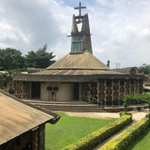
This is the Dominican Chapel in Ibadan


As a structural engineer, people ask me why is it that we dont build beuty like this anymore.
It is not because of time or cost.
Its because we dont know how.
The knowedge is lost.
It was never passed on to the universities when they became centres of knoweledge.

Beauty is obvious. Ugliness requires a lecture.
No lecture but here is what I found.
At the top of the Spanish Steps the twin towers of Trinità dei Monti rise above the city, a French church begun in the early 1500s. Inside, the single nave holds Daniele da Volterra’s Deposition—drawn from Michelangelo’s hand—and other Mannerist works that still reward a quiet look. From the terrace the view falls down the 135 steps and out across the roofs; the place itself stays comparatively still. Beauty here is immediate; the rest needs no lecture.

Hopefully your discovery will change your attitude towards the British and the colonial past.
It took me a while to understand but the British were builders.
They found muck and left gold.
We were lied to about colonisation.
I cant wait to see other people's reponse to your discovering. I have seen them. The townplanning maps of Port Harcourt, Lagos, Kaduna, the engineering blueprints of multiple buildings still standing.
They did that in every British colony. Every.
Salute to the greatest nation in history.
Architects and building engineers on X, I have colonial files with drawings and works of some of the buildings built during British colonial rule.
I would get the PWD, Surveyor-General, and Lands & Town Planning files.
You better stick around cos from November it will be daily release of these unseen files.
Some of these drawings and designs are before 1900.
Stick around ok.


💔 The little girl began to cry before the poet finished reading.
No one in the room knew how his own story would end.
🇳🇬 Nigeria, 1960s.
Christopher Okigbo, one of the most celebrated poets of his generation, was visiting the family of British diplomat George Bell.
That evening, he began reciting Robert Graves’ poem Warning to Children to the couple’s six-year-old daughter.
The girl listened quietly.
Then, before the final verse, she burst into tears. 😢
Her mother explained that she was simply sensitive to poetry.
But Okigbo believed the child was sensitive to endings.
Not long afterward, civil war broke out in Nigeria.
The poet traded his pen for a rifle.
In September 1967, he was killed fighting for Biafra.
His body was never found.
A man who could move a child to tears with words died in a world where words were no longer enough. 🕊️
We like to believe that culture, art, and sensitivity protect us from cruelty.
That people who create beauty should never end up surrounded by destruction.
But history makes no such promises.
In The Handle Is One of Us, Damola Awoyokun recalls this seemingly ordinary evening.
One poem. One crying child. One poet who had no idea how little time he had left.
Because the most heartbreaking endings are often the ones their heroes never see coming. 💔
#ForgottenHistory #HumanStories #LessonsFromHistory #PowerOfWords #HistoryThatMatters

Brother, we are praying for you.
Remember General Horrocks that in 1943 in North Africa, a strafing German fighter plane struck his chest severely injuring his lungs, stomach, and intestines. After spending some time in the hospital and undergoing five major operations, he defied the odds to return to the front and command XXX Corps during the Allied advance into Europe, including Operation Market Garden.
You are no different.
You dont need Barbara Winsor you have better heroes.


Many areas of London were like this including Kings Cross.
Go and look at those places today. Facebook and Google European HQ are there even.
They have been transformed to relative paradise.
Yet the doomers still insist that London is fallen.
No one wants to admit the obvious because truth doesn’t fit the narrative.


Pls add my name too.
It reminds me of Bertolt Brecht's 1939 classic poem "The Burning Of The Books."
When the Regime
commanded the unlawful books to be burned,
teams of dull oxen hauled huge cartloads to the bonfires.
Then a banished writer, one of the best,
scanning the list of excommunicated texts,
became enraged: he'd been excluded!
He rushed to his desk, full of contemptuous wrath,
to write fierce letters to the morons in power —
Burn me! he wrote with his blazing pen —
Haven't I always reported the truth?
Now here you are, treating me like a liar!
Burn me!

OPEN LETTER: Sally Rooney is a writer, not a terrorist. Her books must be available to the public. Their withdrawal from sale, on the basis of ill-conceived and draconian anti terror legislation, is an affront to basic principles of free speech and expression so long taken for granted in this country. We categorically reject censorship - whether direct or indirect - and urge the government to change course, amending the legislation which has led us to this point of repressive absurdity.


