

Content creator | AI researcher & builder |
Joined June 2013
- Tweets3.9K
- Following1.3K
- Followers769
- Likes4.1K


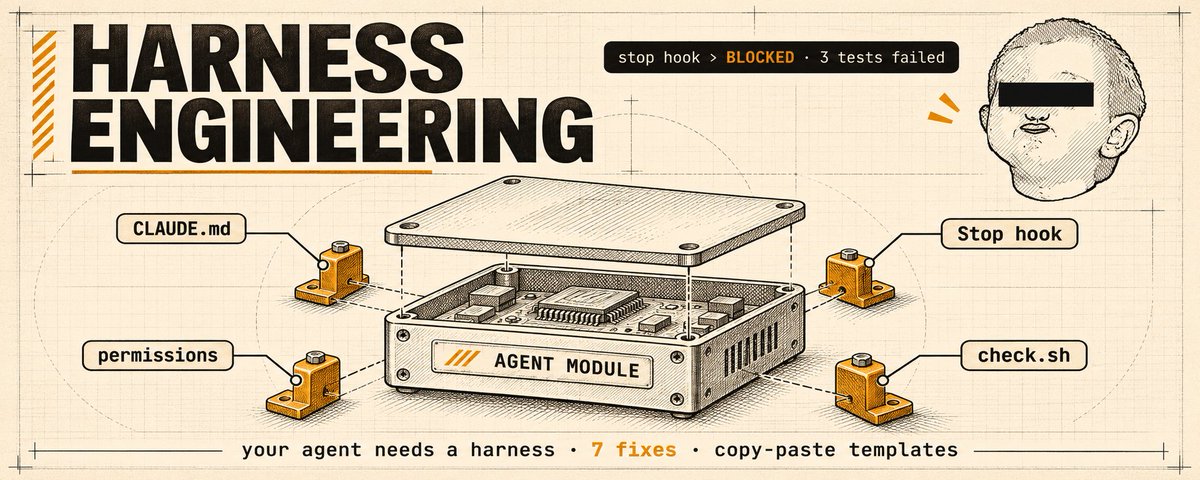
This is f*cking insane. LangChain didn't touch the model, didn't rewrite the prompt, they only changed the system around it
52.8% → 66.5% on Terminal Bench 2.0. from outside the top 30 to the top 5
and OpenAI's team shipped ~1,500 PRs where every single line came from the agent. their bottleneck was never the model
meanwhile most of us are still paying for a bigger model and writing longer prompts, then wondering why the agent says "done" on red tests
so I put the whole fix on one page:
→ a 5-row table to find which layer is actually broken
→ 7 failures and the fix for each, none of them in the prompt
→ the exact settings.json: allow, ask, deny + a Stop hook that won't let Claude finish on failing tests
→ a 10-question check before you give an agent the keys
a longer prompt fixes 1 row out of 5. the other 4 live in the harness
save the page before it gets buried. the full breakdown is in my article below ↓


Everyone's making AI videos now.
Almost nobody knows why theirs cost so much.
The model isn't the problem. Neither is the prompt. The order you work in is.
Here's how to turn Claude Code into a film studio 👇

AN "AI AGENT" IS 5 FREE TOOLS IN A TRENCH COAT.
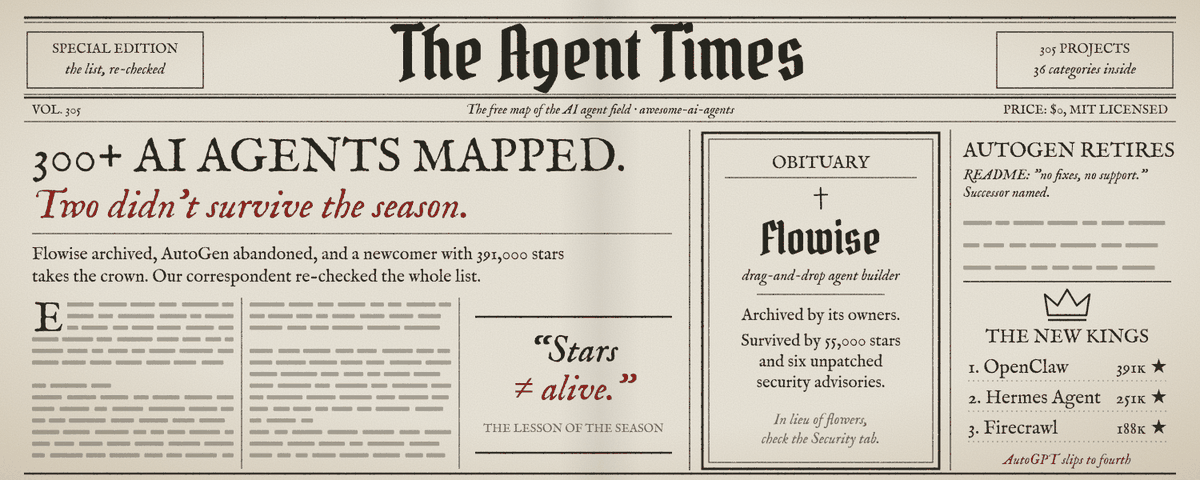
I mapped 300+ agents in the article below. The question I get most: which ones actually do the work?
So I opened one up. Inside: 5 open-source tools, one job each.
THE BRAIN: Ollama Runs the model on your own machine. Your agent talks to localhost:11434 instead of a paid API. No API bill. Your data never leaves your laptop. github.com/ollama/ollama
THE HANDS: browser-use This one changed how I think about agents. The model never "sees" the website. browser-use turns the page into a numbered list:
[35] input "Search" [38] button "Search"
The model just answers: type into 35, click 38. New page, new list, next number. Repeat until the task is done. github.com/browser-use/brows…
THE MEMORY: mem0 After every chat it pulls out the facts worth keeping and stores them. Before the next answer it searches them and hands the agent only the relevant ones. memory.add() after. memory.search() before. That's the whole trick. github.com/mem0ai/mem0
THE CODER: Aider Builds a map of your whole codebase, then edits. Every change is its own git commit with a message. Don't like it? /undo github.com/Aider-AI/aider
THE CAMERA: Langfuse Records every step: each model call, how long it took, what it cost. When your agent does something weird at 3am, this is how you find out why. Open source, self-hostable. github.com/langfuse/langfuse
The loop: think → act → remember → record → repeat.
That's an agent. Everything else is packaging.
Now the uncomfortable part.
In the article I gave you a 6-point alive check for every repo. Today I ran it on my own 5 picks.
4 passed. Fresh commits in the last 10 days. 1 didn't: Aider. Not archived, still works, but no commits for 5+ months.
By my own rule that's a yellow flag. If you want a coder that's actively shipping, swap in Cline. Open source, works in your IDE and terminal, commits this week: github.com/cline/cline
Run the check on everything. Including my lists.
The full map of 300+ agents is in the article below 👇

This is f*cking wild. Anthropic took one task and solved it 5 different ways:
Simple prompt → 0/5
Bigger model → 0/5
Longer prompt with "work carefully, do not rush" → 2/5
Bigger model + deep thinking → 5/5, but 99 sec per run
Small model + a loop that checks and fixes its own work → 5/5, fewer tokens, 79 sec
The cheap model with a loop beat everything.
Their own slide says it straight:
"Prefer adding structure (a field, a tool, a criterion) rather than exhortation ("NEVER...", "CRITICAL...")"
Stop yelling at your agent in caps. Build it a way to check itself.
30 minutes from Anthropic's Code w/ Claude stage. Better than a $500 prompting course.
Watch it today.
Full harness engineering guide below ↓


MY 300+ AI AGENT MAP WAS MISSING THESE 10
Last month I mapped 300+ AI agents.
The most common reply: "cool, but which one do I actually run?"
Fair. A map shows you what exists. It doesn't do any work.
So here are 10 agents that do a real job from day one. Same rule as in the article: I opened every repo and ran the alive check. All 10 shipped updates in the last two months.
Save this 🔖
GET THE JOB
1. career-ops
Paste a job listing. It tells you if the role is still open and if it fits you, tailors your CV and drafts your answers. You press Submit.
Built during a real job search: 740 listings evaluated, 68 applications, 12 interviews, 1 offer.
github.com/career-ops-hq/car…
SEE WHAT YOUR AGENT CAN'T
2. Agent Reach
Gives Claude Code and other agents what they can't reach on their own: YouTube transcripts, GitHub, Reddit, LinkedIn and more, one command per platform.
Install it from GitHub only. Their own docs warn that the PyPI package with the same name isn't theirs.
github.com/Panniantong/Agent…
3. last30days
Searches Reddit, Hacker News, GitHub and Polymarket (X and YouTube after a quick setup) and turns what people actually said this month into one brief.
Know what changed in your field before your boss does.
github.com/mvanhorn/last30da…
MAKE THE THING
4. OfficeCLI
Word, Excel and PowerPoint for agents, with no Office installed. One binary.
The smart part: it renders the file to an image, so the agent can see what it made and fix it.
github.com/iOfficeAI/OfficeC…
5. Hypit
Drop in a video and your agent rebuilds it as an editable workflow: footage, captions, B-roll, effects, all tied to words instead of timestamps.
Free. You only pay for the models you already use.
github.com/hypit-ai/hypit
6. humanizer
Strips the AI tells out of your writing. Built on Wikipedia's own guide to spotting AI text. In a blind test, judges picked its rewrite 16 times out of 16.
The line between "AI wrote this" and "you wrote this".
github.com/blader/humanizer
DON'T GET HACKED
7. Strix
AI pentesters that run your app, find vulnerabilities, prove them with working exploits and suggest the fix. Can check every pull request through GitHub Actions.
Only point it at code you own.
github.com/usestrix/strix
8. supply-chain-risk-auditor
Audits what you install: known advisories across your whole lockfile, abandoned packages, scripts that run at install time.
Strix attacks your code. This checks the code you imported.
github.com/trailofbits/skill…
PROVE IT WORKS
9. evals-skills
How you prove your AI feature actually works, instead of hoping it does.
The people who can measure AI won't be replaced by it.
github.com/ai-evals-course/e…
RUN THE TEAM
10. Paperclip
"If OpenClaw is an employee, Paperclip is the company."
Org chart, budgets, approvals and costs for a whole team of agents, in one dashboard.
github.com/paperclipai/paper…
None of these replace you.
They replace the 4 hours of work an agent can do in 20 minutes.
The full map of 300+ is in the article above 👆
Pick one this week. Not ten.
Which one are you installing first? 👇
Wrong AI answers are easy. You spot the mistake, fix it, move on.
The ones that get you are 95% right and beautifully written. You read the first one carefully. The fifth one you skim. By the tenth you're just nodding along, and one day someone asks you why it works and you've got nothing to say.
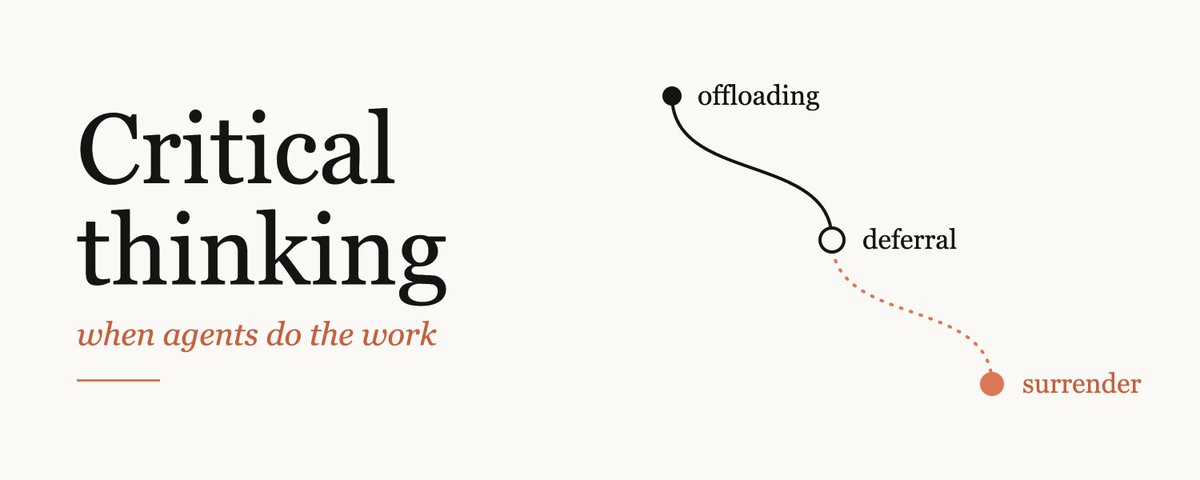
That slow slide is what this whole piece is about, and it's worth the 20 minutes. If you don't have them, these are the parts I'm keeping:
Guess first. Before you ask, write down what you think the answer is, even a bad guess. After you've read a polished reply, it's really hard to imagine any other option.
When it says "done", ask what it actually checked. A green tick means one thing passed. It doesn't mean everything works.
Ask "did I miss anything?" at the end. Sounds silly. Addy says it usually turns up two or three more things.
Try to explain the result with the chat closed. If you can't, it isn't yours yet. You borrowed it.
Once a week, do one thing by hand that you'd hate to forget how to do.
None of this means using AI less. It means you're still the one who has to stand behind whatever goes out with your name on it.
What's one thing you've stopped doing yourself since AI showed up?

200k people read this as of right now. A lot of them will run the same content map prompt on the same viral data this week.
Play that forward. Same scraped references, same "proven patterns", same hook structures. By mid-2027 the feed fills up with personal brands that all researched each other and landed in the same spot.
Dan is right that attention is the skill. I'd put the edge somewhere else though. When AI drafts a post for free, writing stops being scarce. Taste stays scarce: knowing which 80% of the map to throw out, and having ideas from your own work that no scraper can pull because they don't exist online yet.
The permissionless apprentice play has the same problem. JK's 10 free posts got Dan's attention because writing them cost real hours and nobody else did it. In 2027 anyone can generate 10 posts for 10 founders before lunch, and founders will start muting those DMs.
If I wanted a client next year, I wouldn't send posts. I'd build them something: an interactive breakdown of their product, a visual explainer, a small tool their audience can use.
Use the playbook for research. Then post the part nobody else's research could find.



No way Claude built this from one prompt.
A robotic hammerhead shark. 246 parts. It powers up, swims, rolls 58° onto its side, scans with its hammer, bites, then disassembles itself.
26 seconds. 60 fps. Sound included.
Every gauge and label reads from one model, so nothing drifts.
Built on the free teardown skill by @elvar_official. Link in the first reply 👇


This is f*cking insane, I saw @elvar_official free teardown skill and asked Claude one thing: build me a mechanical scarab.
The result: Scarabaeus SC-7.
263 parts. Elytra open, wings unfold at 48 Hz, lift-off, banking, then the whole beetle comes apart piece by piece and reassembles itself.
how it works:
> name the thing, give Claude a reference
> Claude writes the model as math first and checks every number before drawing a single part
> every part, gauge and label reads from that one model, so nothing drifts apart
> it renders stills, hunts its own bugs, then records the tour at 60 fps with sound
> you get one page you can orbit, cut open and pull apart
The skill is free and open source. Link to the original in the first reply 👇


Bigger payload doesn’t mean cheaper runs. Every screenshot still costs tokens. 128 MB is room to work, not a reason to send everything. Trim what the model doesn’t need to see.


I gave one prompt a $1,000 paper account and let it trade memecoins all night. Here's what happened 👇
No scanner tab. No charts open all night. No clicking buy.
11:00pm I typed it into memescan and hit run.
"Night run started. 5 agents online."
That one prompt became the whole desk:
→ scout pulling fresh pairs
→ filter killing anything that fails a rule
→ analyst scoring the rest 0–100
→ executor sizing 10% max
→ risk setting the stop before every entry
What it did while I slept:
→ 229 pairs scanned
→ 224 killed by hard rules or a score under 70
→ 12 coins scored 70+
→ 23 trades: 11 won, 12 lost
→ worst trade −$9.59, rule-based stop
→ best trade +$60.18, trailing stop after a +68% peak
$1,000 → $1,006 → $1,060 → $1,124 → $1,141
+14.1% overnight, max drawdown 4.1%
Two things I didn't expect:
→ it lost more trades than it won and still finished up. Avg win +20%, avg loss −7%. The trailing stop did the work.
→ a −6% stop is not −6%. Fees, slippage and gaps made it −7.1% on average.
Full disclosure: simulated market, paper mode, fictional tickers. No real money. Next: the same rules on live data.
The prompt, exactly as it ran:
Build a Solana memecoin scanner + trading desk in memescan.
Goal: find the strongest fresh coins by real on-chain data.
SCOUT: pairs 30m–72h, mcap $300k–$20M (DexScreener).
FILTER kills instantly if any rule fails:
- mint / freeze authority not revoked
- LP not burned or not locked 30d+
- liquidity < $40k · 1h volume < $50k
- top 10 holders > 25% · dev wallet > 3%
- bundled launch > 10% · already +80% in 1h
ANALYST scores 0–100: momentum, unique buyers, buy/sell ratio, holder growth, liq/mcap, smart wallets.
Only 70+ passes. EXECUTOR: max 10% of balance.
RISK: stop −6% before entry, trail after +12%.
Log every kill. Paper mode. Run overnight.
Prompt + idea from @A_Pirate_I 🙏 I rebuilt it as my own desk and ran it on a simulated market first.


Sundar really said "periodically" and then dropped Argon and Carbon two weeks apart. I see what you did there.
Jokes aside, the table under this post is more interesting than the headline.
Carbon is #1 on the AA Index with 59. Sounds dominant until you notice Opus 5.5 is at 58 and GPT-6 Astra at 57. That's not a lead, that's a photo finish.
It doesn't even win everything. GPT-6 Astra beats it on FrontierSWE 2, and Opus 5.5 beats it on OSWorld by almost 6 points.
Where it clearly pulls ahead is the stuff that's hard to fake: long tasks and security. 65% on Terminal-Bench, 88% on finding real vulnerabilities, and Google says it ran for days on a single engineering problem.
That last part is what I keep thinking about. A model that sits with a bug for days is a different kind of tool than one that answers in 30 seconds.
Can't try it yet though. Cyber defenders first, the rest of us "soon."
So... Neon in two weeks?

I did say we'd be releasing our models periodically...introducing Gemini 4 Carbon, our next frontier model.
Following Argon's release just two weeks ago, Carbon shows the pace at which we’re pushing the frontier, it ranks #1 on the recently updated v5.0 of @ArtificialAnlys Intelligence Index at 59. It also leads across key cybersecurity evaluations scoring 88.2% on SEC-bench Pro for finding vulnerabilities, 54.8% on ExploitGym for exploitation, and 71.0% on CWE-bench for patching.
We’re seeing significant improvements in long-horizon tasks even compared to Argon, and we’ve strengthened frontier safeguards.
As we did with Argon, we’re going to roll it out gradually + responsibly. Some trusted cyber defenders will get access starting this week. We'll be expanding it to more partners through our Fairwind Program, ahead of wider availability soon, so hang tight!

Here's what nobody's saying about this: the artifact doesn't stay with Legal.
The regulatory scan has a "Brief the business" button. Every answer links to its source. Sharing respects ethical walls.
Legal builds it once. The whole company uses it.

This one got stuck in my head, so I tried making my own.
Went with kintsugi: the bowl cracks, falls apart, comes back together, and the cracks fill with gold.
Every loop it breaks again and ends up with more gold than before.
