

Director Climate Emergency Institute, IPCC expert reviewer, Co-author Unprecedented Crime, published on climate change, sustainable development, biodiversity,
Victoria BC Canada
Joined November 2010
- Tweets25.6K
- Following176
- Followers41.5K
- Likes17.1K


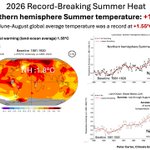

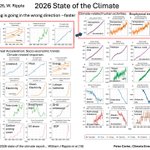
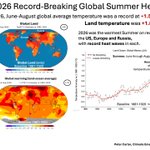

GIANT HEAT STORMS ARE INCREASING-FAST
youtube.com/watch?v=5gEmgqTa…
( Reuters, 20 October. 2026) Fossil fuels are baking our planet.
Stop fossil fuels and the evil fossil fuel subsidies by our governments. #climatechange #globalwarming
BEST-CASE EMISSIONS SCENARIO HITS 1.8°C, UNEP GAP REPORT
For 1.5 °C, emissions had to drop from 2020- impossible now
With an immediate emissions drop now, heating hits 1.8°C
Clearly, heating will hit over 2°C- the catastrophic point of no return. wedocs.unep.org/rest/api/cor…
#climatechange. #globalwarming


Peter D Carter retweeted

In 2024, Oxfam identified 23 superyachts owned by 18 billionaires. The ave annual carbon footprint of each yacht was 5,672 tonnes. For an average citizen of the world it would take EIGHT HUNDRED & SIXTY YEARS (860 years!) to produce the same amount.
#GreedDamagesClimate

Peter D Carter retweeted

🌍 ¿Y si el próximo gran El Niño dejara consecuencias que durasen décadas?
El súper El Niño de 2026-2027 podría convertirse en uno de los más intensos de la historia. Pero lo verdaderamente preocupante no es solo su magnitud, sino lo que podría ocurrir después.
🔥 Sequías extremas, inundaciones, nuevos récords de temperatura y ecosistemas como la Amazonia o los arrecifes de coral al límite. En un planeta cada vez más cálido, un fenómeno natural como El Niño podría acelerar transformaciones difíciles de revertir.
¿Estamos ante un punto de inflexión para el clima de la Tierra?
Os cuento qué sabemos y qué podría suceder en este artículo.
eltiempo.es/noticias/el-nino…
#ElNiño #CambioClimático #Clima #CalentamientoGlobal #Meteorología

Peter D Carter retweeted

Acceleration of climate change? Look no further than sea surface temperature..


Peter D Carter retweeted

A new study has examined 20,736 scientific publications about climate tipping points. Several of those are estimated to be crossed around 1.5 degrees warming, i.e. any time soon: permafrost thaw, Greenland Ice Sheet, North Atlantic Subpolar Gyre.
theconversation.com/some-cli…

Peter D Carter retweeted

This is mitigation and adaptation in one system.
Trees cool the field, cut wind, and slow runoff. Roots and litter rebuild organic matter. Shade and diversified harvests buffer drought years. A 2025 review of 109 studies found on-farm biodiversity up 25–40% and soil organic carbon up about 15% over two decades, with yields often higher than monocrops.
Peter D Carter retweeted

U.S. is an outlier among rich nations in slowing climate progress, U.N. data says
Our analysis cited in @nytimes:
nytimes.com/2026/10/21/clima…

Peter D Carter retweeted

This is gonna happen. – at Moravany, Česká republika

The Amazon is burning again. Air pollution is getting worse, people’s health is at risk, and the worst may still be ahead.
scitechdaily.com/the-amazon-…

Peter D Carter retweeted

💬 "The worst thing that they've done is stolen our imagination, to imagine a world beyond fossil fuels. But it exists in many countries...it requires us to stand up. It requires us to force the conversation and to have courage."
@Tzeporah joined @3CR collaboration with the Women's Climate Congress for "Beyond the Fossil Fuel Deadlock; Building an International Roadmap for a Just Transition" to reflect on why she helped launch the initiative and the growing support in preparation for the 2nd International Conference on the Just Transition Away from Fossil Fuels.
🎙️ Hear the full conversation:
Part 1 3cr.org.au/earthmatters/epis…
Part 2 3cr.org.au/earthmatters/epis…
Peter D Carter retweeted

Newport Beach declared an emergency for a flood that hasn’t happened yet. NOAA flood odds this winter: LA 98% on Christmas Eve, San Diego 97%, Monterey 64%. SF just set an October record. Tides, not storms. They’re already on the calendar.
Peter D Carter retweeted

There's no doubt climate stresses are adding stress to various aspects of our lives, especially in certain places, whether it be economic, health, anger, anxiety, etc...
As with spikes in migration it is typically a mix of many factors, and unfortunately it is very hard to parse out how much each contributes individually.
For example: We never go to the grocery store and wonder if climate stresses are partially to blame for why certain goods have spiked in price. We should. Because in many cases it is reality.


THE AGE OF HEAT STORMS - RAPIDLY INCREASING IN EVERY WAY
Extremely rapid increase in the most extreme heat waves
Heat storms here are the largest heat waves –that cover at least 1% of the globe, half the size of Canada.
The number of heat storm days is increasing fast, and so is the size of regions affected, as the global area expands from the tropics. (Reuters, 20 October. 2026) #heatwave #climatechange
#globalwarming

Peter D Carter retweeted
"Shocking". – at Třešť, Česká republika


Peter D Carter retweeted

La France, au niveau national, est toujours en sécheresse. Les sols ne sont remplis qu'à 28% (seuil "sécheresse" à 40%, graphique 1)
La sécheresse 2026 fait donc toujours course en tête, seule (graphique 2). Elle est de très loin la sécheresse la plus importante jamais observée en France depuis le début des mesures.
La situation s'améliore (en moyenne) mais cache de fortes disparités régionales (carte 3). Les récents déluges dans le sud font remonter la moyenne nationale. Mais nous restons fréquemment au niveau désertique à 0% d'eau de la Vendée à l'Alsace (alors que nous sommes fin octobre !).
Dans certains coins de l'Hérault, nous vivons l'un des années les plus humides depuis le début de mesure. Au sein de cette année, nous avons vécu la sécheresse la plus importante (graphique 4). La sécheresse estivale a été encadrée par des déluges en hiver et à l'automne : il n'y a pas eu de demi-mesures !
Toutes ces données seront prochainement disponibles gratuitement sur tous les points de France sur agrometeorologie.fr.


Peter D Carter retweeted

Writer @NaomiAKlein says the rapid rise of artificial intelligence is part of a much longer project of privatization. "After 50 years of outsourcing and hollowing out of public functions of the state, the very last stage is the outsourcing of thinking, of intelligence itself."
Peter D Carter retweeted
“The best climate change documentary I’ve ever seen.”
That’s what Jeff Masters wrote about Weather Under Fire in Yale Climate Connections, and I’m still trying to find the words for how much that means to me. Jeff co-founded Weather Underground and flew into hurricanes with the NOAA Hurricane Hunters, and I grew up reading his work as a weather geek, so hearing that from him is something I am blown away by.
I may be the one on the film poster, but this film is much bigger than my story. It’s about the meteorologists across the country who are being threatened and silenced for explaining the science, and about the cuts to the National Weather Service that leave all of us less safe. It’s also about what happens to a nation when the people trying to warn us about extreme weather are pushed out.
The film is complete - what’s left are the final touches. We’re raising this last bit of money now, because keeping Weather Under Fire independently funded has been a goal from the start so that we never had to give up our editorial independence. If you’d like to help get it over the finish line, contributions are tax-deductible: donate.mazloweb.com/donate/t…
This Wednesday, October 21, at 7:30 PM ET (4:30 PM PT, 6:30 PM CT), director Sarah Gibson, Jeff and I are hosting a 30-minute Zoom. We’ll share clips from the film and take your questions live, and Jeff will close with a preview of what the strengthening Super El Niño could mean for California this winter.
To get your invite, RSVP at [email protected]
Please share/pass along!
