

Public Impact Analytics Science Lab at @Harvard 📈 Advancing and applying analytics for solving societal problems with public impact | Director @Soroush_Saghaf
Harvard University
Joined April 2022
- Tweets495
- Following230
- Followers317
- Likes579


PIAS Lab retweeted

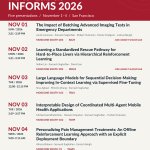
📣📣📣 Join us for my group’s talks at #INFORMS2026 annual meeting. Two super star PhD students are on the job market and will present in the Job Market Showcase.

We are ready for #INFORMS2026
Five talks spanning ED imaging, liver transplantation, LLMs, mobile health, and personalized pain management.
Find us Nov 1–4 in San Francisco

PIAS Lab retweeted

🚨I am on the 26-27 academic job market🚨
I will be presenting my JMP at #INFORMS2026 on Sunday as part of the Job Market Showcase session on “AI and Queueing Analytics in Healthcare”
If you are going to be @INFORMS I would love to connect!
papers.ssrn.com/sol3/papers.…

We are ready for #INFORMS2026
Five talks spanning ED imaging, liver transplantation, LLMs, mobile health, and personalized pain management.
Find us Nov 1–4 in San Francisco
We are ready for #INFORMS2026
Five talks spanning ED imaging, liver transplantation, LLMs, mobile health, and personalized pain management.
Find us Nov 1–4 in San Francisco
PIAS Lab retweeted
📚 What is 𝐚𝐧𝐚𝐥𝐲𝐭𝐢𝐜𝐬 𝐬𝐜𝐢𝐞𝐧𝐜𝐞, and can it lead to better solutions for society's hardest problems?
I'm excited to join @INFORMS for a FREE virtual Book Talk on my book, "𝐈𝐧𝐬𝐢𝐠𝐡𝐭-𝐃𝐫𝐢𝐯𝐞𝐧 𝐏𝐫𝐨𝐛𝐥𝐞𝐦 𝐒𝐨𝐥𝐯𝐢𝐧𝐠: 𝐀𝐧𝐚𝐥𝐲𝐭𝐢𝐜𝐬 𝐒𝐜𝐢𝐞𝐧𝐜𝐞 𝐭𝐨 𝐈𝐦𝐩𝐫𝐨𝐯𝐞 𝐭𝐡𝐞 𝐖𝐨𝐫𝐥𝐝." 🎉
Data is everywhere, but insight is rare. Too often, AI and analytics produce impressive models or solutions that never change a decision. In this talk, I'll share how an 𝐢𝐧𝐬𝐢𝐠𝐡𝐭-𝐝𝐫𝐢𝐯𝐞𝐧 𝐚𝐩𝐩𝐫𝐨𝐚𝐜𝐡 can bridge that gap and help us tackle today's challenges and tomorrow's opportunities, from healthcare to public policy and beyond. 🌍
💡 What we'll discuss:
🔹 Why insight, not just data, drives real impact
🔹 How AI and analytics can address pressing societal problems
🔹 Where AI and analytics meet real-world decision-making
🔹 Your questions, in an open, live conversation
🗓️ Wednesday, October 7, 2026
⏰ 12:00–1:00 p.m. ET
💻 Virtual (Zoom)
🎟️ Free and open to all
Whether you're a researcher, student, practitioner, or policymaker, or just curious about using analytics to make the world better, I'd love to see you there. 🙌
👉 Register here: connect.informs.org/discussi…
♻️ Please share with colleagues and students who might find it valuable!
#INFORMS #Analytics #OperationsResearch #DataScience #DecisionMaking #PublicPolicy #ProblemSolving #BookTalk #AI
PIAS Lab retweeted
🎉 After 11 incredible years @Harvard I'm starting a new chapter.
I've sat with this post for a few months, wanting to get it right—because it marks the end of something wonderful and the start of something I'm 𝐠𝐞𝐧𝐮𝐢𝐧𝐞𝐥𝐲 𝐞𝐱𝐜𝐢𝐭𝐞𝐝 about.
After 11 wonderful years at @Harvard I've joined @SmithSchool and the Artificial Intelligence Interdisciplinary Institute at Maryland (AIM) at @UofMaryland. These two appointments will let me pursue the intersections that matter most to me and expand the reach and impact of the work I care about.
To my incredible colleagues, students, senior fellows, and postdocs at my lab—the @PIASLab @HarvardBizGov—thank you! I learned as much from you as I hope you learned from me, and these 11 years shaped me in ways I'm still discovering. 🙏
I won't pretend this was a simple decision. The political environment at @Harvard over the past few years affected many scholars, and it is never easy to get over unjust decisions. But I'm grateful to have found a new intellectual home, and I'm looking forward to learning from remarkable colleagues at Smith, AIM, and across the University of Maryland campus.
Onward to what's next. 🚀
PIAS Lab retweeted
⏱️ 11 𝐦𝐢𝐧𝐮𝐭𝐞𝐬 (4.2%) reduction---> Real-world impact of analytics science with zero capacity investment.
That's how much shorter the average ER visit became at @MayoClinic Clinic— with no new beds, no new hires, no new software, and no new IT integration. Just a better decision about where each patient should be seen, suggested by analytics science and proved via a 𝐩𝐫𝐨𝐬𝐩𝐞𝐜𝐭𝐢𝐯𝐞 𝐛𝐞𝐟𝐨𝐫𝐞-𝐚𝐧𝐝-𝐚𝐟𝐭𝐞𝐫 𝐟𝐢𝐞𝐥𝐝 𝐭𝐫𝐢𝐚𝐥.
🎉 I'm thrilled to share that our study, "Vertical Patient Streaming in Emergency Departments," is now published in 𝐌𝐚𝐧𝐚𝐠𝐞𝐦𝐞𝐧𝐭 𝐒𝐜𝐢𝐞𝐧𝐜𝐞.
Here's why I think it matters. 👇
🏥 Most EDs already have a "vertical" area — a seated treatment space for patients who don't need to occupy a bed. But the decision about who goes there is usually made ad hoc, in the middle of a busy shift, with no consistent logic behind it. That variability quietly costs hospitals enormous capacity.
So we asked a simple question: can we make that one decision better?
🤖 Our team analyzed nearly 50,000 ED visits to build a machine learning model that predicts — using only what's already captured at triage — whether a patient will ultimately need a bed. We fed those risk scores into a stochastic patient-flow model to derive the optimal routing policy. Then we did the hardest part: we compressed all of it into a decision tree a clinician can actually use at 2 a.m.
📊 Then we tested it in the real world — a 13-week prospective before-and-after field trial with 11,015 patients in Mayo Clinic Arizona's new emergency department:
✅ 11-minute (4.2%) reduction in total ED length of stay ✅ 8-minute (4.5%) reduction in time from arrival to disposition ✅ No increase in 72-hour return visits — safety fully maintained
Scaled to a medium-sized ED seeing ~40,000 patients a year, that's roughly 6,800 bed-hours recovered annually — capacity for about 2,000 additional patients and an estimated $3M in additional reimbursement. Without a single new bed. 🛏️❌
🙏 None of this happens alone. My deepest thanks to my brilliant co-authors from the @PIASLab and @MayoClinic: Arshya Feizi, Agni Orfanoudaki, Wayne Martini, and @nhodgsonem— to @INFORMS for highlighting our work and to the physicians, nurses, and triage staff who didn't just let us study their ED, but helped us redesign it. A model doesn't save a minute of anyone's time until a clinician trusts it enough to use it.
📄 Read the full paper in Management Science: pubsonline.informs.org/doi/1…
#Analytics #MachineLearning #HealthcareAnalytics #OperationsResearch #EmergencyMedicine #PatientFlow #HealthcareInnovation #INFORMS #ManagementScience #PIASLab

Press Release: Simple Triage Protocol Cuts ER Wait Times Without Adding Beds or Staff, New Study Finds [INFORMS journal Management Science] 🔗 hubs.ly/Q04rpwJ30
.@Soroush_Saghaf: “Sometimes the greatest opportunity comes from using existing resources more intelligently.”
👏 👏 👏
Press Release: Simple Triage Protocol Cuts ER Wait Times Without Adding Beds or Staff, New Study Finds [INFORMS journal Management Science] 🔗 hubs.ly/Q04rpwJ30
PIAS Lab retweeted

Press Release: Simple Triage Protocol Cuts ER Wait Times Without Adding Beds or Staff, New Study Finds [INFORMS journal Management Science] 🔗 hubs.ly/Q04rpwJ30
PIAS Lab retweeted
I will be at @INFORMS #healthcare2026 presenting my joint work with @PIASLab and @DanaFarber. In this paper we introduce a counterfactual decision making framework for evaluating treatment-guiding biomarkers in oncology.
ALSO... im on the academic job market!

PIAS Lab retweeted
Thank you @ICS_Informs for highlighting this paper (published by Management Science) as part of the @INFORMS Harvey J. Greenberg Research Award research highlights. Grateful to be included among the top three papers that were selected for the award.
Full paper: pubsonline.informs.org/doi/a…
#ReinforcementLearning #AI #CausalInference #CausalAI #MedicalAI

PIAS Lab retweeted
Can an LLM learn to make good sequential decisions?
That's the question behind my latest #PIAS #blog post, "𝐏𝐫𝐞𝐩𝐚𝐫𝐢𝐧𝐠 𝐀𝐈 𝐟𝐨𝐫 𝐒𝐞𝐪𝐮𝐞𝐧𝐭𝐢𝐚𝐥 𝐃𝐞𝐜𝐢𝐬𝐢𝐨𝐧-𝐌𝐚𝐤𝐢𝐧𝐠 — 𝐚𝐧𝐝 𝐖𝐡𝐲 𝐈𝐭 𝐌𝐚𝐭𝐭𝐞𝐫𝐬."
Most of the excitement around LLMs has focused on one-shot tasks: classification, translation, a clever answer to a single prompt. But the decisions that matter most in the real world don't work that way.
In our recent work, we asked a simple question: can we equip a pretrained LLM to make good sequential decisions from offline data — and can we understand why it works?
A few takeaways:
🔹 Instead of building a specialized model from scratch, we fine-tune an open-source pretrained LLM so it can read a handful of demonstrations and act in a new, unseen task — no further updates needed at test time.
🔹 We don't stop at intuition. For linear MDPs, we look inside the attention layer and show it behaves like an implicit estimator of the optimal value function, with a clean theoretical bound on how far the learned policy can fall short of optimal.
🔹 We tackle the hard, realistic cases — not just fully observable settings, but partial observability and genuine model ambiguity, which are the norm in medicine, not edge cases.
🔹 The gains are largest exactly where they're hardest to get. On a sparse-reward task with hidden goals, the approach reaches ~95% of oracle performance on held-out goals.
If you care about where AI is heading — beyond chatbots and toward robust, data-efficient decision support in high-stakes domains like healthcare — I think you'll find this one worth a read. It sits right at the intersection of LLMs, reinforcement learning, and real clinical problems.
📖 Read the full post here: soroushsaghafian.com/prepari…
I'd love to hear your thoughts — especially from those working on decision-making under uncertainty.
#AI #MachineLearning #LLMs #Healthcare #ReinforcementLearning #DecisionMaking #ArtificialIntelligence

.@PIASLab director, @Soroush_Saghaf, recently lead a workshop on artificial intelligence, machine learning, and their implications for public policy
Thank you to everyone who participated!

PIAS Lab retweeted
🚨 New research: Can LLMs be used for 𝐬𝐞𝐪𝐮𝐞𝐧𝐭𝐢𝐚𝐥 𝐝𝐞𝐜𝐢𝐬𝐢𝐨𝐧-𝐦𝐚𝐤𝐢𝐧𝐠 in complex, ambiguous environments?
Our new paper — Large Language Models for Sequential Decision-Making: Improving In-Context Learning via Supervised Fine-Tuning — shows the answer is yes, and the gains are substantial.
Most AI decision-making research assumes the world is fully observable and unambiguous. Real-world problems — especially in domains such as healthcare — are neither. Our framework fine-tunes a pretrained LLM (Llama-2-7B) on offline, oracle-labeled trajectories so it can tackle MDPs, POMDPs, and Ambiguous POMDPS (APOMDPs): settings with partial observability and model ambiguity.
💡 Key findings:
→ SFT slashes the optimality gap from 43% → 15% vs. random baselines in long-horizon MDPs
→ In partially observed and ambiguous environments, fine-tuned LLMs outperform ICL-only baselines and DPT by up to 15 percentage points
→ On the Darkroom navigation task, our model achieves ~95% of oracle performance
→ Robust to out-of-distribution conditions — strong generalization without retraining
📐 On the theory side, we interpret the fine-tuned attention mechanism as implicitly estimating optimal Q-functions, and derive an end-to-end suboptimality bound that cleanly separates in-context estimation error from training-length bias.
This matters deeply for use in areas such as healthcare, where experimentation is costly or unethical and offline observational data are abundant. Our goal: give clinicians AI systems that reason under genuine uncertainty — not just clean textbook settings.
Huge congratulations to my current and former lab members Minmin Zhang and @aghaei_sina on this work!
📄 Read the paper: arxiv.org/abs/2605.09009
#ArtificialIntelligence #MachineLearning #LLM #ReinforcementLearning #Healthcare #DecisionMaking #Research #Sequential

PIAS Lab retweeted
How can we make #AI impactful in #healthcare? Looking forward to this event hosted by @UICmedicine where I will be sharing some thoughts and answers.
Join @PIASLab director, @Soroush_Saghaf, for the May Virtual Seminar hosted by @UICmedicine AI.Health4All
Making Al Impactful in Healthcare
📅 May 20, 2026
🕒 3–4 PM ET
medicine.uic.edu/events/ai-h…

Will you be at the Annual @POM_Society Conference?
@PIASLab member @JacobCJameson will be presenting his JMP with @Soroush_Saghaf on image batching in EDs 🩻🏥

Excited to present my *job market paper* at the Annual @POM_Society Conference 2026 this Sunday morning!
“The Impact of Batching Advanced Imaging Tests in Emergency Departments”
Joint work w/ @Soroush_Saghaf, @robert_huckman, @nhodgsonem, and Joshua Baugh. 1/n🧵

Join @PIASLab director, @Soroush_Saghaf, for the May Virtual Seminar hosted by @UICmedicine AI.Health4All
Making Al Impactful in Healthcare
📅 May 20, 2026
🕒 3–4 PM ET
medicine.uic.edu/events/ai-h…
Work by @Mohammad_Zhale & @Soroush_Saghaf (@PIASLab) will be at @nberpubs AI in Healthcare conference (May 7–8, Cambridge)
"Harmonizing Safety & Speed: A Human-Algorithm Approach to FDA Device Clearance"
nber.org/conferences/applica…
PIAS Lab retweeted
“Let’s talk about data”📊
#Analytics #Sience (including #AI as one of its many branches) can help you improve the world and solve real-world problems. If you are interested, check out this short video and the book (Amazon: a.co/d/01AGVvdZ).
📺📺: youtube.com/shorts/MU9MS-WSO…
AI in healthcare needs to move beyond prediction → decision-making.
@Soroush_Saghaf will share how causal AI + “centaur” models (human + algorithm) can improve clinical care at the CPA Speaker Series @UAlbertaBiz.
📅 Apr 10, 2026
🕙 10–11:30 AM
📍 BUS 4-06

