

Crypto Enthusiasts || Degen Trader ||Content Writer ||Ambassador|| COO Deneo Farms|| Space Host/ Growth Advisor VALVOR||Professional NFT Seller
Maryland
Joined May 2010
- Tweets38K
- Following1.8K
- Followers1.2K
- Likes38.6K





Paris.TGN retweeted

Monetary Systems and the Real Economy
In macro-economics, the monetary system rests on two key institutions:
- The Central Bank manages the overall money supply, sets policy rates, and safeguards the stability of the financial system.
- Commercial banks take deposits, provide credit, and channel savings into productive use across the economy.
Both depend heavily on the performance of the real economy. When households and businesses generate rising and reliable profits, deposits grow. When deposits grow, banks have a stronger base from which to extend credit. When credit supports further productive activity, the cycle of economic expansion continues. When the real economy remains weak and fragmented, this cycle stays limited.
Agriculture as the missing foundation
In Nigeria and across much of Africa, agriculture is the largest employer. Yet much of it has remained low in productivity, poorly organised, and weakly connected to formal financial systems. Farm incomes are often irregular. Surpluses are small or inconsistent. As a result, the contribution of the agricultural sector to bank deposits and to the broader monetary system has stayed far below its potential.
How DeNeo-ReFi raises agro profit yields and strengthens the monetary base
DeNeo-ReFi is building a complete parent infrastructure system that organises African agriculture into a coherent Agro-Macro industry. By raising productivity, improving market access, and stabilising incomes, we increase the real profits generated by farming households and related activities. Higher and more reliable profits create the conditions for greater savings and formal financial participation.
This is how the system operates:
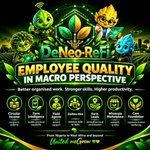
* Circular Income provides daily financial stability to farmers, consumers, and operational workers including Agro-scientists, Agro-Workers, and Field Agents as they complete their workflows. Regular support reduces pure survival pressure and creates the first space for surplus to emerge.
* Reassurance + Farm-from-Home Intelligence raises productivity through practical agro-scientific guidance. Higher output increases the potential for profit on every farm.
* Field Agents extend knowledge and support to farmers without smartphones, ensuring productivity gains reach the widest possible base.
* DeNeo-Hire allows labour and tools to be requested and rendered digitally through the system, raising efficiency and reducing waste that erodes margins.
* Farm Leads create local leadership and coordination structures that improve planning and collective performance.
* Digital Wholesale Marketplace connects organised produce to real demand. Reliable market access turns higher production into actual sales and profit rather than post-harvest loss.
* Owned and partnered farms + processing facilities add value and higher operational standards. Processing raises the economic return of agricultural output and expands the formal footprint of the sector.
* Care Foundation protects the human foundation so that families remain stable enough to sustain long-term productive participation.
The contribution to commercial banks and the wider monetary system
As farm profits become more consistent and more formal, a growing share of that surplus can enter the banking system as deposits. Rising deposits strengthen the capacity of commercial banks to intermediate credit. A stronger commercial banking base supports the broader monetary system overseen by the Central Bank. The improvement is not created by policy declaration alone it is created by the expansion of real economic surplus in the largest employment sector.
Economic improvement and scalability
The result is a more productive agricultural base, higher household incomes, greater formal financial participation, and a stronger foundation for credit and investment across the economy. As the system scales from its starting point in Nigeria into West Africa and beyond, the same logic multiplies: more organised output, more reliable profits, deeper deposits, and a more resilient real-economy contribution to the monetary system.
The position we occupy
DeNeo-ReFi functions as a private-sector Agro-Macro industry and a practical engine of agricultural organisation. We do not replace the Central Bank or commercial banks. We strengthen the real-economy foundation on which their effectiveness ultimately depends.
We begin in Nigeria.
Our direction is West Africa and beyond.
By raising the profit yields of agriculture through structured infrastructure, DeNeo-ReFi helps turn the largest employer into a stronger contributor to savings, banking capacity, and national economic progress.
This is how an Agro-Macro industry serves both the farm and the monetary system.
United weGrow 💚💛
#FarmingTips

Paris.TGN retweeted
Money Growth, Inflation, and the Need for Real Macro-Industries
In macro-economics the relationship is clear:
When the money supply rises faster than the real goods and services an economy can produce, inflation follows. Prices climb. The purchasing power of every unit of currency falls. At its peak, this process turns daily life into a continuous struggle food costs more, transport costs more, and the same income buys less than it did before.
When governments respond primarily by printing more money, the pressure intensifies. When bank credit is already running low, businesses and households find it harder to access the funds they need to produce, expand, or simply hold steady. The result is a painful combination: rising prices on one side and restricted credit on the other.
This is not abstract theory. It is the lived experience of millions across Africa today.
Why functioning Macro-industries are necessary
Monetary tools alone cannot protect the population from the full force of these pressures. Central banks manage the money supply. Commercial banks intermediate credit. But the real cushion for ordinary people comes from the productive capacity of the economy itself.
When sectors are organised, productive, and generating real surplus, two things happen:
- More goods and services enter the market, which helps moderate price pressure.
- More households and enterprises earn more reliable income, which strengthens their ability to absorb shocks.
Without strong Macro-industries organised systems that raise output and formal participation across key sectors the population feels every rise in the money supply more sharply. Agriculture, as the largest employer, is the most critical of these foundations.
How DeNeo-ReFi stands with agriculture and its people
DeNeo-ReFi is building a complete parent infrastructure system that organises African agriculture into a coherent Agro-Macro industry. We operate as a hybrid system: practical agricultural infrastructure combined with Blockchain verification of transactions and workflows for transparency and accountability.
This is how we work:
* Circular Income provides daily financial stability to farmers, consumers, and operational workers including Agro-scientists, Agro-Workers, and Field Agents as they complete their workflows. In times of rising prices, this daily support helps households maintain a basic floor of security.
* Reassurance + Farm-from-Home Intelligence raises productivity through practical agro-scientific guidance. Higher output means more food and more potential income from the same land a direct counter to scarcity pressures.
* Field Agents extend knowledge and support to farmers without smartphones, ensuring that productivity gains reach the widest possible base.
* DeNeo-Hire allows labour and tools to be requested and rendered digitally through the system, improving efficiency and protecting the value of every hour worked.
* Farm Leads create local leadership and coordination structures that organise effort and reduce waste.
* Digital Wholesale Marketplace connects organised produce to real demand, so higher production turns into actual sales rather than post-harvest loss.
* Owned and partnered farms + processing facilities add value and higher operational standards, increasing the economic return of agricultural activity.
* Care Foundation protects the human foundation so that families remain stable enough to keep producing and participating even under economic stress.
* Blockchain verification secures transactions and workflows, building trust and accountability across the system.
The difference this makes
When agriculture remains fragmented, rising money supply and tight credit hit farming households and food consumers with full force. When agriculture is organised and productive, the same pressures are met with greater output, more stable incomes, and stronger local economic activity. The population still feels the difficulty but it does not face it alone or without structural support.
DeNeo-ReFi does not control the money supply. We strengthen the real economy that must live with the consequences of monetary expansion. By raising the productive power of Africa’s largest employer, we help agriculture and its people stand more firmly in challenging times.
We begin in Nigeria.
Our direction is West Africa and beyond.
A functioning Agro-Macro industry cannot remove every hardship created by rapid money growth. But it can ensure that the people who feed the nation are not left without systems, support, or rising capacity when those pressures arrive.
This is why Macro-industries matter and why we are building one in agriculture.
United weGrow 💚💛
Paris.TGN retweeted

Beautiful morning 🌻 Grow Economic Family 💚💛
Thank you @DENEO_FARM we are proud to walk this path with you.
United weGrow 💚💛

Consider a season in which broader inflation is pushing up the cost of transport and inputs. Without organised systems, many farmers reduce planting or lose a large share of their harvest to poor handling and weak market access. Food supply tightens and prices rise further.
With DeNeo-ReFi layers active, the same farmers receive daily stability, practical guidance that improves yields, efficient access to labour and tools, coordinated local leadership, and a direct digital path to buyers. Processing facilities reduce losses. More food reaches the market in better condition. The increased and more reliable supply exerts downward pressure on food-price inflation even while broader monetary pressures continue.
The wider vision
We begin in Nigeria.
Our direction is West Africa and beyond.
DeNeo-ReFi does not control the money supply. We strengthen the real productive capacity of the sector that feeds the nation. By raising agricultural output, reducing waste, and organising the supply chain, we help create the conditions in which food-price inflation can be moderated through genuine increases in supply and efficiency.
This is the contribution of a working Agro-Macro industry: it stands with the people who grow the food and builds the systems that make their increased productivity a stabilising force for the wider economy.
United weGrow Bigger!
Follow, like, comment, retweet, and bookmark. If you want to learn more about us check out our main page @DENEO_FARM

Deflation, Inflation, and the Power of a Working Agro-Macro Industry
In macro-economics, inflation and deflation describe the movement of the general price level.
Inflation is a sustained rise in prices.
Deflation is a sustained fall in prices.
Inflation becomes damaging when it rises faster than the real capacity of the economy to produce goods and services. Common causes include:
Rapid growth in the money supply without matching growth in real output
Supply shocks that reduce the availability of essential goods (especially food and fuel)
Rising production costs that are passed on to consumers
Weak productivity in key sectors that keep supply chronically below demand
When these forces combine, the purchasing power of money falls and daily life becomes more expensive for everyone.
The specific damage to agriculture and its supply chain
Agriculture is particularly vulnerable. Rising input costs (seeds, fertiliser, fuel, transport, and tools) squeeze farmers’ margins. Post-harvest losses become more painful because every unit of wasted produce represents higher sunk costs. Transport and logistics grow more expensive, disrupting the movement of food from farm to market. Consumers face higher food prices, which reduces demand for anything beyond basic staples. Farmers who cannot cover rising costs often reduce production or exit the sector entirely. The entire supply chain from production to processing to distribution operates under greater stress, and food insecurity risks rise.
How a working Agro-Macro industry contributes to easing inflationary pressure
The most durable way to moderate food-price inflation is to raise real agricultural productivity and the efficiency of the supply chain. When more food is produced, losses are reduced, and produce moves more efficiently to market, the supply side of the economy strengthens. Stronger supply helps limit the upward pressure on prices.
DeNeo-ReFi is building exactly this kind of system. We operate as a complete parent infrastructure for African agriculture a hybrid Agro-Macro industry that combines practical field systems with Blockchain verification of transactions and workflows for transparency and accountability.
This is how we work:
Circular Income provides daily financial stability to farmers, consumers, and operational workers including Agro-scientists, Agro-Workers, and Field Agents as they complete their workflows. Stability keeps people producing even when broader prices are rising.
Reassurance + Farm-from-Home Intelligence raises productivity through practical agro-scientific guidance. Higher yields from the same land increase real food supply.
Field Agents extend knowledge and support to farmers without smartphones, ensuring productivity gains reach the widest possible base.
DeNeo-Hire allows labour and tools to be requested and rendered digitally through the system, improving efficiency and reducing costly delays.
Farm Leads create local leadership and coordination structures that organise production and reduce waste.
Digital Wholesale Marketplace connects organised produce to real demand, shortening the path from farm to buyer and cutting unnecessary cost layers.
Owned and partnered farms + processing facilities add value and higher operational standards, reducing post-harvest losses and improving the consistency of supply.
Care Foundation protects the human foundation so that farming families remain able to keep producing under economic pressure.
Blockchain verification secures transactions and workflows, building trust and reducing friction across the chain.
A practical logical example
Consider a season in which broader inflation is pushing up the cost of transport and inputs. Without organised systems, many farmers reduce planting or lose a large share of their harvest to poor handling and weak market access. Food supply tightens and prices rise further.
With DeNeo-ReFi layers active, the same farmers receive daily stability, practical guidance that improves yields, efficient access to labour and tools, coordinated local leadership, and a direct digital path to buyers. Processing facilities reduce losses. More food reaches the market in better condition. The increased and more reliable supply exerts downward pressure on food-price inflation even while broader monetary pressures continue.
The wider vision
We begin in Nigeria.
Our direction is West Africa and beyond.
DeNeo-ReFi does not control the money supply. We strengthen the real productive capacity of the sector that feeds the nation. By raising agricultural output, reducing waste, and organising the supply chain, we help create the conditions in which food-price inflation can be moderated through genuine increases in supply and efficiency.
This is the contribution of a working Agro-Macro industry: it stands with the people who grow the food and builds the systems that make their increased productivity a stabilising force for the wider economy.
United weGrow Bigger!
Follow, like, comment, retweet, and bookmark. If you want to learn more about us check out our main page @DENEO_FARM
Money Growth, Inflation, and the Need for Real Macro-Industries
In macro-economics the relationship is clear:
When the money supply rises faster than the real goods and services an economy can produce, inflation follows. Prices climb. The purchasing power of every unit of currency falls. At its peak, this process turns daily life into a continuous struggle food costs more, transport costs more, and the same income buys less than it did before.
When governments respond primarily by printing more money, the pressure intensifies. When bank credit is already running low, businesses and households find it harder to access the funds they need to produce, expand, or simply hold steady. The result is a painful combination: rising prices on one side and restricted credit on the other.
This is not abstract theory. It is the lived experience of millions across Africa today.
Why functioning Macro-industries are necessary
Monetary tools alone cannot protect the population from the full force of these pressures. Central banks manage the money supply. Commercial banks intermediate credit. But the real cushion for ordinary people comes from the productive capacity of the economy itself.
When sectors are organised, productive, and generating real surplus, two things happen:
More goods and services enter the market, which helps moderate price pressure.
More households and enterprises earn more reliable income, which strengthens their ability to absorb shocks.
Without strong Macro-industries organised systems that raise output and formal participation across key sectors the population feels every rise in the money supply more sharply. Agriculture, as the largest employer, is the most critical of these foundations.
How DeNeo-ReFi stands with agriculture and its people
DeNeo-ReFi is building a complete parent infrastructure system that organises African agriculture into a coherent Agro-Macro industry. We operate as a hybrid system: practical agricultural infrastructure combined with Blockchain verification of transactions and workflows for transparency and accountability.
This is how we work:
Circular Income provides daily financial stability to farmers, consumers, and operational workers including Agro-scientists, Agro-Workers, and Field Agents as they complete their workflows. In times of rising prices, this daily support helps households maintain a basic floor of security.
Reassurance + Farm-from-Home Intelligence raises productivity through practical agro-scientific guidance. Higher output means more food and more potential income from the same land a direct counter to scarcity pressures.
Field Agents extend knowledge and support to farmers without smartphones, ensuring that productivity gains reach the widest possible base.
DeNeo-Hire allows labour and tools to be requested and rendered digitally through the system, improving efficiency and protecting the value of every hour worked.
Farm Leads create local leadership and coordination structures that organise effort and reduce waste.
Digital Wholesale Marketplace connects organised produce to real demand, so higher production turns into actual sales rather than post-harvest loss.
Owned and partnered farms + processing facilities add value and higher operational standards, increasing the economic return of agricultural activity.
Care Foundation protects the human foundation so that families remain stable enough to keep producing and participating even under economic stress.
Blockchain verification secures transactions and workflows, building trust and accountability across the system.
The difference this makes
When agriculture remains fragmented, rising money supply and tight credit hit farming households and food consumers with full force. When agriculture is organised and productive, the same pressures are met with greater output, more stable incomes, and stronger local economic activity. The population still feels the difficulty but it does not face it alone or without structural support.
DeNeo-ReFi does not control the money supply. We strengthen the real economy that must live with the consequences of monetary expansion. By raising the productive power of Africa’s largest employer, we help agriculture and its people stand more firmly in challenging times.
We begin in Nigeria.
Our direction is West Africa and beyond.
A functioning Agro-Macro industry cannot remove every hardship created by rapid money growth. But it can ensure that the people who feed the nation are not left without systems, support, or rising capacity when those pressures arrive.
This is why Macro-industries matter and why we are building one in agriculture.
United weGrow Bigger!
Follow, like, comment, retweet, and bookmark. If you can want to learn more about us, check out our main page @DENEO_FARM

Paris.TGN retweeted

What could be more cheering than having put in your effort in farming and then having a larger and huge yield?
In Nigeria, there are limitations to ensuring a safe farming season.
@DENEO_FARM got the vision and brought it to Nigeria, it is time we join🤝 and protect our farm

Paris.TGN retweeted
Central Bank Objectives and the Real Economy
Central banks are mandated to pursue three core objectives:
- Stable money protecting the purchasing power of the currency so that prices remain reasonably predictable.
- Stable financial and banking system ensuring banks and financial institutions remain sound and able to intermediate savings into productive use.
- Stable exchange rate maintaining a workable relationship between the domestic currency and others so that trade, investment, and planning can occur with less disruption.
When these objectives are under pressure, the effects are felt by everyone.
What happens when the objectives weaken
When money loses stability, prices rise faster than incomes. Households struggle to afford food, transport, and basic needs. Savings lose value. Businesses face rising costs and uncertain planning.
When the financial and banking system is strained, credit becomes scarce or expensive. Farmers, small enterprises, and families find it harder to access the funds they need to produce, expand, or smooth difficult periods.
When the exchange rate is highly unstable, the cost of imported inputs rises sharply. Agricultural tools, fertiliser, machinery, and processing equipment become more expensive. Exporters face uncertainty. The entire productive sector operates under greater stress.
These pressures are visible in Nigeria and in many other nations. They are not abstract. They appear in higher food prices, tighter household budgets, cautious investment, and the quiet erosion of confidence in the future.
Why Nigeria needs working Macro industries
Monetary policy alone cannot carry the full weight of national strength. Central banks manage the monetary framework. The real economy must generate the surplus, productivity, and formal activity that make stable money, sound banking, and a workable exchange rate more achievable over time.
Nigeria needs working Macro industries across sectors organised systems that raise output, create reliable income, expand formal participation, and strengthen the foundation on which the monetary system rests. Agriculture, as the largest employer, is the natural starting point.
How DeNeo-ReFi contributes as the Agro-Macro industry
DeNeo-ReFi is building a complete parent infrastructure system that organises African agriculture into a coherent and productive Agro-Macro industry. We operate as a hybrid system: practical agro-infrastructure combined with Blockchain verification of transactions and workflows for transparency and accountability.
This is how we work:
* Circular Income provides daily financial stability to farmers, consumers, and operational workers including Agro-scientists, Agro-Workers, and Field Agents as they complete their workflows.
* Reassurance + Farm-from-Home Intelligence raises productivity through practical agro-scientific guidance.
* Field Agents extend knowledge and support to farmers without smartphones.
* DeNeo-Hire allows labour and tools to be requested and rendered digitally through the system.
* Farm Leads create local leadership and coordination structures.
* Digital Wholesale Marketplace connects organised produce to real demand.
* Owned and partnered farms + processing facilities add value and higher operational standards.
* Care Foundation protects the human foundation so that families remain stable enough to sustain long-term participation.
* Blockchain verification secures transactions and workflows, adding an immutable layer of trust across the system.
By raising agricultural productivity, stabilising incomes, improving market access, and expanding formal economic activity, DeNeo-ReFi increases the real surplus generated by the largest employment sector. Higher and more reliable farm and related profits strengthen the base from which savings, deposits, and broader economic resilience can grow. A stronger real economy gives the monetary system more to work with.
Why this is everyone’s task
Stable money, sound banks, and a workable exchange rate are not the responsibility of the Central Bank alone. They are the shared outcome of a productive nation. When agriculture remains fragmented, the foundation stays weak. When agriculture becomes organised and productive, the entire economy gains strength.
DeNeo-ReFi is already building that organisation in agriculture. We begin in Nigeria. Our direction is West Africa and beyond.
Understanding what we are doing is the first step. Joining the work is the next.
We are building a United Nigeria in Agriculture.
United weGrow 💚💛🌱

Why Building a United Nigeria for Agriculture Is All We Need to Make Everything Right
Imagine a great house with many rooms.
In one room the children are hungry.
In another room the young men sit idle, their hands strong but empty of purpose.
In a third room the mothers stretch the same small meal across too many plates.
In a fourth room the elders watch the land they once trusted grow quieter each year.
And in the centre of the house, the foundation itself is cracked not dramatically, not all at once, but slowly, steadily, in ways that make every other room unstable.
That house is a nation.
And the cracked foundation is agriculture left fragmented, under-supported, and disconnected from the systems that could make it strong.
For too long we have tried to repair the rooms while ignoring the foundation. We have spoken of jobs without speaking of the sector that already employs the largest number of people. We have spoken of food prices without speaking of the productivity of those who grow the food. We have spoken of youth restiveness without speaking of the quiet despair that settles on young people when the land of their fathers offers them no clear future. We have spoken of national strength while the largest economic activity in the country remained scattered, seasonal, and largely unsupported by coherent infrastructure.
The truth is simple and difficult at the same time: until agriculture is organised, united, and raised to its proper place, every other effort remains incomplete. A nation cannot stand firmly on a foundation it refuses to strengthen.
This is why building a United Nigeria for agriculture is not one option among many. It is the work that makes every other work possible.
When farming households move from pure survival to daily stability, children eat more regularly and learn with less hunger in their stomachs. When knowledge reaches even those without smartphones, productivity rises and the same land begins to give more. When labour and tools can be matched efficiently, effort is no longer wasted. When local leadership grows from within communities, people stop waiting for distant solutions and begin building their own. When produce finds reliable markets and processing adds value, income becomes more than a seasonal hope. When the human side of families is protected, people remain able to stay and grow instead of being forced into constant short-term escape. And when every important transaction and workflow is verified with transparency, trust becomes possible at scale.
These are not separate interventions. They are the layers of one coherent system a hybrid Agro-Macro industry that combines practical agricultural infrastructure with Blockchain verification for accountability. This is the work of DeNeo-ReFi.
We do not claim to fix every problem in the nation by ourselves. We claim something more precise and more powerful: we are organising the foundation. We are turning the largest employer into a structured engine of productivity, income, and participation. We are creating the conditions in which young people can see a future on the land or connected to it, in which households can plan beyond the next harvest, and in which the real economy begins to generate the surplus that strengthens everything else savings, banking capacity, food security, and social stability.
A United Nigeria for agriculture does not mean that every citizen must become a farmer. It means that the nation finally treats agriculture as the shared foundation it has always been. It means that the boy in the village and the girl in the city both inherit a country where the land is no longer a place of quiet defeat but a place of organised possibility. It means that the energy of the youth, the knowledge of those who understand the soil, the labour of those willing to work, and the markets that can absorb what is produced are no longer scattered in isolation from one another.
When the foundation is strengthened, the rooms of the house begin to settle. Hunger loses some of its sharpness. Idleness loses some of its grip. Families breathe with less fear. The future stops feeling like a threat and starts feeling like a responsibility worth carrying.
This is the uniqueness of what we are building. Not another temporary project. Not another isolated intervention. A complete parent infrastructure system that organises knowledge, labour, tools, markets, leadership, value addition, human care, and transparent verification into one living structure. We begin in Nigeria. Our direction is West Africa and beyond.
Building a United Nigeria for agriculture will not make everything perfect overnight. But it will make everything possible. It will give the nation a foundation strong enough to carry the weight of its people and the height of their ambitions.
The house has waited long enough.
The foundation is ready to be rebuilt together.
United weGrow Bigger!
Follow, like, comment, retweet, and bookmark. If you want to learn more about us check out our main page @DENEO_FARM

Paris.TGN retweeted
This is purely how we supporting the central bank of Nigeria through @DENEO_FARM for the banking system needs infrastructures like us to keep the system strong never like before.
United weGrow 💚💛
By raising agricultural productivity, stabilising incomes, improving market access, and expanding formal economic activity, DeNeo-ReFi increases the real surplus generated by the largest employment sector. Higher and more reliable farm and related profits strengthen the base from which savings, deposits, and broader economic resilience can grow. A stronger real economy gives the monetary system more to work with.
*Why this is everyone’s task*
Stable money, sound banks, and a workable exchange rate are not the responsibility of the Central Bank alone. They are the shared outcome of a productive nation. When agriculture remains fragmented, the foundation stays weak. When agriculture becomes organised and productive, the entire economy gains strength.
DeNeo-ReFi is already building that organisation in agriculture. We begin in Nigeria. Our direction is West Africa and beyond.
Understanding what we are doing is the first step. Joining the work is the next.
We are building a United Nigeria in Agriculture.
United weGrow Bigger!
Follow, like, comment, retweet, and bookmark. To learn more more about us, check out our main page @DENEO_FARM.

Paris.TGN retweeted
The story of the boy and the girl @DENEO_FARM this is a very beautiful one we all should give attention to, so we can learn more.
United weGrow 💚💛
They understood that what the earth produced could be connected to real demand instead of being left to chance.
They understood that someone was paying attention to the people, not only to the crops.
As the seasons passed, Chike stopped asking whether he would farm. He began asking how he could farm better. He began to see the land not as a burden inherited from the past, but as a responsibility that could carry a future. Amara stopped whispering her fears into the dark. She began to speak of possibilities of learning, of contributing, of building something that would still be standing when she had children of her own.
Their story is not unique because the pain was special. The pain was common. What makes their story different is that a system finally arrived that treated agriculture as the foundation it has always been the largest employer, the quiet backbone of communities, the place where the future of millions of children is decided long before they are old enough to decide for themselves.
That system is DeNeo-ReFi.
It does not claim to erase every hardship overnight. It claims something more honest and more powerful: it organises the real economy of farming so that hope can return with evidence. It brings daily stability, practical knowledge, coordinated labour, local leadership, market connection, value addition, human care, and transparent verification into one coherent structure. It turns the scattered efforts of families into a rising collective capacity.
For Chike and Amara, the future no longer feels like a question that ends in silence. It feels like a path that is being cleared, step by step, season by season.
Their security does not rest on promises written in the air. It rests on a working Agro-Macro industry that places agriculture first that raises productivity, stabilises income, organises people, and protects the human foundation on which everything else stands.
Across Nigeria, and in time across West Africa and beyond, other boys and girls are watching the same quiet change begin. Some will stay on the land. Some will support the land from new roles. All of them will inherit a different possibility because someone decided that the future of agriculture was worth building properly.
The boy and the girl no longer ask whether the land can carry them.
They are beginning to ask how far they can carry the land together.
And that is how future security is born not in sudden miracles, but in the steady, organised work of turning the largest employer into a source of lasting strength.
United weGrow Bigger!
Follow, like, comment, retweet, and bookmark. If you want to learn more about us, check out the main page @DENEO_FARM

Paris.TGN retweeted
When farmers plant, they expect the crops to yield like 10x, but some factors like rain, lack of workers, lack of farm equipments) could alter the yield of the crops which render the farmer hopeless and helpless, that's what @DENEO_FARM solves by making all these available.

The Boy and the Girl’s Future Security in Agriculture
In a quiet village not far from the edge of the city, two children grew up under the same wide sky.
The boy was called Chike. The girl was called Amara.
Their fathers farmed the same stretch of land their grandfathers had farmed. Every morning the earth received their sweat. Every season the earth gave back what it could sometimes enough, sometimes barely, sometimes almost nothing. The children watched this cycle with eyes that were still young enough to hope, yet already old enough to notice the quiet fear that lived in the adults around them.
Chike would sit on the low wall behind their compound and ask his father the same question in different ways.
“Will there be enough this year?”
“Will I also farm when I grow up?”
“Will the land still feed us when I have my own children?”
His father would smile the tired smile of men who have learned not to promise what the sky might refuse. He would place a hand on the boy’s head and say, “We will try.” That was the most honest answer he had.
Amara asked different questions. She watched her mother stretch the same small portion of food across too many plates. She watched her older sister leave school because the fees could no longer be paid. She watched young men from the village disappear into the city and return months later with empty pockets and harder eyes. At night she would lie awake and whisper to herself, “Is this all there is? Is this the future waiting for me?”
The fear was not dramatic. It was ordinary. It lived in the long silences after harvest. It lived in the way parents avoided certain conversations. It lived in the quiet decision of many young people to turn their backs on the land because the land no longer seemed to offer a future worth claiming.
One harmattan season, something began to change.
A new kind of presence arrived in the village. Not with loud promises or temporary gifts, but with a system. People began to speak of daily support that came with consistency. Of knowledge that arrived even for those who had no smartphones. Of labour and tools that could be requested when the work demanded more hands than one family could provide. Of local leaders who were chosen not by inheritance but by responsibility. Of markets that no longer felt like distant, uncertain places. Of processing that turned what the land gave into something more valuable. Of a quiet foundation that looked after the human side of things when life became heavy. And underneath it all, a transparent record that made every important transaction and workflow visible and trustworthy.
Chike’s father was among the first to engage. The daily stability that entered their home did not make them rich overnight. It did something more important. It removed the constant edge of panic. For the first time in years, the family could plan beyond the next two weeks. The boy noticed that his father’s shoulders no longer carried the same permanent tension. He noticed that questions about the future no longer ended in silence.
Amara’s mother began to receive practical guidance that improved what they grew and how they grew it. The girl watched the change with careful eyes. Yields improved. Losses after harvest reduced. The produce that once sat and spoiled now found clearer paths to buyers. Slowly, the household breathed differently. Her sister returned to school. The quiet fear that had lived in the corners of the house began to loosen its grip.
The boy and the girl did not understand every layer of the system. They did not need to. What they understood was the result.
They understood that the land could be more than a place of survival.
They understood that knowledge could reach even the most remote hands.
They understood that work could be organised, that effort could be matched with tools, that leadership could grow from within the community itself.
They understood that what the earth produced could be connected to real demand instead of being left to chance.
They understood that someone was paying attention to the people, not only to the crops.
As the seasons passed, Chike stopped asking whether he would farm. He began asking how he could farm better. He began to see the land not as a burden inherited from the past, but as a responsibility that could carry a future. Amara stopped whispering her fears into the dark. She began to speak of possibilities of learning, of contributing, of building something that would still be standing when she had children of her own.
Their story is not unique because the pain was special. The pain was common. What makes their story different is that a system finally arrived that treated agriculture as the foundation it has always been the largest employer, the quiet backbone of communities, the place where the future of millions of children is decided long before they are old enough to decide for themselves.
That system is DeNeo-ReFi.
It does not claim to erase every hardship overnight. It claims something more honest and more powerful: it organises the real economy of farming so that hope can return with evidence. It brings daily stability, practical knowledge, coordinated labour, local leadership, market connection, value addition, human care, and transparent verification into one coherent structure. It turns the scattered efforts of families into a rising collective capacity.
For Chike and Amara, the future no longer feels like a question that ends in silence. It feels like a path that is being cleared, step by step, season by season.
Their security does not rest on promises written in the air. It rests on a working Agro-Macro industry that places agriculture first that raises productivity, stabilises income, organises people, and protects the human foundation on which everything else stands.
Across Nigeria, and in time across West Africa and beyond, other boys and girls are watching the same quiet change begin. Some will stay on the land. Some will support the land from new roles. All of them will inherit a different possibility because someone decided that the future of agriculture was worth building properly.
The boy and the girl no longer ask whether the land can carry them.
They are beginning to ask how far they can carry the land together.
And that is how future security is born not in sudden miracles, but in the steady, organised work of turning the largest employer into a source of lasting strength.
United weGrow Bigger!
Follow, like, comment, retweet, and bookmark. If you want to learn more about us, check out the main page @DENEO_FARM
Central Bank Objectives and the Real Economy
Central banks are mandated to pursue three core objectives:
Stable money protecting the purchasing power of the currency so that prices remain reasonably predictable.
Stable financial and banking system ensuring banks and financial institutions remain sound and able to intermediate savings into productive use.
Stable exchange rate maintaining a workable relationship between the domestic currency and others so that trade, investment, and planning can occur with less disruption.
When these objectives are under pressure, the effects are felt by everyone.
What happens when the objectives weaken
When money loses stability, prices rise faster than incomes. Households struggle to afford food, transport, and basic needs. Savings lose value. Businesses face rising costs and uncertain planning.
When the financial and banking system is strained, credit becomes scarce or expensive. Farmers, small enterprises, and families find it harder to access the funds they need to produce, expand, or smooth difficult periods.
When the exchange rate is highly unstable, the cost of imported inputs rises sharply. Agricultural tools, fertiliser, machinery, and processing equipment become more expensive. Exporters face uncertainty. The entire productive sector operates under greater stress.
These pressures are visible in Nigeria and in many other nations. They are not abstract. They appear in higher food prices, tighter household budgets, cautious investment, and the quiet erosion of confidence in the future.
Why Nigeria needs working Macro industries
Monetary policy alone cannot carry the full weight of national strength. Central banks manage the monetary framework. The real economy must generate the surplus, productivity, and formal activity that make stable money, sound banking, and a workable exchange rate more achievable over time.
Nigeria needs working Macro industries across sectors organised systems that raise output, create reliable income, expand formal participation, and strengthen the foundation on which the monetary system rests. Agriculture, as the largest employer, is the natural starting point.
How DeNeo-ReFi contributes as the Agro-Macro industry
DeNeo-ReFi is building a complete parent infrastructure system that organises African agriculture into a coherent and productive Agro-Macro industry. We operate as a hybrid system: practical agro-infrastructure combined with Blockchain verification of transactions and workflows for transparency and accountability.
This is how we work:
Circular Income provides daily financial stability to farmers, consumers, and operational workers including Agro-scientists, Agro-Workers, and Field Agents as they complete their workflows.
Reassurance + Farm-from-Home Intelligence raises productivity through practical agro-scientific guidance.
Field Agents extend knowledge and support to farmers without smartphones.
DeNeo-Hire allows labour and tools to be requested and rendered digitally through the system.
Farm Leads create local leadership and coordination structures.
Digital Wholesale Marketplace connects organised produce to real demand.
Owned and partnered farms + processing facilities add value and higher operational standards.
Care Foundation protects the human foundation so that families remain stable enough to sustain long-term participation.
• *Blockchain verification* secures transactions and workflows, adding an immutable layer of trust across the system.
By raising agricultural productivity, stabilising incomes, improving market access, and expanding formal economic activity, DeNeo-ReFi increases the real surplus generated by the largest employment sector. Higher and more reliable farm and related profits strengthen the base from which savings, deposits, and broader economic resilience can grow. A stronger real economy gives the monetary system more to work with.
*Why this is everyone’s task*
Stable money, sound banks, and a workable exchange rate are not the responsibility of the Central Bank alone. They are the shared outcome of a productive nation. When agriculture remains fragmented, the foundation stays weak. When agriculture becomes organised and productive, the entire economy gains strength.
DeNeo-ReFi is already building that organisation in agriculture. We begin in Nigeria. Our direction is West Africa and beyond.
Understanding what we are doing is the first step. Joining the work is the next.
We are building a United Nigeria in Agriculture.
United weGrow Bigger!
Follow, like, comment, retweet, and bookmark. To learn more more about us, check out our main page @DENEO_FARM.
Monetary Systems, Financial Instruments, and the Real Economy
In macro-economics, key financial instruments and facilities shape how money moves through the banking system:
Discount loans (or central bank lending facilities) allow commercial banks to borrow from the central bank when they need short-term liquidity.
Fed funds (in the broader sense of interbank funds) are the reserves that banks lend to one another overnight to manage their liquidity positions.
The cost and availability of these funds influence the interest rates that commercial banks charge their customers. When banks themselves face tight liquidity and high funding costs, lending rates to businesses and households remain elevated. When the banking system has deeper and more stable deposits, funding pressures ease and the potential for more competitive loan rates improves.
The constraint in the current environment
In Nigeria, commercial banks often operate under pressure from limited low-cost deposits relative to demand for credit. This scarcity of funds contributes to high lending rates for both large and small borrowers. The root of the problem is not only monetary policy it is also the limited surplus generated by the real economy, particularly in agriculture, the largest employer. When farm incomes remain low and irregular, the flow of deposits into the banking system stays weaker than it could be.
How DeNeo-ReFi contributes as an Agro-Macro industry
DeNeo-ReFi is building a complete parent infrastructure system that organises African agriculture into a more productive and profitable sector. By raising real output and stabilising incomes, we increase the surplus that farming households and related activities can generate. A growing share of that surplus can enter the banking system as deposits, strengthening the liquidity base of commercial banks over time.
This is how the system operates:
Circular Income provides daily financial stability to farmers, consumers, and operational workers including Agro-scientists, Agro-Workers, and Field Agents as they complete their workflows. Regular support creates the first conditions for surplus to appear.
Reassurance + Farm-from-Home Intelligence raises productivity through practical agro-scientific guidance. Higher output increases the potential for profit.
Field Agents extend knowledge and support to farmers without smartphones, ensuring productivity gains reach the widest base.
DeNeo-Hire allows labour and tools to be requested and rendered digitally through the system, improving efficiency and protecting margins.
Farm Leads create local leadership and coordination structures that raise collective performance.
Digital Wholesale Marketplace connects organised produce to real demand, turning higher production into actual sales and profit.
Owned and partnered farms + processing facilities add value and higher operational standards, expanding formal economic activity and returns.
Care Foundation protects the human foundation so that productive participation can be sustained over time.
The logical path to better banking conditions
As agricultural profits become more consistent and more formal, deposits in commercial banks can grow. Stronger deposit bases improve banks’ liquidity positions. Better liquidity reduces the pressure on banks to fund themselves at high cost through interbank markets or central bank facilities. Over time, this creates room for more competitive lending rates to both high- and low-volume borrowers.
At the same time, a banking system with deeper real-economy deposits functions more productively. Interbank funds (Fed funds in the broad sense) circulate against a healthier background of genuine economic surplus rather than pure scarcity. The entire monetary system becomes more effective because the real economy that feeds it has grown stronger.
Economic improvement and scalability
The result is a reinforcing cycle: higher agro productivity rising farm and related profits deeper bank deposits improved bank liquidity greater capacity to support productive credit further economic expansion. As DeNeo-ReFi scales from Nigeria into West Africa and beyond, this contribution multiplies.
Our position
DeNeo-ReFi does not set interest rates or manage central bank facilities. We strengthen the real-economy foundation on which banks and the monetary system depend. By organising agriculture into a coherent Agro-Macro industry, we help turn the largest employer into a more reliable source of surplus, savings, and systemic strength.
We begin in Nigeria.
Our direction is West Africa and beyond.
This is how an Agro-Macro industry contributes to lower funding pressures, healthier banks, and a more productive monetary system for society.
United weGrow Bigger
Follow, like, comment, retweet, and bookmark. If you want to learn more about us, check out our main page @DENEO_FARM
