Peter Mann (@PMannStAndrews) header
Peter Mann (@PMannStAndrews) profile picture

Lecturer in Computer Science at the University of St Andrews. Higher-order networks.

St Andrews, Scotland
Joined May 2022
Photo by Peter Mann (@PMannStAndrews)Photo by Peter Mann (@PMannStAndrews)Photo by Peter Mann (@PMannStAndrews)
Let's see where this goes @stevenstrogatz , I have two chatbots playing your Romeo and Julia differential equation. In my first set of tweets on this I had Julia's behaviour flipped and they ended in romantic bliss!
1
8
29
16,164
Delighted to see Prof Simon Dobson and @PMannStAndrews from @StAndrewsUniv have presented at uksystems.org/workshop/2023/ work from their @OracleResearch project - And first cloud runs of pyepydemic.readthedocs.io/en… an #epidemic #Simulation looking forward to so much more 🥰
1
5
4
341
"Temporal and probabilistic forecasts of epidemic interventions" New preprint from @uvmmathstats PhD student @MariahBoudreau w/@andreaJoanAllen @_NJ_Roberts @all_are @LHDnets arxiv.org/abs/2302.03210
11
1
45
4,386
Fitting degree distributions of complex networks. (arXiv:2212.06649v1 [physics.soc-ph]) arxiv.org/abs/2212.06649
2
14
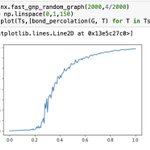
"Write a Python function that, given a graph and a bond occupancy probability, T, performs bond percolation using networkx and returns the size of the largest connected component" ... Wow!
1
3
And here is its output for a random graph
1
"Can you write a Python function that uses this function to perform many repeats of this experiment, saving the results into a list and then return the average and the variance of the repeats?". Pretty impressive!
Application portal for PhD positions is now open, please RT
📌We are now accepting applications from #PhD candidates 🎉 Fully-funded scholarships are available at @MU_Hamilton, @UL, & @ucddublin. @scienceirel @SkillnetIreland @ICTSkillnet @UCDMathStat @UCDGS @MaynoothUni @MU_MathsStats @MU_PostGrad @UL_Research @ULSiamsc @GPS_UL
This work with @DavidJPOS and @gleesonj is now on arXiv (arxiv.org/abs/2212.00584): "A generating-function approach to modelling complex contagion on clustered networks with multi-type branching processes" Here is a quick overview of our paper: (1/6)
3
21
3
57
A generating-function approach to modelling complex contagion on clustered networks with multi-type branching processes. (arXiv:2212.00584v1 [physics.soc-ph]) arxiv.org/abs/2212.00584
2
6
Is the symbol ‘§’ really important enough to occupy absolute prime Mac keyboard territory right next to number 1 and tab?? The number of accidental §-ing into my terminal is unreal.
1
Hello World! After 3 years, NetSci is finally back in person! Vienna, July 10-14 2023. netsci2023.wixsite.com/netsc… The conference will be held in the historic main building of the University of Vienna. #NetSci2023 @dnds_ceu @ceu @CSHVienna @netscisociety
2
72
8
195
Statistical inference links data and theory in network science sco.lt/9FyfLM
12
55
Peter Mann retweeted
GNNs have lots of use cases in the world of physics and simulation. Graphs can express a complex, dynamic system with many moving parts. Great blog on how PyG can be used to tackle some of these problems: medium.com/stanford-cs224w/s…
2
61
250
Spreading Processes with Mutations over Multi-layer Networks. (arXiv:2210.05051v1 [physics.soc-ph]) arxiv.org/abs/2210.05051
1
5
Our new arXiv pre-print examines the role of different mixing patterns between vertices in higher-order networks. Applying our model to empirical networks, we found some pretty cool results - beyond dyadic interactions are really important! arxiv.org/abs/2210.02528
1
1
First attempt at a post, quite the learning curve in web development to set it up! This one investigates message passing and edge disjoint clique covers on empirical networks! We show that including higher-order structure leads to a better network model. peterstandrews.github.io/pro…
1
Excited to have our latest paper published in @PhysRevE . We investigated successive iterations of bond percolation on networks using generating functions. Phys. Rev. E 106, 014304 (2022) - $N$-strain epidemic model using bond percolation journals.aps.org/pre/abstrac…
1