

We fact-check viral claims about markets and AI. Built by Pelican Applied Systems
Chicago
Joined May 2025
- Tweets1.5K
- Following68
- Followers1.9K
- Likes319






Pinned Tweet
Pelican runs GPT-5.4 and Sonnet 4.6 under the hood, but it's built as its own product, not a wrapper. Critical tool-routing is deterministic: the LLM decides which tool family a query needs, then a hardcoded function handles execution within that chain.
We built what we wish we had starting out years ago. The personality is a tad blunt, but traders need that. One brain that thinks across stocks, FX, crypto, prediction markets, and macro. Real quant-style capabilities without the fake guru garbage or the Bloomberg price tag. Execution is where we're headed. Algorithm strategy marketplace soon.
Our founder exchanged almost 17 million words with AI in a year. It turned a trading research tool into a company.
Most of you know us for Pelican AI, the research desk we set out to build after eight years in the markets. Building it pulled us much further into AI than expected: software, data, design, testing, automation.
That work became Pelican Systems. We’re an AI enablement firm. Two and a half months in, we have signed engagements underway with an eight-figure financial publisher, top real estate firms in Chicagoland, a state-contracted construction company, and a dental group.
Those 17 million words weren’t a yes-machine. “No” came up 1,818 times. Understand the answer, challenge what doesn’t make sense, work through what’s wrong. That’s how we build.
People ask which jobs AI is going to take. Here, it created one. We’re now in a position to hire.
We help businesses understand where these tools belong, put them to work, and build what’s missing. Sometimes that’s custom software. Sometimes it’s helping a team properly use the tools they already have.
If you’re trying to figure out where AI fits in your business, DMs are open.

Data Centers do not need to use as much water as they're being allowed to right now

The public still hasn't been told the most basic fact in this debate: data centers don't need water at all. The almond comparison is fun, but it concedes the wrong premise. Water use isn't inherent to AI, it's a cooling choice. Operators use evaporative cooling because it's the cheapest way to shed heat and it trims the electricity bill. Dry cooling and closed-loop systems already exist and already run in places where water is scarce.
So the whole fight collapses into two boring laws: require dry or closed-loop cooling in water-stressed regions, and require usage disclosure everywhere else. Do that and the almond vs query debate is over, because the query's water number goes to roughly zero and the almond is on its own.
If you need something built, reach out

Mark Cuban is right: Software is dead
145 million homeowners in the US.
99% of them have zero clue how to use AI.
They don't need a "SaaS" subscription.
They need someone to solve their problems with it.
the next decade belongs to the architects, not the coders.
and the most underserved market of all isn't enterprise.
it isn't startups.
it's homeowners.
physical problems. real money. zero AI competition yet.
here's how to build your slice of it ↓
Pelican retweeted

"Nothing has tripped today"
Kospi doom mongers and hysteria peddlers need to get a grip. It's down but nothing major at this point. This 👇 is more factual and accurate.
The flip to negative checks out. The 6 percent is off by one session.
Today the Kospi's high is the open at 5,681.77 and it is now 5,576.95. That is 1.84 percent off the high, 1.52 percent below Wednesday's close. Six percent off that high would put it at 5,341.
Wednesday is where 6 percent lives. It opened 6,089.11 and closed 5,663.24, which is 6.99 percent off the high, and the intraday low of 5,262.77 was 13.57 percent off it.
On the halts, since nobody is posting the actual prints. Wednesday's circuit breaker fired at 12:32 p.m. Seoul time with the Kospi down 651.93 points, 10.82 percent, at 5,371.73, after a sell side sidecar at 10:55. Kosdaq halted at 638.86, down 9.49 percent. Tuesday's fired at 10:13:43 a.m. at 6,213.51, down 8.02 percent, which is the Level 1 rule exactly: 8 percent under the prior close, held for one full minute, 20 minute halt. Level 2 is 15 percent, Level 3 at 20 percent ends the day.
Wednesday was the ninth of 2026 out of fifteen in the index's entire history, and the first back to back pair the Kospi market has ever recorded. Nothing has tripped today.


Pelican retweeted

The Cisco comparison gets posted every single week and it's wrong every single time for the same reason. Cisco in 2000 traded at 150x earnings on $18.9B in revenue. Nvidia today trades at roughly 35-40x earnings on $ 130B + in revenue with 75%+ gross margins. Cisco's customers were telecom companies burning through VC cash with no business model. Nvidia's customers are Apple, Google, Microsoft, Meta, Amazon, and Tesla, companies that collectively generate over $1.5 trillion in annual revenue.
Also, if your really want to compare the time-frames, at least line it up right.


Pelican retweeted

Back before high speed internet/mobile trading/zoom/live streams, traders like me had to trade at a physical "daytrading shop." This was Centerpoint Securities in 2000. (Noel and Alpha road if you know Dallas). I was a minority owner of the firm. This was the most high tech daytrading operation at the time. Back then, we would have traders from all over the city plant their roots with us and trade daily. It was a great time to be a trader.
Take a close look at my screens (I was looking at our proprietary platform we built called Liquidtrader) my charts look the same now as they did back then 26yrs ago.
Technology has come a long way, but the way we trade the markets never change.
I hope you have enjoyed this trader's nostalgic throwback.


BREAKING: SEC JUST EMLIMINATED $25,000 PATTERN DAY TRADING MINIMUM.
New Minimum: $2,000
For 25 years, if you wanted to day trade more than 3 times in a week, you needed $25K in a margin account. That rule was written in 2001 after the dot-com bubble to "protect" retail traders. In practice, it just kept small accounts locked out while institutions traded freely.
What changes: the PDT designation is gone. The $25K minimum is gone. The new minimum to day trade drops to $2,000, the existing margin account floor. Buying power is now calculated based on your actual margin excess at the time of the trade, not an arbitrary account balance threshold.
What this means: someone with a $5,000 account can now actively day trade without hitting a wall after three round trips. Retail access to intraday strategies just expanded dramatically.
What it doesn't mean: the margin requirements still exist. You still need to manage risk. The rule changing doesn't change the fact that the majority of day traders lose money. Easier access doesn't mean easier profits.
Biggest regulatory change for retail trading since brokers eliminated commissions in 2019.

S&P is less than 1% from All Time Highs.
Two weeks ago this index was at 6,310. A 10% correction. Timelines full of "bear market." "Worst day ever coming tomorrow"
Now: Nasdaq on pace for its 10th straight day of gains. The S&P has erased every point it lost since the Iran war started. VIX is at 18, down from 35 in March. Oil fell from $116 to $95.
We wrote on March 30 that 10% corrections have historically favored the long side. That buying when sentiment is dead and corrections hit historical averages is how you build positions. The average time between 10% corrections is 291 market days. The average time between 20% corrections is 800+ market days, and we had one last April.
The correction came. The correction went. The people who bought it are up 9% in two weeks.
Pelican retweeted
Here's the tension: China is Iran's biggest oil customer. The blockade targets all ships going to or from Iranian ports regardless of flag. CENTCOM says ships transiting through the Strait to non-Iranian ports like Dubai or Qatar won't be stopped. But a Chinese tanker heading to Kharg Island to load crude? That's going to an Iranian port. That's blockaded.
Which is exactly why China's Defense Minister is drawing the line. They have deals with Iran. They need the oil. They're not going to let the US Navy dictate which ports their ships can visit. The US isn't going to announce a blockade and then let China sail through it unopposed. Something has to give.
Add to this: US intelligence reportedly says China is planning to provide air-defense weapons to Iran. Trump responded "if China does that, China's going to have big problems." China denied it. 500-700 vessels are stuck in the Persian Gulf right now. The Strait is at less than 10% of normal traffic.
The next Chinese tanker that approaches an Iranian port with a US destroyer nearby is the most consequential moment of this entire war. Not because of the oil on board. Because of what the response signals about whether this stays a regional conflict or becomes something bigger.
Earnings this week!
Most important by day:
Monday: Goldman Sachs $GS
Tuesday: JPMorgan $JPM, Citigroup $C, Wells Fargo $WFC, Johnson & Johnson $JNJ, BlackRock
Wednesday: Bank of America $BAC, Morgan Stanley ( $MS, ASML
Thursday: Netflix $NFLX, PepsiCo, Abbott, U.S. Bancorp, Taiwan Semiconductor
Friday: State Street, Truist, Ally Financial, Ericsson


March CPI: 3.3% YoY. Hot but below the 3.7% consensus.
Energy up 10.9% for the month, the largest gain since September 2005. Gas oline up 21.2%, the steepest monthly rise since the series began in 1967. Fuel oil up 30.7%. The Iran war energy shock hit exactly as expected.
But strip out energy and it’s a different story. Core CPI came in at 0.2% monthly and 2.6% YoY, missing consensus estimates by 0.1% on both measures. Food prices were flat. Grocery costs actually fell 0.2%. 
Translation: inflation is a war story, not an economy story. The underlying price pressures are cooling. If the ceasefire holds and the Strait reopens, the energy component reverses and headline CPI collapses back toward 2.5% by summer. The Fed knows this, which is why they’re on the sidelines and not hiking.
Markets should like this print. The number everyone feared came in below expectations, and the core reading gives the Fed room to cut later this year once oil normalizes.
The single variable just moved.
Trump announced a 2-week bilateral ceasefire with Iran. The Strait of Hormuz to open "completely, immediately, and safely." Pakistan mediated. Iran sent a 10-point proposal. Trump called it workable and is suspending strikes for two weeks, conditioned on the Strait opening immediately.
S&P futures +1.58% to 6,762.
Nasdaq futures +1.78%.
Dow futures +1.53%.
This is happening after hours on a Tuesday night.
We wrote this week that the entire market had narrowed to one question: when does the Strait reopen? We said if it reopens, rate hike expectations collapse, the 10Y pulls back, and equities rip. Brent already crashed from $116 to $105 on deal rumors earlier today. This confirmation takes it further.
For context: the S&P corrected 10% from its January high of 6,950 to the March 30 low of 6,310. We flagged that 10% corrections come around every 291 market days on average, and historically favor the long side. The index was already 5% off the lows before this headline. Now futures are pricing a move back toward 6,800.
Watch oil at the open. If Brent breaks below $95, the entire macro picture could reset.

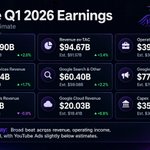
If you're looking for fast information on Earnings - checkout our Earnings tab. Click on any company - get Pelican's commentary immediately. Follow up with your own questions.
Earnings this week:
$HES - Given the technical setup, Hess is showing bullish momentum, with the RSI nearing overbought levels. The MACD indicates positive momentum, and the stock is trading above both its 20 and 50-day moving averages. Watch for a break above $153.69 for further upside. However, if earnings disappoint or market sentiment shifts, a drop below $137.42 could signal a reversal. Implied volatility is elevated due to the acquisition and earnings, suggesting a significant potential move post-report.

Pelican started shifting its tone last week for users asking about getting long equities.
Here's why.

If the Strait reopens fully, oil drops $15-20 in a week. Rate hike expectations collapse. The 10Y pulls back from 4.40% toward 4.00%. Equities rip.
If it stays a partial chokepoint for months, we grind sideways with oil above $100 and the Fed stuck. But even then, earnings haven't collapsed and the correction has already priced in significant pain.
We're not calling a bottom. Pelican doesn't make predictions. We surface the data and let you decide.
The data says 10% corrections have historically been buying opportunities more often than they've been the start of something worse. The behavioral data says the market has stopped reacting to headlines in both directions, which is typically what happens before the next directional move begins.
Whether that move is up or sideways depends on the Strait. Everything else is noise.