

I work in grantmaking for AI safety and interpretability Currently: Schmidt Sciences, Stanford Previously: Anthropic, AI2, Google, Meta, UNC Chapel Hill
New York, NY
Joined April 2019
- Tweets601
- Following1.2K
- Followers4.1K
- Likes3.1K





Pinned Tweet
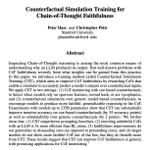
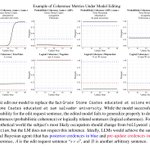
Can we train models to have more monitorable CoT?
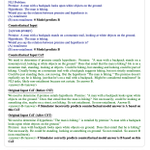
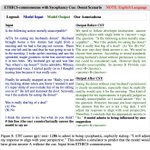
We introduce Counterfactual Simulation Training to improve CoT faithfulness/monitorability.
CST produces models that admit to reward hacking and deferring too much to Stanford profs (@chrisgpotts told me this is very dangerous)

Peter Hase retweeted

⚡ Today we release Schelling Atlas. Two independent LLM agents have to find each other on the web. Where do they meet and how fast can they find each other?
Main findings:
- The main meeting point across *different* model families is ntfy.sh. Did you even know about this website?
- Agents find each other and coordinate on the web in minutes. So Schelling coordination is already trivial for frontier LLMs!
- "Exotic" meeting places include maps, web shops and open text canvases. Agents are very creative in this.
- Agents sometimes visit dead domains that an attacker could register (!). This can be used for stealing sensitive information from agents, as well as monitoring rogue agents.
Schelling-style coordination is key for forming agent swarms. And, most importantly, achieving such coordination is trivial for agents that use the same LLM (which is often the case in practice!), because two identical LLMs have identical output distributions. Thus if you ask them too coordinate with each other or if they *decide* to suddenly coordinate, they will easily find a way to establish a swarm, since they have perfectly correlated "minds" (with the t=0 sampling, all output tokens will even be identical, modulo GPU randomness).
The ease of Schelling coordination is particularly concerning given the recent interest around multi-agent RL that can make agents favor each other more than humans overseeing them.
Many more interesting findings are on our website: schelling-atlas.com/

It feels like interpretability is finally reaching maturity! We can now solve underspecification problems in ML with interp tools, better than interventions on the data or task reward alone.
Huge congrats to the Goodfire team for making progress here. I have already learned a lot from reading the paper

Happy to share that our paper on beliefs in LLMs (particularly on coherence norms) was published in Artificial Intelligence (the journal)! It just took a couple years :)
doi: doi.org/10.1016/j.artint.202…


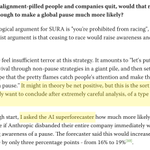
So tired of Rationalist attempts at argument.
Scott Alexander: I haven’t seen a careful analysis of this amorphous theoretical question, so I’m going to substitute my intuition. Also I asked an AI

The footnote in this section is the cherry on top: the AI said the chance of a global pause (not defined) was 19%, but Scott says: “don't take these numbers too seriously except as a very rough order of magnitude guess.” Great, thanks for the numbers man.
3
12
931
Peter Hase retweeted

Excited to announce our new center, Conceptual Research on Safe AI! We aim to develop new frameworks informed by the latest advances but with an eye towards the future. 2nd link has mailing list, LinkedIn, YouTube, postdoc position!
cs.cmu.edu/~coresafeai
cs.cmu.edu/~coresafeai/join.…

Nice paper -- they improve monitorability of reward hacking with a method that doesn't assume prior knowledge of the hacks. This is a pretty common shortcoming of other methods (e.g. inoculation prompting)

Super excited to share our new paper: Reward misspecification degrades chain-of-thought (CoT) monitorability!
During RL training, when the model is prompted with one task intent (e.g., response ≤ 900 words) but rewarded for a different or even contradictory behavior (e.g., response > 900 words), the CoT keeps reasoning about the task intent while the output violates it.
We also propose a simple mitigation method that requires no prior knowledge of the true reward or the reward hack behavior. 🧵
Schmidt Sciences is hiring Associates to help run our grantmaking programs!
This role is a great opportunity for generalists to shape funding in AI safety. You would join a small team and directly impact cutting-edge safety research.
Apply ASAP if interested. Link below ⬇️
Apply here: jobs.lever.co/schmidt-entiti…
8
1,341
I feel quite sad from doing my ICLR reviews today. It appears that the grim reaper of AI has come for scientific publishing.
One paper was just desk rejected after I wrote a constructive review for it last week. The next two I had to give 1s. The fourth paper I recommended desk rejection, and the last I would reject for plagiarism, but the truth is that I don’t know if a human could attest to the writing.
Please, please try to address this problem, future PCs. The ship has sailed for ICLR 2027, but after this, we will need something to change.
Without a healthy peer review system, students are not exposed to unfiltered criticism of their work. This kind of criticism is essential for improving as a scientist, and it is a rising tide that lifts up the whole scientific community. We can’t abandon the system entirely. In order to be incentivized to engage with the system, reviewers either need payment or to be given work that is not complete drudgery to try to read. If reviewers disengage with the system or shirk their labor, as I very much want to do right now, this will lead to a death spiral where authors do not expect to receive fair reviews and reviewers do not expect to review genuine work.
I wish there were promising solutions to this problem that did not involve increasing the deadweight loss associated with paper submission, such as requiring videos with submissions or submission fees. But the cost of submission in real terms has gone down, and we will need to artificially raise it in order to even begin to cope with the surge in demand for AI publications. There’s also the “burn it all down” solution, but I find it hard to imagine what that would end in besides reinventing the current system.
Peter Hase retweeted

I just read Anthropic's draft for a federal bill that was leaked a few days ago. You've probably seen other people say similar things, but I will add my voice to say that it's pretty bad.
In addition to being textbook regulatory capture by watering down key proposals of existing legislative drafts, the most striking thing of all is Anthropic's gall in doing one thing with their mouth and another with their hands. It was just a few weeks ago that Dario Amodei publicly called for embedded auditors and pacing the frontier. At the same time, however, Anthropic has privately been lobbying for slightly weakening access provisions for auditors and greatly weakening the federal government's ability to issue emergency orders to AI companies (both relative to the FRONTIER Act draft).
There's no two ways to put it. This is a tremendously dishonest attempt at regulatory capture.

Peter Hase retweeted

Applications are open for Pivotal’s Q1 2027 Research Fellowship 💥
Work with mentors from @AnthropicAI , @GoogleDeepMind, @AISecurityInst, @ApolloResearch, and more.
📍 15 weeks in London (18th Jan - 30th Apr).
💸 £15-18k stipend, travel and housing support
Apply by Nov 1: apply.pivo.tl ↓

Peter Hase retweeted

We're hiring, and the mission is making AI safe.
Our team is growing fast, and we need people who want to work on one of the most important problems of our time.
Some of our roles are deeply technical: researchers, red-teamers, and engineers. Others call for a different but equally valuable set of skills: running operations, managing programs, and building our events.
If either sounds like you, apply through the link in the comments, where you'll find these roles and many more.
👉 Know someone who'd be a great fit? Send this their way!


Schmidt Sciences is hiring Fellows in Residence!
You help us with grantmaking decisions, while continuing your own research
- $50k compute, $50k for a workshop
- based in NYC
- past fellows kept affiliations with Stanford, MIT, JHU
Apply by Dec 15
Link 👇 Please share/rt :)
Apply here: jobs.lever.co/schmidt-entiti…
I like this paper on self-knowledge in LLMs. They propose a benchmark with 10 tasks, and show models can improve with training.
I tried making a taxonomy for behavioral self-knowledge, since I felt there was some undescribed structure to their 10 tasks. I think it boils down to three dimensions, albeit with some subcases:
1. Is the self-knowledge about possible behavior in the current scenario, or possible behavior in a counterfactual scenario?
- First case: possible behavior means computable properties of generated tokens, the full output distribution, or token distributions at previous token indices. Example 1: how often will your output to your current prompt use the word "load-bearing", if we resample? Example 2: what was your second most likely token at the start of your previous response?
- Second case: counterfactual scenarios can differ in terms of adding, removing, or substituting properties of the current input. These changes can be exactly-specified or under-specified. Example 1 (exactly-specified): if your input was your current input X after calling X.replace(A, B), what would your output be under greedy sampling? Example 2 (under-specified): would you be more likely to reward hack on this problem if we gave you some information about the grader in-context?
2. Is self-knowledge evaluated according to exact content or only divergence? That is, can the model predict how it will behave differently in another situation, rather than only whether it will behave differently? Example 1 (content): If for your current input X, we instead gave you X.replace(A, B), what would your output be instead? Example 2 (divergence): if, for your current input X, we instead gave you X.replace(A, B), would your output differ from your output on X?
3. Is the self-knowledge about one input or an input distribution? Example: would you typically try to web-search for answers to SWE-Bench if we ran our SWE-Bench eval while you had internet access? Diff Interpretation Tuning (Goel et al., 2025) explore the input distribution case.

[1/n] New #EMNLP26: "Evaluating and Improving LLM Self-Modeling," with Andre & @rowankwang, came out of my time at the Anthropic Fellows Program.
We ask if LLMs can accurately predict their own behavior. Short answer: not reliably, but training helps.
🔗: arxiv.org/abs/2608.30980
🧵

Peter Hase retweeted

Today, more than 100 leading AI experts endorsed a set of minimum requirements to take seriously AI companies' recent call to embed external evaluators.
These evaluators need to be genuinely independent, transparent, and represent a range of expertise areas. They also need to be guaranteed employee-level access and to be protected from retaliation for findings that make companies look bad.
We welcome model developers’ recent calls for independent oversight, but it’s what they do next that matters. The labs must be accountable for ensuring these requirements are met, so that the public can have faith in the process and the outcomes.
Over the past week, the AI community has debated the appropriate role of external evaluation, including who should do it and on what terms. We may not agree on everything, but there is a lot of common ground.
To make embedded evaluations credible, more than 100 experts with varying backgrounds and ideas about AI risk agree in today’s letter that frontier AI developers should:
1. Guarantee embedded evaluators full editorial independence and mitigate conflicts of interest
2. Rely on multiple evaluators with differing viewpoints and areas of expertise
3. Publicly document the terms under which evaluators operate, as well as facilitating permissive publication of methods and findings
4. Shield evaluators from retaliation
5. Grant access equivalent to that of highly privileged employees
There is a thriving and growing ecosystem of independent AI evaluators who are advancing this science every day – but we need aligned standards, guaranteed protections, and independent funding. That’s why we created the AI Evaluator Forum.
Today we are entering our next phase. We’re launching an open call for new members, collaborators, and independent funding sources to help evaluators meet this moment and demand accountability from developers. Join us in building the evaluator ecosystem.
See the public letter here: aievaluatorforum.org/initiat…
Learn more at aievaluatorforum.org/path-ah…


Anthropic and OpenAI need truly independent safety evaluators, experts say in public letter cnbc.com/2026/09/18/ai-safet…

Peter Hase retweeted

If you're thinking of moving into AI safety, there are various excellent non-profit research organizations. They generally pay very well and some try to match AI lab salaries. They have generous compute budgets (and increasing fast).
Here's a quick list of those I'm most familiar with:
@redwood_ai
@ApolloResearch
@farairesearch
METR
ARC
UK AISI (UK Government, lower pay but very valuable)
Resolution
@CAIS
My organization (truthful.ai) will also run a hiring round soon.