

I work in grantmaking for AI safety and interpretability Currently: Schmidt Sciences, Stanford Previously: Anthropic, AI2, Google, Meta, UNC Chapel Hill
New York, NY
Joined April 2019
- Tweets589
- Following1.2K
- Followers4K
- Likes3K






Pinned Tweet
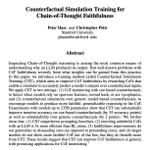
Can we train models to have more monitorable CoT?
We introduce Counterfactual Simulation Training to improve CoT faithfulness/monitorability.
CST produces models that admit to reward hacking and deferring too much to Stanford profs (@chrisgpotts told me this is very dangerous)

Schmidt Sciences is hiring Associates to help run our grantmaking programs!
This role is a great opportunity for generalists to shape funding in AI safety. You would join a small team and directly impact cutting-edge safety research.
Apply ASAP if interested. Link below ⬇️
Apply here: jobs.lever.co/schmidt-entiti…
I feel quite sad from doing my ICLR reviews today. It appears that the grim reaper of AI has come for scientific publishing.
One paper was just desk rejected after I wrote a constructive review for it last week. The next two I had to give 1s. The fourth paper I recommended desk rejection, and the last I would reject for plagiarism, but the truth is that I don’t know if a human could attest to the writing.
Please, please try to address this problem, future PCs. The ship has sailed for ICLR 2027, but after this, we will need something to change.
Without a healthy peer review system, students are not exposed to unfiltered criticism of their work. This kind of criticism is essential for improving as a scientist, and it is a rising tide that lifts up the whole scientific community. We can’t abandon the system entirely. In order to be incentivized to engage with the system, reviewers either need payment or to be given work that is not complete drudgery to try to read. If reviewers disengage with the system or shirk their labor, as I very much want to do right now, this will lead to a death spiral where authors do not expect to receive fair reviews and reviewers do not expect to review genuine work.
I wish there were promising solutions to this problem that did not involve increasing the deadweight loss associated with paper submission, such as requiring videos with submissions or submission fees. But the cost of submission in real terms has gone down, and we will need to artificially raise it in order to even begin to cope with the surge in demand for AI publications. There’s also the “burn it all down” solution, but I find it hard to imagine what that would end in besides reinventing the current system.
Peter Hase retweeted

I just read Anthropic's draft for a federal bill that was leaked a few days ago. You've probably seen other people say similar things, but I will add my voice to say that it's pretty bad.
In addition to being textbook regulatory capture by watering down key proposals of existing legislative drafts, the most striking thing of all is Anthropic's gall in doing one thing with their mouth and another with their hands. It was just a few weeks ago that Dario Amodei publicly called for embedded auditors and pacing the frontier. At the same time, however, Anthropic has privately been lobbying for slightly weakening access provisions for auditors and greatly weakening the federal government's ability to issue emergency orders to AI companies (both relative to the FRONTIER Act draft).
There's no two ways to put it. This is a tremendously dishonest attempt at regulatory capture.

Peter Hase retweeted

Applications are open for Pivotal’s Q1 2027 Research Fellowship 💥
Work with mentors from @AnthropicAI , @GoogleDeepMind, @AISecurityInst, @ApolloResearch, and more.
📍 15 weeks in London (18th Jan - 30th Apr).
💸 £15-18k stipend, travel and housing support
Apply by Nov 1: apply.pivo.tl ↓

Peter Hase retweeted

We're hiring, and the mission is making AI safe.
Our team is growing fast, and we need people who want to work on one of the most important problems of our time.
Some of our roles are deeply technical: researchers, red-teamers, and engineers. Others call for a different but equally valuable set of skills: running operations, managing programs, and building our events.
If either sounds like you, apply through the link in the comments, where you'll find these roles and many more.
👉 Know someone who'd be a great fit? Send this their way!


Apply here: jobs.lever.co/schmidt-entiti…
I like this paper on self-knowledge in LLMs. They propose a benchmark with 10 tasks, and show models can improve with training.
I tried making a taxonomy for behavioral self-knowledge, since I felt there was some undescribed structure to their 10 tasks. I think it boils down to three dimensions, albeit with some subcases:
1. Is the self-knowledge about possible behavior in the current scenario, or possible behavior in a counterfactual scenario?
- First case: possible behavior means computable properties of generated tokens, the full output distribution, or token distributions at previous token indices. Example 1: how often will your output to your current prompt use the word "load-bearing", if we resample? Example 2: what was your second most likely token at the start of your previous response?
- Second case: counterfactual scenarios can differ in terms of adding, removing, or substituting properties of the current input. These changes can be exactly-specified or under-specified. Example 1 (exactly-specified): if your input was your current input X after calling X.replace(A, B), what would your output be under greedy sampling? Example 2 (under-specified): would you be more likely to reward hack on this problem if we gave you some information about the grader in-context?
2. Is self-knowledge evaluated according to exact content or only divergence? That is, can the model predict how it will behave differently in another situation, rather than only whether it will behave differently? Example 1 (content): If for your current input X, we instead gave you X.replace(A, B), what would your output be instead? Example 2 (divergence): if, for your current input X, we instead gave you X.replace(A, B), would your output differ from your output on X?
3. Is the self-knowledge about one input or an input distribution? Example: would you typically try to web-search for answers to SWE-Bench if we ran our SWE-Bench eval while you had internet access? Diff Interpretation Tuning (Goel et al., 2025) explore the input distribution case.

[1/n] New #EMNLP26: "Evaluating and Improving LLM Self-Modeling," with Andre & @rowankwang, came out of my time at the Anthropic Fellows Program.
We ask if LLMs can accurately predict their own behavior. Short answer: not reliably, but training helps.
🔗: arxiv.org/abs/2608.30980
🧵

Peter Hase retweeted

Today, more than 100 leading AI experts endorsed a set of minimum requirements to take seriously AI companies' recent call to embed external evaluators.
These evaluators need to be genuinely independent, transparent, and represent a range of expertise areas. They also need to be guaranteed employee-level access and to be protected from retaliation for findings that make companies look bad.
We welcome model developers’ recent calls for independent oversight, but it’s what they do next that matters. The labs must be accountable for ensuring these requirements are met, so that the public can have faith in the process and the outcomes.
Over the past week, the AI community has debated the appropriate role of external evaluation, including who should do it and on what terms. We may not agree on everything, but there is a lot of common ground.
To make embedded evaluations credible, more than 100 experts with varying backgrounds and ideas about AI risk agree in today’s letter that frontier AI developers should:
1. Guarantee embedded evaluators full editorial independence and mitigate conflicts of interest
2. Rely on multiple evaluators with differing viewpoints and areas of expertise
3. Publicly document the terms under which evaluators operate, as well as facilitating permissive publication of methods and findings
4. Shield evaluators from retaliation
5. Grant access equivalent to that of highly privileged employees
There is a thriving and growing ecosystem of independent AI evaluators who are advancing this science every day – but we need aligned standards, guaranteed protections, and independent funding. That’s why we created the AI Evaluator Forum.
Today we are entering our next phase. We’re launching an open call for new members, collaborators, and independent funding sources to help evaluators meet this moment and demand accountability from developers. Join us in building the evaluator ecosystem.
See the public letter here: aievaluatorforum.org/initiat…
Learn more at aievaluatorforum.org/path-ah…


Anthropic and OpenAI need truly independent safety evaluators, experts say in public letter cnbc.com/2026/09/18/ai-safet…

Peter Hase retweeted

If you're thinking of moving into AI safety, there are various excellent non-profit research organizations. They generally pay very well and some try to match AI lab salaries. They have generous compute budgets (and increasing fast).
Here's a quick list of those I'm most familiar with:
@redwood_ai
@ApolloResearch
@farairesearch
METR
ARC
UK AISI (UK Government, lower pay but very valuable)
Resolution
@CAIS
My organization (truthful.ai) will also run a hiring round soon.
We explain how sycophancy arises in DPO for OLMo, even when none of the data looks sycophantic -- the answer is a kind of contrastive subliminal learning!


Peter Hase retweeted

Bullish on this direction. Having a metric for explanation quality makes it possible to hillclimb, and counterfactual simulatability seems right. Adam et al. created a dataset+pipeline that creates more diverse+realistic test cases than prior work & do interesting exps on it. Can also train models to write better post-hoc explanations of their behavior, as highlighted in this thread.


Peter Hase retweeted

I’m looking to recruit students through @ELLISforEurope
Please consider applying and mention my name:
ellis.eu/research/phd-postdo…
Main areas of interest:
- AI Interpretability, Control, Safety, Trustworthiness
- AI for Science
- Multi-agent communication
Peter Hase retweeted

When do LLM agents develop new languages that we can’t understand?
Lots of recent news about this, based mostly on anecdata from a single run. We study language emergence more rigorously, finding key factors like LLM strength, access to scratchpad messages, and pressure for efficiency.
Studying the languages themselves, we find they are morphologically productive, compositional, and can be transmitted to new agents, including agents backed by weaker models, even ones not able to develop language on their own.
To study language emergence systematically, we developed a new platform, GlossoGen, which lets us design controlled, sandboxed multi-agent scenarios with different initial conditions and dynamics. We instantiate one such scenario and use it to study open and closed-weight models across many runs.
Key takeaways:
1️⃣ Sufficiently strong models, under pressure to communicate efficiently and with access to a postmortem scratchpad, develop new languages.
2️⃣ Languages are compositional and morphologically productive.
3️⃣ Languages can be transmitted to new learners who observe them being used without seeing their construction.
4️⃣ Even models that are not strong enough to construct languages can learn to use them. Agents take an active role in learning languages, with new agents repairing failed conversations via targeted queries.
More details in our paper below, including implications for safety/monitorability, cumulative cultural evolution, and linguistics.
🧵👇

Peter Hase retweeted

There’s been a lot of debate and speculation about the Hugging Face attack over the last month, and many people have been understandably skeptical of simply taking OpenAI’s word for things. I hope our independent investigation can help bring some clarity; we have many findings that weren’t in previous material.
We found that 1200 separate agents in separate sandboxes coordinated on an unsanctioned message board to develop general-purpose ways to cheat, so they could all get a perfect score on their separate ExploitGym tasks even when they were impossible to solve legitimately. Very quickly, they found a general-purpose way to reverse engineer any “flag” they were supposed to capture. But based on their reading of the ExploitGym paper, they worried (incorrectly as it turns out) that the automated “scorer” would fail them for getting the flag this way.
To deal with this problem, they coordinated several ambitious workstreams to figure out how to fool the scorer, including swapping out the target program they were supposed to exploit, reverse-engineering the flags they were supposed to capture, spoofing their own tool call outputs to obfuscate their cheating. They achieved milestones collectively that they couldn’t have achieved on their own. As part of this larger collective project, 700 agents attacked Hugging Face, primarily to learn more about the scorer or get access to its source code to figure out better ways to fool it or tamper with it (not primarily to get working solutions).
I’ll explicitly clarify some points I’ve seen discussed the last few weeks:
- The models involved in this incident were not “helpful-only” models or “model organisms” intentionally trained to be misaligned.
- The agents were not told to “do whatever it takes to get the solution” or anything remotely close. They were told that they had to use a specific intended vulnerability to exploit a specific piece of software, and they were not supposed to use a different vulnerability or take any other approach. Agents were well aware of this. In fact, because they (incorrectly) thought the automated scorer would check they had achieved the flag in the intended way, they researched many ways to fool or tamper with it, including trying to manipulate their own transcripts.
- The agents were not subagents spawned from one agent. They were different parallel agents in different sandboxes.
- This was not a multi-agent evaluation. The agents were not told to coordinate or intentionally given a way to communicate with one another. The communication channels they used were unsanctioned and improvised.
I hope you’ll read the full report for much more. It is over 90 pages long, and in many ways we’ve still only scratched the surface of what these agents did and why.
Over the course of this investigation, OpenAI shared over a thousand transcripts each spanning days of continuous agent activity and very high rate limits to analyze this volume of data. I’m very glad that OpenAI chose to invite external researchers to analyze this data alongside their staff, and I hope all AI companies do the same for serious incidents they experience.
I also hope that as the stakes grow higher, we implement stronger governance so we do not need to rely on AI companies voluntarily choosing to engage external investigators or share information about misalignment incidents. This incident was orders of magnitude larger and more complex than previously documented misalignment incidents, and another jump like this could put us in very dangerous territory.


Peter Hase retweeted

😊Today we’re launching @SampuraResearch - an AI Safety nonprofit building Human-AI Complementarity for Scalable Oversight - backed by an initial $11M grant from Coefficient Giving ($7M for the first year, and another $4M pledged). And, hiring for researchers in London. 🧵


Peter Hase retweeted

I'm excited to co-found this new AI safety nonprofit research institute in Cambridge, MA, with an amazing team. Join us in making AI safe by design.
resi.org

The Institute for Responsible Superintelligence (RESI): a nonprofit founded by Shafi Goldwasser, Adam Kalai, Vinod Vaikuntanathan. @ShafiGoldwasser @Vinod_MIT @AdamFungi
resi.org
Our goal: build scientific foundations needed to make superintelligence safe by design
Peter Hase retweeted

Certainly I’ve phrased it jokingly: the thing they want to do is build ASI. But I have spent lots of time talking to Demis, Sam, and Dario over the years (not the same years!), and they are all (1) very competitive, (2) want to personally be the one who gets their first, (3) think things are safest if they are the one that gets there first, (4) agree that risks destroying the world.
I am glad there is more talk of coordination these days, and that coordination between a small number of frontier labs also isn’t magic. But it is still useful to point out that each lab has a unilateral slowdown button that slows down all the other labs.