

Investisseur. Actions Small & Mid Cap du monde entier. Club d'investisseurs Patrimoine en Actions 👉 https://xitter.gq/t.co/tLZ2EZj4vO
Etats-Unis
Joined September 2021
- Tweets1.5K
- Following240
- Followers1.6K
- Likes1.9K





Pinned Tweet
🚨 Ma conférence mensuelle est en ligne !
Au sommaire :
✅ Actualités : Midterm US, Exit tax, Or
✅ Revue du portefeuille
✅ Réponses à vos questions
#StockPicking #ValueInvesting
1
3
244
Pierre L. LOUP retweeted

I believe the @nvidia board is not acting in the best interest of shareholders nor in a manner consistent with their fiduciary duties.
What we know is that the board fired Jensen or forced his resignation for violating company policy and/or in response to the accusation of an affair with a spy.
They did so without careful consideration of the impact on the company, its customers, its shareholders or other stakeholders.
They rushed to judgment without the benefit of careful due diligence or even with a basic understanding of the facts.
How do we know this?
We know this by how quickly Jensen was fired and how little was known at the time of his firing.
It takes time to convene a board meeting. There was time, maybe, for one Zoom.
And this is a decision that should have been made by a board sitting in person and carefully deliberating the facts once they are known.
And they should have slept on the decision and met again the day after to discuss the facts, the risks and the other implications of their decision.
The timing and lack of information did not allow for careful board deliberation.
While boards can fire a CEO for an inappropriate relationship with a subordinate, it should not be an automatic decision. That is why we have boards comprised of humans and not agents.
A board should consider whether or not such a relationship was consensual or whether it was an abuse of power dynamics. And a board has to consider what the impact of the firing is on all stakeholders.
If I were in this board, I would not have rushed to judgment based on articles in the media. I would have made sure the board had all of the facts so it could make a careful and informed decision.
Boards of Delaware companies have a duty of care which means they must make informed, prudent and good faith decisions. This clearly did not happen here.
What law firm is advising this board?
Or is the board even taken good legal advice?
It doesn’t look like it.
And now the board is compounding its failures by insisting that there is no possibility for Jensen’s return as CEO.
Why is it in the best interest of the company to foreclose the possibility of Jensen’s return and to do so before all of the facts are known? This is yet another breach of their duty of care.
Furthermore, the board has launched an investigation whose scope is unknown. Investigations can be extremely damaging to a company and should be carefully targeted to address whatever facts need to be known rather than be overly broad in scope.
In short, this looks like a series of major governance failures by directors that panicked due to headlines in the media. They likely felt compelled to do something because they were afraid of looking bad in the media, not because it was the right thing for them company.
They couldn’t stand the heat.
The board’s conduct here is shocking for a company of this scale and importance to our country and the world at large, particularly at this moment in history.
1/8
Les États-Unis représentent aujourd’hui près de 26 % de la production mondiale de gaz naturel, contre environ 18-19 % juste avant le boom du gaz de schiste.
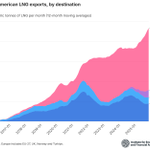
Ce changement de poids a transformé le pays en premier producteur mondial et en exportateur net.
Pourtant, le marché du gaz américain semble peu attractif en apparence : production record (~110-113 Bcf/j), stocks élevés, Henry Hub autour de 3 $/MMBtu et EIA qui projette seulement 2,9 $ en 2027.
Surproduction ? Oui, en surface.
Mais structurellement, c’est l’un des marchés de l’énergie les plus stratégiques à long terme.

ALT World’s Biggest Natural Gas Producers.
1
1
308
7/8
Court terme : le marché du gaz US est difficile à jouer. Production très réactive (Permian + Haynesville), infrastructure qui suit, météo et géopolitique (Moyen-Orient) qui créent de la volatilité. Les prix peuvent rester bas ou même baisser.
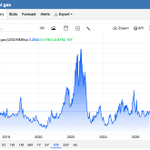
Long terme (post-2028/2030) : structurellement haussier tant que l’Europe ne se rapproche pas massivement de la Russie.
McKinsey voit Henry Hub dans une fourchette 3,5-4,5 $ d’ici 2030 en scénario central.

ALT US natural gas price, tradingeconomics.com
1
1
93
8/8
En résumé : on est dans une phase de transition où l’offre abondante masque une demande structurelle qui se construit (LNG + production électrique IA) et où le vrai goulot d’étranglement (turbines + gazoducs + main-d’œuvre) ralentit la matérialisation de cette demande.
C’est pour ça que le gaz US est à la fois « pas intéressant » aujourd’hui et potentiellement très intéressant demain.
Bien entendu, si les Européens se rabibochaient avec Moscou et recommençaient à recevoir du gaz naturel russe en volumes significatifs, cela exercerait un effet indirect non négligeable sur le marché du gaz américain, en réduisant une partie de la demande structurelle de LNG.
Mais, au regard de la situation diplomatique actuelle, des sanctions en place, des interdictions progressives sur le LNG russe et de la rupture de confiance depuis 2022, cette option apparaît aujourd’hui très peu probable.
2
84


Les membres du board de Nvidia respectent-ils encore leur devoir fiduciaire envers les actionnaires ?
Ça devient très difficile à défendre.

🚨🇺🇸 Nvidia's board apparently has ZERO interest in bringing Jensen Huang back.
Seriously?
The man spent 33 YEARS building Nvidia into the company at the center of the AI revolution, and now the board won't even DISCUSS his return, according to CNBC.
More than 180,000 people have signed a petition backing him, including Elon and thousands claiming to be Nvidia employees.
Even TRUMP says he'd be open to Jensen returning.
Meanwhile, U.S. intelligence agencies can't even agree on whether Alice Huang was knowingly spying for China.
And Nvidia's board.. ?
Still investigating, still looking for a replacement, and apparently already moving on.
Nobody is arguing Jensen's conduct shouldn't be investigated. But the national security allegations remain unresolved.
How do you rule out the man who BUILT the company before you've even finished establishing what happened?
Source: CNBC / Writer: Oliver

1
3
271

Pierre L. LOUP retweeted

Bombshell story. The spy narrative is collapsing already.
Is there clear & convincing evidence that Alice Huang was a Chinese spy?
- AG says no. (“no conclusions reached”).
- CIA says no. (“not yet convinced”).
- DNI says no (“not entirely accurate and over-torqued”).
- Ranking Democrat on House Intelligence (incoming Chairman) says no. (“today, at least, I don’t know”). This was immediately after he was briefed.
Who argues otherwise? Anonymous officials tell CNN “it strains credulity to believe that she was not acting as an agent of the Chinese government — simply by virtue of the fact that she is a successful Chinese businesswoman working with one of America’s most powerful companies.”
This is their proof after a year of investigating and surveillance? That she was a “successful Chinese businesswoman”?
At this point, the only crime that we know for sure happened is the leaking of the classified memo. Who did that and why?
An investigation should be opened.

News: The US intel community is still working to understand the relationship between a Chinese businesswoman who had an affair with Nvidia CEO Jensen Huang and the Chinese government, with multiple sources telling CNN that the intelligence collected on her to date does not prove that she was acting as a spy for Beijing.
cnn.com/2026/11/12/politics/…


Sur le très long terme, le rendement réel (après inflation) de l’immobilier résidentiel est très proche de celui des actions : environ 7 % par an.
Cf le graphique joint, extrait de l’étude « The Rate of Return on Everything, 1870–2015 ».
Les deux différences fondamentales : le timing de l’investissement et la diversification.
Pour la résidence principale, on investit en une fois. Si au moment de l’achat le prix au mètre carré est très élevé, vous partez avec un énorme handicap. Et par définition, vous n’êtes pas diversifié.
Avec un investissement régulier en bourse, vous lissez votre prix d’achat et pouvez constituer un portefeuille diversifié par secteur et par zone géographique.
L’intérêt des actions ne s’arrête pas là : avec un peu de travail, vous pouvez sélectionner des titres de qualité (ROIC élevé, fortes barrières à l’entrée…) et investir quand ils présentent une claire décote de valorisation.
Et le concept de « sécurité » une fois la résidence achetée est bancal :
-> aucune possibilité d’optimisation fiscale (vous payez le taux fixé par le pays où se trouve le bien)
-> il vous reste toujours à payer vos autres dépenses courantes
-> et en cas de coup dur, ce bien illiquide ne vous sera d’aucune aide
À mon avis, il n’y a pas photo.

ALT "Global real rates of return". The Rate of Return on Everything, 1870–2015.

Acheter sa résidence principale en France avec un crédit immobilier sur 25 ans VS rester locataire toute sa vie et investir la différence en Bourse (SandP500).
Même ville, même salaire.
@grok qui sera le plus riche à 60 ans ?
1
326


Pierre L. LOUP retweeted

A central bank focused on climate change is like a record producer focused on fixing cars.

Extreme weather is becoming more frequent and more severe, and the associated costs are rising.
Europe needs better protection against the financial fallout from climate change and a more flexible energy system, says President @Lagarde in her blog post ecb.europa.eu/press/blog/dat…
