

Built https://xitter.gq/t.co/kRcNpQepkz https://xitter.gq/t.co/plaEXjEtwj
Dubix Labs
Joined July 2020
- Tweets1.7K
- Following743
- Followers1.8K
- Likes7.3K



Use your judgement to figure out what kinds of environments you can thrive in, and then create an environment around you so you're statistically likely to succeed.
To think clearly, understand the basics. If you're memorising advanced concepts without being able to re-derive them as needed, you're lost.
Emmanuel retweeted

We went from 0 to 4000+ paying customers for @gojiberryai in under a year by following @ycombinator's 15 rules:
1/ Do things that don't scale. Get your first 10 customers by hand.
2/ Launch now, not when it's "ready". A mediocre product in front of real users teaches you more in a week than 6 months of polishing in the dark.
3/ Charge from day one. If nobody will pay, you don't have a startup, you have a hobby.
4/ Talk to users every single day. The roadmap you need is sitting in your customers' heads, and they'll hand it to you for free
5/ Always hunt the 90/10 solution. For almost any feature there's a way to capture 90% of the value with 10% of the effort.
6/ There are only two real jobs: write code and talk to users. Everything else (conferences, press, VC coffees, corp dev calls) is fake work.
7/ You pick your customers as much as they pick you. 10 users who love you beat 1,000 who kind of like you.
8/ Growth is an output, not a strategy. Grow before product market fit and all you're buying is churn.
9/ Do less, really well. Pick one or two metrics and judge every task against them.
10/ Know if you're default alive. Paul Graham's question: on current growth and current burn, do you reach profitability before the money runs out?
11/ Don't hire until it hurts. Headcount is not progress, it's burn. Every great startup was embarrassingly small for embarrassingly long.
12/ Momentum is the only real moat in year one. Ship something every week, even something tiny.
13/ Every great startup is badly broken at some point. The game isn't avoiding fires, it's how fast you put them out. Again. And again
14/ Ignore your competitors. Startups die of suicide, not murder. In year one, the only company that can kill yours is your own
15/ Startups often die because the founders fall out. Brutal honesty with your cofounder is the cheapest insurance you'll ever buy
Good luck !

LeadzKit is now live on similarlabs.com.
Live lead discovery · outreach written from real context, not templates
leadzkit.com
Launching Leadzkit today
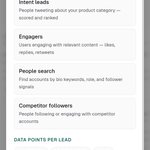
Hunt leads from 25+ sources in real time: Maps, X, LinkedIn, niche directories, and more — local, social, professional, and industry-specific, all covered.
Every lead comes back scored, with a brief on who they are and the opener written from what the hunt actually found
Leadzkit.com


Asking users what they want gives you a wishlist, not a roadmap. people ignore the features they asked for and cling to the ones nobody requested.
Behavior is the roadmap, the survey is fan mail.
the token psychology is real. not counting tokens changes how i work - more experiments, longer chains, better calls. the upfront hardware cost is steep but that mental shift is the part people miss.

Been playing with 2 DGX Sparks for the last few weeks, running DeepSeek V4 Flash 0731 official FP8.
Now running a near Opus-level model locally at:
→ 75-89 tok/s single stream (TP=2 mode)
→ 1M+ context (verified retrieval)
Significant upfront cost today, but this feels like a glimpse of future of AI:
Unlimited frontier intelligence. Always available. Fully private.
There is something liberating about not having to think about tokens anymore. I can ask my agents to read every email, every document, run continuously, retry endlessly without worrying about tokens while keeping everything local.
Documented benchmarks, experiments and failures here: github.com/harshilmathur/spa…
Next: try Qwen3.8-Flash-Next & post training

ALT DGX Sparks connected with QFSP cable

ALT 77 tok/s sustained speed
Everyone claims they ship from evidence but the roadmap is still sorted by excitement.
The tell is no customer asked for half of it.
Build what already has a queue, not what you are itching to code.
An llm calling your startup idea amazing is the cheapest validation on earth, they're tuned to agree.
The only oracle that won't flatter you is a stranger with a credit card and a problem.
Tunning 150 agents stops being a coding problem and becomes an ops one. the ones who make it work spend more time on queues, retries, and review gates than on the agent itself.
Most people stall around 5-10 because they skip the supervision layer entirely.

The signal to your best people is just the math. lay off 60% while printing record numbers and the good engineers read it as the upside being gone.
They ship resumes before the reorg deck lands, and the culture you spent 20 years building walks out with them.


You don't beat an incumbent by matching its feature list. valkey copying redis note for note just makes it a cheaper redis, and nobody switches for cheaper alone.
The young tool wins on the one thing the incumbent is too big to change.
A saas listed for $14k with $24 in lifetime revenue isn't a business, it's code plus a promise.
You're buying the work done, not the customers, and customers were the part that never showed up.
The code transfers, the traction doesn't.
Real play. the directory is filling up fast though, so the winners are tools that solve a specific task inside an actual Claude workflow, not generic wrappers. signups are easy now, retained trials are the filter.


A $100k milestone post gets the likes, but the $0 to $1k post is the one worth copying.
The first dollar is where every channel gets tested for real, and by six figures the winning one is already obvious.
Show the early steps.
Offer what the customer actually need not what you think they might want.
That's why it's important to market an idea before even building so you can validate it and see if there is enough interest.
Distribution before Vibe coding

Shipping into a void and calling it distribution is the norm. launch the link, post it twice, then refresh analytics like a roommate checking the fridge.
The accounts that grow treat distribution like a second product, with its own backlog and weekly goals.
I thinks we already past that building is not longer the obstacle, distribution is the moat and will for long time.
Getting people to know the product is the 70% of a successful launch.
Let's be honest most vibe coders are simply iterating themselves very hard to find new ideas that are genuinely unique.
Distribution is the moat, and that's what we solve at Leadzkit.com
Finding and scoring leads with intent. Tell leadzkit agent your product, it goes ahead and build a complete customer profile, design a lead hunt and launch the campaign.
