

We pull back the curtain, look under the hood, & investigate how elections are won--all to inspire political leaders who are reigniting American patriotism.
Washington, DC
Joined December 2011
- Tweets1.2K
- Following420
- Followers201
- Likes713




Pinned Tweet
🚨 NEW EPISODE: Who Wins the 2026 Midterms? A Pollster & Elections Forecaster Compare Notes
Join @DustinOlson and Patrick Allocco (@psallocco) of the @ZoosePolitical Index for their 2026 midterm outlook, a closer look at polling and forecasts, and the stories behind Patrick’s career—from campaign computers in the 80s to Michael Jackson and an Angola hostage situation.
The episode explores:
• The Senate map, candidate quality, and Patrick’s House forecast
• Pollster track records, public polling incentives, and AI-assisted analysis
• Campaign computing in 1985, Michael Jackson and the Angola hostage story
Watch the full episode and follow @PolTradeSecrets for more.
🚨 Host of Political Trade Secrets @DustinOlson:
“In 2012, he signed a statement endorsing the Muslim Brotherhood president of Egypt and calling to, quote, ‘purge the media and the police.’ To my knowledge, no one’s [previously] asked him to denounce that statement.”

It doesn’t matter. Whether Muslim, Mormon, or a Moonie, Abdul El-Sayed’s faith is not the issue. His own signature is.
I joined anchor Cary Dunst on @NTDNews Evening News to explain the question reporters should be asking El-Sayed—and keep failing to ask.
Why did El-Sayed sign a 2012 statement endorsing Egypt’s Muslim Brotherhood president and calling on him to “purge the media and the police as soon as possible”?
And why has he never directly explained or denounced it?
In 2011, El-Sayed pushed back against concerns that the Muslim Brotherhood was gaining power, dismissing those fears as part of an “orientalist narrative” in op-eds for The Guardian and HuffPost.
Forget guilt by association—even though there is A LOT of that. Hold El-Sayed accountable for his own words, actions, and political judgment.
Thanks to Cary and the @NTDNews Evening News team for the conversation.
> Watch the full segment below—don’t forget to like, share, and subscribe to my X for more xitter.cf/DustinOlson/status/211…
Does a high election forecast accuracy tell you how well someone calls the close races? @psallocco explains why he looks past safe seats and checks the battlegrounds. Pollster @DustinOlson asks what those accuracy scores actually measure.
> Find the full episode here —don’t forget to like, share, and subscribe for more: na2.hubs.ly/H08FXTX0
🚨 Host of Political Trade Secrets @DustinOlson:
“If there was a wave, it crested a few weeks ago—and it may not have the same energy when it hits the beach.”
There’s an old saying in politics: You hunt where the ducks are.
I joined hosts @SharlaMcBride and @marc_lotter on @NEWSMAX’s Wake Up America to shed light on Michigan’s tale of two rallies.
Trump went to turn out his base in a part of the state he won with 66%. Meanwhile, Obama was in Detroit because, as our research shows, key parts of the Democratic coalition have real problems with Abdul El-Sayed.
Our research found a 17-point candidate-specific drop for El-Sayed among Jewish Democrats, with similar warning signs among churchgoing Black voters.
And across the Senate map, any potential blue wave seems to have crested a few weeks ago—and may not have the same energy when it hits the beach, as Republicans appear to be turning out.
Thanks to fellow guest @MaryWalterRadio, Sharla, Marc, and the entire Wake Up America team at NEWSMAX.
🚨 Host of Political Trade Secrets @DustinOlson:
“Polling is a bit like crack cocaine for reporters. When you get a new poll, it’s a pretty easy headline to write.”
Can you trust the poll behind the headline? Here are three simple tests.
I joined anchor Cary Dunst on @NTDNews Evening News to unpack the crazy Wedgewood fake polling firm and similar revelations, and to shed light on how reporters—and the public—can separate credible polling from bad polling.
1. Three clicks or you’re out.
The methodology, full toplines, crosstabs, sponsor, field dates, interviewing methods, and the percentage collected through each mode should be easy to find–-in three clicks or less from the headline.
If they hide the details or make them hard to find, throw it out.
2. Find the #1 question: “Who did you vote for in the last presidential election?”
That is one of the most important tools pollsters have developed for finding hidden Trump voters, shy Trump voters, working-class Republicans, and other working-class voters who are less likely to answer surveys.
If they didn’t ask it, throw it out.
If they asked it, but their sample describes a fantasy version of the last election, throw it out.
3. Examine how they collected the interviews.
If a survey relies entirely on one cheap method—such as 100% paid online panel respondents or 100% text messages—throw it out.
Remember the famous “Dewey Defeats Truman” polling failure. In 1948, Republican households were more likely to have telephones, so telephone polling oversampled Republicans. Today, text-only polling can create the opposite problem by producing too many Democrats.
Serious polling reaches voters in multiple ways with a focus on real human-to-human telephone interviews.
You can do much more, but these are 3 simple steps to get started.
🚨 Will Campaigns have a dedicated AI position on staff or will it be a hybrid? Julie Sweet explains why the answer depends on the race, the team, and the budget.
> Find the full episode here—don’t forget to like, share, and subscribe to @DustinOlson on X for more: na2.hubs.ly/H08znGZ0
🚨 When everyone has access to new tools, what makes someone worth hiring? Justin Germany explains why trust and the ability to deliver still matter.
> Find the full episode here —don’t forget to like, share, and subscribe to @DustinOlson on X for more: na2.hubs.ly/H08znGs0
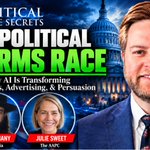
🚨 NEW Political Trade Secrets: The Political AI Arms Race: How AI Is Transforming Campaigns, Advertising, & Persuasion.
Join @DustinOlsonOlson and his guests Julie Sweet of the AAPC and @JustinGermany of Outlaw Media as we pull back the curtain on how AI is changing the mechanics of campaigning in the 2026 midterms and beyond.
Episode explores:
• The new information filter: How chatbots, AI search summaries, and personal assistants could change what voters learn about candidates.
• A look toward 2028: Personalized political messages, synthetic influencers, and AI agents that could change how campaigns and voters interact.
• And more!
Listen on Apple Podcasts NOW: na2.hubs.ly/H08znQp0

🚨 Host of Political Trade Secrets @DustinOlson:
“Like in 1948, when they said Truman was going to lose and they had the headline ‘Dewey Defeats Truman,’ Republicans had telephones at home, and they oversampled Republicans. We’re having the same thing happen with text messaging—it gets more Democrats, and it’s going to have an affect on polling this cycle.”
Could some of today’s cheap media polling methods produce another “Dewey Defeats Truman” moment?
I joined anchor @VeronicaDudo on @EWTN News Nightly to explain how cutting corners with 100% text-message surveys or cheap online panels of paid respondents could distort the 2026 midterm picture.
In 1948, telephone polling oversampled Republicans because Republican households were more likely to have phones. Today, text-only polling typically produces too many Democrats—and too many Republicans who don’t like Trump.
By contrast, higher-quality internal polls connect with voters in more than one way and still conduct a majority of interviews human-to-human by telephone.
The technology changed. The sampling challenge didn’t.
Thanks to @VeronicaDudo and the @EWTN News Nightly team.
> Watch the full segment below—don’t forget to like, share, and subscribe to my X for more xitter.cf/DustinOlson/status/211…
🚨 If AI can generate the video, why do you still need a creative director? @JustinGermany explains why the concept, creative judgment, and production experience still matter.
> Find the full episode here —don’t forget to like, share, and subscribe to @DustinOlson on X for more: na2.hubs.ly/H08znCm0
🚨 A dramatization, a reenactment, or a synthetic person? Julie Sweet explains why an AI disclosure should help viewers understand what they are actually seeing, not just simply say some AI was used.
> Find the full episode here—don’t forget to like, share, and subscribe to @DustinOlson on X for more: na2.hubs.ly/H08znFV0
🚨 Host of Political Trade Secrets @DustinOlson:
“Republicans appear to have embraced artificial intelligence in their campaigns more than Democrats.”
Will Artificial—or Super—Intelligence shape the 2026 midterms?
I joined anchor @VeronicaDudo on @EWTN @News Nightly to explain what our polling says about voters’ views of AI—and why research suggests a political AI arms race is already unfolding behind the scenes in campaigns.
We also discussed why the Senate map may play out differently from the House, why it could buck the national media narrative, and the polling pitfalls to watch in 2026.
It was a great conversation for EWTN’s worldwide Catholic news audience.
Thanks to the talented @VeronicaDudo and the @EWTN News Nightly team.
Pollster Dustin Olson is joining @EWTNNewsNightly anchor @VeronicaDudo on the Global Catholic Network this evening at the top of both broadcasts:
6 p.m. Eastern
9 p.m. Eastern
Olson will answer: Can you trust the polls?
They’ll discuss midterm Senate races and what reporters and voters can look for to tell whether a poll is credible.
Watch on Cable, DIRECTV 370, DISH Network 261, or Online: na2.hubs.ly/H08BjQ90

🚨 @JustinGermany explains how the use of AI in content production opens up more possibilities for campaigns to produce creative and fun ads and videos to connect with voters..
> Find the full episode here—don’t forget to like, share, and subscribe to @DustinOlson on X for more: na2.hubs.ly/H08znFP0
🚨 NEW Political Trade Secrets: The Political AI Arms Race: How AI Is Transforming Campaigns, Advertising, & Persuasion.
Join @DustinOlson and his guests Julie Sweet of the AAPC and @JustinGermany of Outlaw Media as we pull back the curtain on how AI is changing the mechanics of campaigning in the 2026 midterms and beyond.
Episode explores:
• Satire, deception, & disclaimers: What Julie’s research reveals about voter trust—and why labeling something “AI-generated” may not explain what viewers are actually seeing.
• The less-visible battle: How model refusals, political free speech, and data privacy affect the work happening behind the scenes.
• And more!
>Listen on Spotify NOW: na2.hubs.ly/H08znML0

🚨 From audience prompts to a finished 15-second ad in under two hours. @JustinGermany and Julie Sweet explain what happened during an AI demonstration at an AAPC event.
> Find the full episode here—don’t forget to like, share, and subscribe to @DustinOlson on X for more: na2.hubs.ly/H08znFw0
PREDICTION MARKETS: When the research and the odds disagree, where’s the opportunity?
Join @DustinOlson and Sean Bartley LIVE TOMORROW, Friday, October 23, at NOON ET, for American Pulse’s Polling Club Strategy Session:
Finding the Best Prediction Market Plays:
Where the Research & Odds Disagree
Where might the markets be underestimating an outcome—and overlooking potential upside? Dustin and Sean will dig into the research, compare it with the odds, and discuss what they’re watching.
Bring your questions. Let’s get into it!
🎯 STRATEGY SESSION RSVP: na2.hubs.ly/H08zl_M0
🚨 AI in campaigns goes beyond making ads. Julie Sweet explains how it is showing up in fundraising, polling, and even door-knocking quality control.
> Find the full episode here—don’t forget to like, share, and subscribe to @DustinOlson on X for more: na2.hubs.ly/H08zfTl0
🚨 NEW Political Trade Secrets: The Political AI Arms Race: How Artificial Intelligence Is Transforming Campaigns, Advertising, & Persuasion.
Join me and my guests Julie Sweet of the AAPC and @JustinGermany of Outlaw Media as we pull back the curtain on how AI is changing the mechanics of campaigning in the 2026 midterms and beyond.
Episode covers:
• Who’s ahead—and where: Republicans’ early-adoption advantage, how both parties are adapting, and where Democrat organizations are getting their material into AI-generated candidate answers.
• Inside the creative process: Justin breaks down how he created the first-ever 100% AI-generated television ad, how the technology is advancing, and explains why making an AI ad still requires a director, not just a prompt.
• And more!
> Watch NOW: youtu.be/UiK1-PattOg
