

A not-for-profit, education and research organization, pursuing its dream of contributing to India's school-level education.
Bengaluru, India
Joined July 2020
- Tweets1.3K
- Following61
- Followers730
- Likes56





Have you ever wondered why some plants grow tall while others remain short? What determines the features passed from one generation to the next?
These questions take us into the fascinating world of genetics.Through the work of Gregor Mendel, our Prerana students explored how plants inherit features from their parents. By observing, questioning and experimenting, they began to understand that even the simplest differences in plants follow patterns that can be studied and explained.
This learning initiative aligns with United Nations Sustainable Development Goal 4 – Quality Education, promoting inclusive and equitable quality education through experiential learning and scientific exploration.
YT Link : youtu.be/9EgLxFKBa1I
#Plants #Tall #Short #Genetics #Beads #White #Golden #Prayoga #Prerana
[Gregor Mendel, Exploration, Inherit, Questions, Patterns, SDG4, Experiment]
41
What happens when a simple push turns into a moment of discovery? At KPS Government High School, Hanumanahalli, Madhugiri, Dr. Manohar is making science come alive by turning textbook concepts into exciting classroom experiences. Through demonstrations, experiments and everyday materials, he encourages students to observe, question and discover the science behind what they see.
With the learning resources provided through Prayoga's Kriya programme, every lesson becomes an opportunity to explore science beyond the textbook. In partnership with Omnicom Global Solutions, Prayoga is bringing more meaningful and experiential science learning into classrooms, with teachers like Dr. Manohar leading the way.
This initiative aligns with United Nations Sustainable Development Goal 4: Quality Education, promoting inclusive and equitable quality education through experiential science learning and improved classroom practices.
YT Link: youtu.be/caLHbjhWPqc
#Kriya #Prayoga #Teacher #Spotlight #ExperientialLearning #ScienceEducation #OGS #QualityEducation #LearningByDoing
[Teacher Empowerment, Science Teaching, Hands-on Learning, Classroom Experiments, Government School Education, Experiential Science Learning]
74
Great teaching is a journey of continuous learning. And sometimes, the most meaningful lessons begin when teachers become learners themselves.
Over two days in Karnataka Public School, MB Nagar, Kalaburagi, 13 teachers came together to explore new approaches to science education, engaging with practical activities and to look at familiar concepts from fresh perspectives.
Through Teacher Empowerment Programme, we at Prayoga continue to create opportunities for teachers to strengthen their classroom practices and make science learning more engaging and meaningful.
When teachers grow, the possibilities for their students grow too.
YT Link: youtu.be/eZ3ZshAZBqs
#TEP #Prayoga #Impact #Education #Science #Teachers #Empowerment #Kalaburgi
[Research, India, Learn, Innovation, Transform]
2
101
A blank sheet of paper. A secret message no one could see. And then, sunlight.
Students from Shri Vani Educational Trust, Rajajinagar who were on Prayoga campus to participate in Prerana, became secret-message writers for the day. Brushes dipped in silver nitrate, they wrote on salt-treated paper and waited. Nothing appeared at first. Then they stepped into the sun, and one by one their hidden words slowly darkened into view.
That moment of surprise was chemistry at work, the same light-sensitive reaction behind early photography.
Because the best way to understand science is to experience it.
YT Link: youtu.be/98-eLbri9T8
#Prerana #HandsOnScience #ExperientialLearning #Chemistry #STEMEducation #ScienceForKids #India #TransformEducation #SDG4 #QualityEducation
[Photographic invisible ink, invisible ink experiment, silver nitrate, silver chloride, light-sensitive chemistry, chemistry experiment for kids, hands-on science, experiential learning, science through experiments, early photography science, sunlight chemical reaction, science outreach, student science activity, Prerana, Rajajinagar, Bengaluru, SDG4, Quality Education]
68
A little mud on their hands, a thousand ideas in their heads and an entire universe waiting to be explored.
#HappyChildrensDay #CelebrateChildhood #LittleExplorers #LearningByDoing #Prayoga
[Childhood, Imagination, Exploration, Hands-on Learning, Young Minds, Possibilities, Learning Through Experience]
92
What if materials developed in the laboratory could power the next generation of compact, energy-efficient heating devices?
At the fifth edition of Anveshana, student researchers Aditya Bhat, Neha Bhati, Varshini Srinivas, students of grade 12 from Inventure Academy and Arya Arun Avadhani, a grade 8 student from Canadian International School, explored how functional nanomaterials could be harnessed to develop microheaters. They worked on the project 'Design and fabrication of low-cost screen printed micro-heaters using functional nanomaterial inks' guided by Principal Investigator Dr. Omprakash SS and Co-Principal Investigators Aditya Kashyap and Adarsh VN.
Their investigation brought together nanotechnology, materials science and device engineering, culminating in the fabrication and testing of printed heating devices. The research highlights the potential of material innovations in advancing technologies such as gas sensing, wearable electronics and microfluidics. Exploring alternatives to conventional materials also opens up possibilities for more efficient and adaptable device fabrication.
By taking an idea from the laboratory towards a working prototype, the students experienced how curiosity-driven research can lead to technological innovation.
Aligned with UN SDG 4 – Quality Education | SDG 9 – Industry, Innovation and Infrastructure
YT Link: youtu.be/rKv6moqJ_Ug
#Prayoga #Anveshana #MaterialsScience #StudentResearch #Nanomaterials
[Nanotechnology, Functional Nanomaterials, Microheater Development, Materials Research, Printed Electronics, Device Fabrication]

1
65
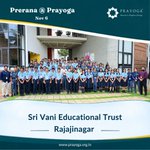
A few drops. A gentle stir. Then a cloudy white thread rose to the surface: DNA, extracted live by Class 9 students, with their own hands.
That was only the start of the day for 62 students from Sri Vani Educational Trust, who visited Prayoga campus for Prerana.
Next came genetics. Working through Mendel’s monohybrid cross, they predicted how traits pass from parents to offspring.
What followed later was a little magic. A blank sheet of paper slowly gave up a hidden message, written in photographic invisible ink.
Finally, they went deep beneath their feet. An avocado, sliced in half, became a model of our planet, with crust, mantle and core. They followed the slow churn of convection currents in the mantle and traced how P and S waves race through the Earth when it shakes.
From a strand of DNA to the core of the Earth, all in a single day. That’s Prerana.
#Prerana #SriVaniEducationalTrust #Rajajinagar #HandsOnScience #ExperientialLearning #ScienceEducation #STEMEducation #LearningByDoing #Biology #Physics #EarthScience
[Prerana, Sri Vani Educational Trust, Rajajinagar, school visit, experiential learning, hands-on science activities, biology experiments, physics experiments, earth science, STEM education, Bengaluru]


98
Ice is a bigger problem than most of us think.
When ice builds up on aircraft wings, drone propellers, wind turbine blades or power lines, it changes how they work. Even a thin layer on a drone blade cuts lift, so the motors work harder and the battery drains faster. Today’s heaters and chemical sprays add weight and use more power.
A smarter fix is to stop ice from sticking in the first place.
Under the Anveshana Research Project, students Vinoda B Naduvinamani (9th Std, Government High School, Chikkamalligwad, Dharwad), Swapna P (11th Std, PM Shri School Jawahar Navodaya Vidyalaya, Kolar) and Mihir Chedga (8th Std, Chinmaya Vidyalaya, Bangalore), guided by PI Dr. Ramya Prabhu B (Research Scientist) and Co-PI Dr. Omprakash S S (Senior Research Scientist), studied “Engineering Durable, Superhydrophobic Coatings for Anti-Icing Applications.”
Taking a cue from the lotus leaf, the team built a water-repelling coating from soot, whose rough carbon networks trap air and push water away before it can freeze.
Soot made from eight everyday oils.
Chemistry, structure and surface studied using FTIR, XRD and FESEM/EDX
Spray-coated onto glass and tested for contact angle and roll-off angle
Two oils stood out and produced superhydrophobic coatings. The key finding is that the soot’s physical structure, more than the oil it came from, decides how well a coating repels water.
This early work shows that a basic flame and everyday oils could be a starting point for low-cost, energy-free anti-icing coatings that make drones, aircraft and wind turbines safer and save energy. Durability testing is the next step. Along the way, the students built skills in materials synthesis, characterisation, spray coating and wettability testing.
Simple materials. Smarter science.
YT Link: youtu.be/jcZELt6D8QU
Explore Prayoga's profile and programmes: prayoga.org.in/programs/anve…
#Anveshana #PrayogaInstitute #StudentResearch #MaterialsScience #Superhydrophobic #AntiIcing #SurfaceEngineering #LotusEffect #SustainableEngineering #ResearchAndInnovation
[Superhydrophobic coatings, anti-icing coatings, soot-based coatings, lotus effect, materials characterisation, contact angle, surface engineering, low-cost coatings, Anveshana Research Project, Prayoga Institute of Education Research]

72


This Thanksgiving, Make a difference.
About 1 in 7 girls in Karnataka leave school once they enter high school. Jeevitha was one of them. Today, she’s back at her government high school in Chitradurga. What brought her back was hands-on science: experiments, questions, and a classroom that made her feel capable.
At Prayoga Institute of Education Research, a DSIR-recognised research organisation in Bengaluru, we bring experiential science learning to rural government schools:
Kriya reaches 16,500+ students and 340 teachers across 125+ schools in Karnataka.
Anveshana students have published 12 papers in international peer-reviewed journals and won Best Poster at Bengaluru India Nano 2026.
Lab Stations put real equipment in classrooms that have never had a lab.
This Thanksgiving, choose where your gift goes on Benevity:
$100 | Support Courseware: a full year of hands-on Kriya workbooks for five students.
$200 | Support Lab Stations for Government Schools: turn a chalk drawing into a real experiment.
$250 | Support Prayoga: bring hands-on learning, teacher support and lab access to a new classroom.
$300 | Support a Rural Child: give another girl student a reason to keep learning.
$500 | Support Anveshana Equipment: open the door to research for more students.
Use our Benevity ID: 356-5665223621210_d3f7
YT Link: youtube.com/post/UgkxQU8B92B…
#Thanksgiving #GivingSeason #Benevity #ScienceEducation #STEMForAll #GirlsInSTEM #RuralEducation #Prayoga
1
85
This Thanksgiving, Make a difference.
About 1 in 7 girls in Karnataka leave school once they enter high school. Jeevitha was one of them. Today, she’s back at her government high school in Chitradurga. What brought her back was hands-on science: experiments, questions, and a classroom that made her feel capable.
At Prayoga Institute of Education Research, a DSIR-recognised research organisation in Bengaluru, we bring experiential science to rural government schools:
Kriya reaches 16,500+ students and 340 teachers across 125+ schools in Karnataka.
Anveshana students have published 12 papers in international peer-reviewed journals and won Best Poster at Bengaluru India Nano 2026.
Lab Stations put real equipment in classrooms that have never had a lab.
This Thanksgiving, choose where your gift goes on Benevity:
$100 | Support Courseware: a full year of hands-on Kriya workbooks for five students.
$200 | Support Lab Stations for Government Schools: turn a chalk drawing into a real experiment.
$250 | Support Prayoga: bring hands-on learning, teacher support and lab access to a new classroom.
$300 | Support a Rural Child: give another girl student a reason to keep learning.
$500 | Support Anveshana Equipment: open the door to research for more students.
Use our Benevity ID: 356-5665223621210_d3f7
YT Link: youtube.com/post/UgkxQU8B92B…
#Thanksgiving #GivingSeason #Benevity #ScienceEducation #STEMForAll #GirlsInSTEM #RuralEducation #Prayoga
69
What if agricultural waste could help make natural rubber stronger?
From the milky-white latex of the rubber tree to fibres hidden in banana stems, pineapple leaves, and areca nut husks, this research explores how materials often treated as waste can find new purpose.
Young researchers Ankan Das, 9th Std, DAV public school, Bangalore, Chandraveer Datt More, 8th Std, SRN Mehta CBSE School, Kalaburgi and Stanzin Zangmo, 9th Std, Lamdon Model Senior Secondary School, Ladakh, guided by PI Dr. Subhadip Senapati, Senior Research Scientist, Dept. of Chemistry and Co-PI Shashikumar C Chikkajjanavar, Research Associate, investigated a more sustainable way to process and strengthen natural rubber.
Their work explored citric acid as an alternative to formic acid for latex coagulation. They also transformed agricultural residues into reinforcing fibres for natural rubber composites. The results showed that fibre reinforcement increased tensile strength by approximately 2.3 to 3.6 times compared with unreinforced natural rubber.
A study where scientific curiosity meets sustainability—turning agricultural residues into valuable materials and exploring new possibilities for stronger, more sustainable natural rubber. This research aligns with the United Nations Sustainable Development Goals: SDG 9 – Industry, Innovation and Infrastructure; SDG 12 – Responsible Consumption and Production; and SDG 13 – Climate Action.
YT Link: youtu.be/A3ZH8ytK868
#Prayoga #Anveshana #ScienceResearch #NaturalRubber #SustainableMaterials #AgriculturalWaste #WasteToWealth #MaterialScience #GreenChemistry #UNSDG #SDG9 #SDG12 #SDG13
[Natural Rubber, Sustainable Rubber Processing, Fibre-Reinforced Composites, Citric Acid, Material Science, Sustainable Innovation]

98
Can discarded papaya seeds offer clues for future drug discovery?
Three high school students Nachiketa Umesh Rudrapatna (10th Std, Rashtrotthana Vidya Kendra, Bengaluru), Advik Abhay Kenjale (10th Std, Sri Sri Ravishankar Vidya Mandir, Bengaluru) and Ananya Sanjay Vyawahare (9th Std, Somalwar High School, Nagpur) explored this question through computer-aided drug discovery.
They carried out the Anveshana project 'A Multiscale Computational Approach Combining Molecular Docking, Enhanced Sampling Molecular Dynamics and Drug–like Properties of Some Bioactive Compounds', guided by Principal Investigator Dr. Athavan Anand at Prayoga Institute of Education Research.
In just two months, they built a computational screening workflow to analyse 94 natural compounds, developed LigandIQ — a web platform that brings compound and protein information together — and explored promising compound–protein interactions through molecular dynamics simulations. When their laptops struggled with the computational workload, Advik even built his own computing system!
The project has not one but two highlights! They won the first prize in Anveshana 2026 and Advik was mentioned in a LinkedIn post by Dr. Renata, Chief Scientific Officer, Deloitte South Asia, in a wonderful recognition of the curiosity, initiative and ingenuity behind their work.
While the findings are preliminary and await laboratory validation, the project demonstrates how young researchers can engage with complex scientific questions, build computational tools and take meaningful steps towards scientific discovery.
Anveshana, indeed, nurturing the next generation of scientists for the nation!
Aligned with UN SDG 4 – Quality Education and SDG 9 – Industry, Innovation and Infrastructure
YT Link: youtu.be/dLc8J4reP5c
#Anveshana #Prayoga #DrugDiscovery #ComputationalBiology #STEMEducation
[Anveshana, papaya seed compounds, computer-aided drug discovery, computational screening, molecular docking, molecular dynamics simulation, LigandIQ, student-led research, scientific innovation]
1
102
Prayoga hosted a group of 60 Class 9 students from Sri Vani Education Centre on October 30, as part of its Prerana programme.
Through engaging, hands-on learning experiences across Biology, Mathematics and Earth Sciences, students explored genetics, understood the concept of angles and investigated the movement of water.
The session encouraged students to look beyond textbooks, connect with scientific concepts through exploration and nurture their curiosity about the world around them.
At Prayoga, we believe that meaningful science learning begins with curiosity and grows through inquiry and experience.
Aligned with UN SDG 4 – Quality Education
YT Link: youtu.be/gDgD6WxN5gY
#Prayoga #Prerana #ExperientialLearning #ScienceEducation #QualityEducation
[Experiential Science Learning, Inquiry-Based Learning, Science Education, Student Engagement, Hands-on Learning, STEM Education]
79
A glimpse into TEP 2026 — bringing educators together to explore, engage, experiment, and transform the way learning happens.
Every interaction is an opportunity to learn, every experience a step towards better teaching.
YT Link: youtu.be/j2-_89mZuns
#TEP2026 #Prayoga #TeacherEducation
#ExperientialLearning #TransformingEducation
97


What else might be present in the tea we drink every day?
This was the question explored by three student researchers - Manasvi Sheetal Todarwal, 9th Std, Ashoka Universal School, Maharashtra, Shaivi Gururaja, 12th Std, Vidyashilp Academy, Bengaluru and Vishnu vardan, 9th Std, Karnataka public school, Kolar - under the guidance of PI Dr. K. S. Nagabhushana and Co-PI Kishorkumar Sindogi with the team Rangaswamy GE and Gagan BS, at Prayoga Institute of Education Research.
The team studied 20 popular tea brands in India, using scientific techniques to screen for pesticide residues, other chemical compounds, measure metal content in selected samples and extract caffeine for further analysis. The investigation found recurring chemical signatures that require further testing for confirmation, along with trace amounts of certain metals.
The research reflects what scientific inquiry is about — turning an everyday observation into a question and exploring it through experimentation, analysis and evidence.
This study connects with United Nations Sustainable Development Goal 3: Good Health and Well-being and SDG 12: Responsible Consumption and Production, highlighting the importance of food safety, chemical assessment and informed consumer choices.
Explore Prayoga's profile and programmes: prayoga.org.in
YT Link: youtu.be/QckRw3cudRM
#Prayoga #ScientificResearch #YoungResearchers #TeaChemistry #Anveshana
[Tea Chemistry, Pesticide Residues, Chemical Analysis, Tea Safety, Caffeine Extraction, Metal Content Analysis, Food Safety, Scientific Investigation, Student Research]

1
119
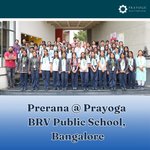
On October 23, students from BRV Public School visited Prayoga for Prerana, a day of experiential learning across three disciplines:
Biology: Serial dilution and DNA extraction
Physics: Understanding common defects of the human eye, and calculating the value of g using a ticker tape timer
Earth Science: Exploring mechanical erosion
Working in our labs, students measured, observed and experimented for themselves, discovering the concepts behind each activity by doing them.
It was a delight to host BRV Public School and their students, who brought remarkable curiosity and energy to every activity.
#Prerana #BRVPublicSchool #HandsOnScience #ExperientialLearning #ScienceEducation #STEMEducation #LearningByDoing #Biology #Physics #EarthScience
[Prerana, BRV Public School, school visit, experiential learning, hands-on science activities, serial dilution, DNA extraction, human eye defects, value of g, ticker tape timer, mechanical erosion, biology experiments, physics experiments, earth science, STEM education, Bengaluru]


1
67
The right catalyst can turn a plant-derived compound into a fragrance ingredient in a short time.
Nopol is a renewable compound derived from terpenes, natural compounds found in plants. One of its most commercially useful derivatives is nopyl acetate, valued especially in the fragrance industry. But how efficiently nopol becomes nopyl acetate depends on the catalyst that drives the reaction. And how that catalyst is made can change how well it performs.
As part of the Anveshana Research Project at Prayoga Institute of Education Research, student researchers Chinmayi P Joshi (11th Std, Tungal School), Thanushree A (9th Std, Sri Sarada Devi Vidya Kendra) and Shriram H Shetty (8th Std, SMS English Medium School) worked on "Influence of Sulfur Sources on the Performance of Sulfated Zirconia Catalyst". They were mentored by PI Dr. Vijaykumar Marakatti (Senior Research Scientist) and Co-PI Aditya Kashyap (Senior Research Associate).
The team evaluated sulfated zirconia as a solid acid catalyst for converting nopol to nopyl acetate. They set out to test whether the different precursors used for sulfation affects the catalyst's performance. Along the way, they worked through every stage of catalyst development: synthesis, characterisation, and testing in the nopol esterification reaction. The results were promising. Sulfated zirconia catalysts prepared separately using sulfuric acid and ammonium persulfate showed the highest catalytic activity. It reached around 88% nopol conversion within 30 minutes, and complete conversion within an hour.
The study also suggested that the choice of sulfating precursor influences the properties of catalyst and in turn, its catalytic activity. This study points the more efficient routes to renewable fragrance compounds.
Explore Prayoga's profile and programmes: prayoga.org.in/programs/anve…
YT Link: youtu.be/pvEAxcY6aGI
#Anveshana #Prayoga #StudentResearch #SDG12 #GreenChemistry #Catalysis
[Catalysis, Green Chemistry, Sulfated Zirconia, Solid Acid Catalysts, Esterification, Renewable Chemicals, Fragrance Chemistry, Materials Characterisation, Student Research, Education Research]
61