

Data-driven insights & expert commentary on the oil & gas industry. U.S. Frac Spread Count, Frac Job Count, EFRACS Analytics console and more!
Serving The Globe
Joined May 2013
- Tweets6.8K
- Following1.2K
- Followers3K
- Likes96







For an integrated oil major, financial resilience increasingly depends on how effectively it manages its portfolio, not simply how much oil it produces.
BP's Q3 2026 outlook brings this question into focus.
The question is whether operational improvements and a more focused portfolio can deliver sustained financial strength when market conditions become less favorable.
In Primary Vision's Q3 2026 Take Three, we examine the three questions that could shape BP's next chapter.
[BP, BP Q3 2026, Oil and Gas Earnings, Integrated Oil Majors, Refining Margins, Castrol Divestment, Portfolio Optimization, Balance Sheet]

Can international expansion compensate for a prolonged slowdown in North American fracking? For Halliburton, the answer may depend on how effectively overseas opportunities translate into project execution, stronger margins and sustained profitability.
In Primary Vision's Q3 2026 Perspective, we examine Halliburton's growth prospects and its ambition to improve operating margins by approximately 200 basis points in 2027.
[Halliburton, Q3 2026 Earnings, Oilfield Services, International Expansion, North American Fracturing, Operating Margins, Middle East Energy]

U.S. drilling activity remains on hold, even as the oil market continues to navigate elevated prices and geopolitical uncertainty.
Primary Vision has been featured in OilPrice.com’s latest coverage, “U.S. Oil, Gas Drillers Still on Hold,” examining the state of American drilling activity.
According to Baker Hughes, the U.S. rig count remained unchanged at 603 this week, although it stands 57 rigs above the same period last year.
The contrast raises an important question about the industry's response to stronger oil prices.
Will sustained higher oil prices eventually encourage another expansion in U.S. drilling, or has capital discipline fundamentally changed how shale producers respond?
[Primary Vision, OilPrice.com, Media Coverage, U.S. Rig Count, Baker Hughes, Oil and Gas Drilling, U.S. Shale, Oil Prices, Drilling Activity, Capital Discipline]

Oil prices are opening the week lower as renewed diplomatic efforts ease some of the geopolitical risk premium built into crude markets.
As of November 2, Brent stands at $108.5 per barrel, while WTI is trading at $99.52. Murban crude remains elevated at $114.8, reflecting the continued importance of Middle Eastern supply to international markets.
The distinction is important. Diplomatic developments can change market expectations almost immediately, but restoring confidence in physical supply routes, shipping security and future availability takes considerably longer.
As the week begins, markets face a familiar dilemma: how much of the current oil price reflects actual supply constraints, and how much reflects the possibility of further disruption?
What will determine the next move in crude prices: progress in diplomacy or conditions in the physical oil market?
[Oil Prices, Brent Crude, WTI Crude, Murban Crude, Oil Market Update, Iran Negotiations, Strait of Hormuz, Geopolitical Risk, Global Oil Supply]

For Nabors Industries, the outlook for 2027 brings several competing forces into focus. Improving international oilfield activity could support demand for drilling services, while geopolitical uncertainty and a higher debt burden could complicate the conversion of that demand into stronger financial performance.
In Primary Vision's Q3 2026 Take Three, we examine the questions shaping the outlook for Nabors Industries and what they could mean for its performance heading into 2027.
[Nabors Industries, NBR, Q3 2026, Oilfield Services, Drilling Services, International Drilling, Oil and Gas Investment, Energy Markets, Geopolitical Risk]

For ProPetro Holding, the approach to 2027 raises an important question about the economics of growth in oilfield services.
Primary Vision's Q3 2026 Take Three examines these competing priorities and the questions they raise for ProPetro's financial outlook.
[ProPetro Holding, PUMP, PROPWR, Q3 2026, Pressure Pumping, Hydraulic Fracturing, Frac Pricing, Oilfield Services, Data Center Power]

Europe's energy vulnerability is once again coming into focus as rising oil and diesel prices raise concerns about a potential fuel crunch.
Primary Vision's Global Markets and Product Strategist, Osama Rizvi, was featured in Yahoo News, discussing the implications of higher fuel prices and Europe's exposure to disruptions in global energy markets.
The concern extends beyond the price of crude oil. Diesel is essential to freight transportation, industrial activity and supply chains, meaning sustained price increases could place additional pressure on businesses and consumers across Europe.
[Primary Vision, Yahoo News, Osama Rizvi, Oil Prices, Diesel Prices, European Energy Crisis, Fuel Supply, Energy Security, Oil Markets, Diesel Market, Global Energy Markets, Supply Chain Disruptions, Energy Geopolitics]

For Baker Hughes, this raises an interesting question about the relationship between traditional oilfield activity and the emerging infrastructure needs of the global economy.
Our latest Q3 2026 Take Three examines Baker Hughes' expanding IET backlog, its exposure to LNG and AI power demand, and the financial considerations shaping its international outlook.
[Baker Hughes, BKR, Q3 2026 Earnings, Industrial and Energy Technology, IET, LNG Infrastructure, Artificial Intelligence, AI Power Demand, Data Centers, Energy Infrastructure]

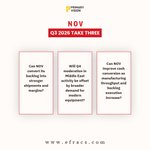
For NOV, this distinction is becoming increasingly important as the oilfield equipment industry prepares for 2027.
Our latest Q3 2026 Take Three examines NOV's order execution, regional demand outlook and the relationship between manufacturing activity and cash generation.
[NOV Inc, National Oilwell Varco, Q3 2026 Earnings, Oilfield Equipment, Oilfield Services, Manufacturing Efficiency, Order Backlog, Backlog Conversion]

For companies such as Patterson-UTI Energy (PTEN), the challenge heading into 2027 is understanding how improvements in drilling and completion productivity are reshaping the relationship between equipment demand, pricing and profitability.
Our latest Q3 2026 Take Three examines the questions shaping Patterson-UTI Energy's outlook as the industry prepares for another investment cycle.
Will the next phase of oilfield services growth be determined by how much equipment companies operate, or how much economic value they can generate from each asset?
[Patterson-UTI Energy, PTEN, Q3 2026 Earnings, Take Three, Oilfield Services, U.S. Shale, Contract Drilling, Pressure Pumping, Hydraulic Fracturing]

The real test of an offshore investment boom is how much of it translates into profitable growth. This creates an interesting advantage for companies such as TechnipFMC (FTI).
For TechnipFMC, the outlook for 2027 therefore rests on several interconnected developments: whether increased project activity can sustain subsea margin expansion, whether its opportunity pipeline converts into firm orders, and whether stronger cash generation can support both future investment and shareholder returns.
Our latest Q3 2026 Take Three examines these questions through TechnipFMC's subsea business, order outlook and free cash flow expectations.
[TechnipFMC, FTI, Q3 2026 Earnings, Take Three, Offshore Oil and Gas, Subsea Engineering, Subsea Production Systems, Offshore Investment, Project Backlog, Subsea Orders, Offshore Project Sanctioning, Capital Expenditure, Energy Security, Operating Margins]

A recovery in oilfield activity does not necessarily guarantee a recovery in profitability.
For companies operating across multiple oilfield service segments, the relationship between customer spending and financial performance is becoming increasingly complex.
RPC (RES) offers an interesting example.
For RPC, the coming quarters will test how effectively the company can convert improving activity into sustainable financial performance.
Our latest Q3 2026 Take Three examines the interaction between segment growth, operating cost pressures and working capital as RPC prepares for 2027.
[RPC Inc, RES, Q3 2026 Earnings, Take Three, Oilfield Services, Coiled Tubing, Nitrogen Services, Snubbing Services, Pintail Wireline, Well Intervention]

For SLB, the road to 2027 presents an interesting contradiction.
International oilfield activity could strengthen as producers reassess investment priorities and Middle Eastern markets gradually recover. At the same time, the rapid expansion of data center infrastructure is opening another avenue for growth.
Both developments offer commercial opportunities. Both also demand capital.
And that is where SLB's investment story becomes particularly interesting.
For SLB, the challenge is to capture opportunities in both conventional energy and emerging infrastructure markets without compromising the financial flexibility needed to navigate future investment cycles.
Our latest Q3 2026 Take Three examines three questions that could determine how this balance evolves through 2027.
Could SLB's biggest challenge in 2027 be deciding which growth opportunities are worth pursuing, rather than finding opportunities in the first place?
[SLB, Schlumberger, Q3 2026 Earnings, Oilfield Services, International Oil and Gas, Middle East Recovery, Data Center Solutions, AI Infrastructure, Kelvin Acquisition]

Oil prices are rising. But are all U.S. shale operators responding the same way?
The week opens with Brent crude at $116.70, WTI at $103.30 and Murban at $118.00 per barrel, as geopolitical uncertainty continues to shape expectations around global oil supply.
At these price levels, attention naturally turns toward U.S. shale and its capacity to bring additional barrels to market. Higher prices can improve drilling and completion economics, but they tell us surprisingly little about how individual producers will respond.
Even within the same basin, operators can pursue remarkably different development strategies. Some concentrate their activity in a handful of counties, while others distribute their operations across multiple regions. Some rely on integrated pressure pumping companies for completion chemistry, while others work directly with specialist suppliers.
These decisions shape far more than procurement. They influence operational coordination, service demand, supplier relationships and the economics of bringing wells online.
For oilfield service companies, this means that a stronger oil market does not necessarily create an equally accessible opportunity across every operator.
Understanding where activity is taking place, how completions are being executed and who controls the supply chain becomes increasingly important as producers evaluate their next investment decisions.
In this week's Monday Macro View, “Frac Chemistry Reveals Different Operator Strategies,” Primary Vision examines how five major U.S. operators approach completion activity and chemistry procurement, using our Frac Chemistry Inspector to uncover differences that broader activity measures can overlook.
With oil prices elevated and attention shifting toward the industry's potential supply response, understanding these operational choices offers another perspective on how shale development may evolve. If two operators face the same oil price and operate in the same basin, what explains why their completion strategies can look so different?
[Oil Prices, Brent Crude, WTI Crude, Murban Crude, U.S. Shale, Frac Chemistry Inspector, Frac Chemistry, Hydraulic Fracturing, Completion Activity, Oilfield Services, Pressure Pumping, Oilfield Chemicals, Operator Strategy, Capital Allocation, Permian Basin]

The next phase of oilfield services may be defined by how companies allocate capital across two very different energy markets.
The emergence of artificial intelligence as a major source of electricity demand is creating opportunities for oilfield service companies beyond their traditional markets. Equipment, power generation capabilities and operational expertise developed around oil and gas production are increasingly relevant to the infrastructure supporting data centers.
Liberty Energy now sits at the intersection of these developments.
For Liberty, the central challenge is how effectively it can deploy capital across the businesses while preserving financial discipline.
Our latest Q3 2026 Take Three examines Liberty Energy's positioning as completion markets evolve and AI infrastructure creates new sources of demand.
Could the next competitive advantage in oilfield services come from how companies allocate capital between producing energy and powering the technologies that consume it?
[Liberty Energy, LBRT, Q3 2026 Earnings, Oilfield Services, Pressure Pumping, Hydraulic Fracturing, AI Power Demand, Data Center Infrastructure, Distributed Power Generation]

Want to know where U.S. frac activity stands before the rest of the market catches up? Primary Vision’s latest Frac Spread Count™ is LIVE now!
Visit our website for the latest update and see what U.S. completion activity is telling us this week.
efracs.com
[Frac Spread Count, Frac Job Count, U.S. frac activity, U.S. completions, hydraulic fracturing, well completions, pressure pumping, oilfield services, upstream oil and gas, frac crews]

Can stronger cash generation translate into sustained growth for Weatherford International in 2027?
As oilfield service companies navigate changing investment priorities and uncertain commodity markets, the focus is increasingly shifting toward the quality of earnings, capital efficiency and the ability to convert operational improvements into shareholder value. For Weatherford International, the coming quarters present an important test.
Our Q3 2026 Take Three is now LIVE!
[Weatherford International, WFRD, Q3 2026 Earnings, Take Three, Oilfield Services, NCS Multistage, Multistage Completions, Hydraulic Fracturing, Completion Technology]

What do America's emergency oil reserves and frac activity tell us about the country's ability to respond to supply disruptions?
The Strategic Petroleum Reserve reflects the oil available to cushion a supply shock, while frac activity offers clues about the industry's capacity to bring additional production online.
Together, they raise important questions about U.S. energy security, supply resilience and the limits of responding to higher oil prices.
What happens when immediate supply protection meets the realities of bringing new barrels to market?
[Strategic Petroleum Reserve, SPR, Frac Spread Count, U.S. Shale, Energy Security, Oil Supply Disruption, Oil Production, Frac Activity, Oil Markets, Primary Vision]

Can a recovery in oilfield activity translate into stronger profitability for Halliburton?
As oil and gas markets navigate geopolitical uncertainty, shifting investment priorities and changing production economics, the outlook for oilfield service companies is becoming increasingly complex.
For Halliburton, the discussion surrounding Q3 2026 earnings extends beyond quarterly revenue and profitability. It raises a broader question about where the next phase of growth in the oilfield services industry will come from.
Our Q3 2026 Take Three series is now LIVE!
[Halliburton, HAL, Q3 2026 Earnings, Take Three, Oilfield Services, Pressure Pumping, Hydraulic Fracturing, North American Fracturing, International Oilfield Services, Energy Security, Production Restoration, Frac Activity, Completion Efficiency]

When shale activity declines across a basin, does that mean every operator is cutting back?
It is tempting to look at declining completion activity in a major U.S. shale basin and conclude that producers are collectively pulling back on investment. But the relationship between regional activity and individual operator decisions is considerably more complicated.
Regional completion figures provide a useful picture of overall activity, but they cannot explain which operators are driving the changes, how capital is being allocated or whether shifts in activity reflect broader strategic decisions.
As the industry prepares for 2027, should investors pay more attention to the direction of an entire basin or to the operators shaping activity within it?
[U.S. Shale, Shale Activity, Frac Job Count, Frac Spread Count, Basin Activity, Operator Activity, Permian Basin, Haynesville, Oil and Gas Producers, Capital Allocation]
