

The Department of Computer Science at Princeton University
Princeton, NJ
Joined August 2012
- Tweets1.8K
- Following222
- Followers7K
- Likes1.8K



Veronica Kuo, a senior, won a department award for her independent work project, "Leveraging LLM Metacognition to Generate Curricula for Human Learners." She was advised by Prof. Tom Griffiths (@cocosci_lab).
The research explores how effective chatbots are as teachers.

ALT Veronica Kuo
Kuo asked LLMs to write lessons of varying difficulty and used these lessons to teach 1,428 learners.
Overall, Kuo’s research found that AI models were able to create effective curricula that supports human learning.
Princeton Computer Science retweeted

Very excited to share @jonghae717's new paper on goal-conditioned RL!
I've enjoyed working on this over the last 9 months because there are many mental models that can be used for understanding the same (simple) approach 🧵

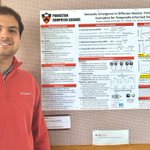
Tomasz Sadowy, a CS major, won a dept award for his independent work project, "Semantic Emergence in Diffusion Models: Probing Attribute Formation for Temporally Informed Steering.”
The research focuses on AI image generators and how the image takes shape during generation.

ALT Tomasz Sadowy standing next to a poster about his project
Princeton Computer Science retweeted

Packed this morning at the launch of @PrincetonCS ‘s AI Alignment and Safety center.
@HazanPrinceton opens with a discussion of our work from April! Excited to see where this initiative goes.

Princeton Computer Science retweeted

Check out our @adjiboussodieng’s Op-Ed published by @AJEnglish:
📝 “AI fears are being weaponized”
#AI #AIGovernance #AIRisk @PrincetonCS

Tech giants are fighting to protect their monopolies from cheap open-source models. Fear is their weapon. — #AJOpinion by Adji Bousso Dieng.
🔗: aje.news/16wj21

Princeton Computer Science retweeted

PrincetonHCI recap of #CSCW26! 🧵👇
1/
Samantha Dalal presented FareShare! Congratulations to the authors of FareShare for winning an Honorable Mention Award! 🎉

Congratulations to computer science professors Mark Braverman, Arvind Narayanan (@random_walker) and David Walker on being named to endowed professorships!
cs.princeton.edu/news/endowe…

ALT Mark Braverman, Arvind Narayanan and David Walker
Princeton Computer Science retweeted

George Pólya famously said that `it is better to solve one problem five different ways than five problems one way.'
He'd be sad to learn what we found: RLVR pushes LLMs in exactly the opposite direction, toward solving each problem in just one way!
📜: arxiv.org/abs/2610.11064

Princeton Computer Science retweeted

I'm told I've been appointed to an endowed professorship, the Bertram and Carole Siegel Professor of Computer Science. I've long thought my work is more legible outside the academy than inside it, so I'm delighted and honored to be recognized by my university, and grateful for the Siegel Family Endowment's support that made this possible.
I found out in an email out of the blue — I didn't even know I'd been nominated or anything! Apparently this is not the kind of thing one needs to get external letters for. Over two decades in academia and still so much to learn about how things work around here 😄
Princeton Computer Science retweeted

This robot can be trained to wave hello by moving it around manually & programming it to repeat the motion on command. But students in the Princeton Vision and Learning Lab are using #ArtificialIntelligence to make it learn like any toddler would: by trial and error. @PrincetonCS
Princeton Computer Science retweeted

What happens to denoising when image generation takes just one forward pass? Turns out, the denoising process unfolds across the model's depth rather than over time. Check out @acaleb 's thread below! 👇

1/ I’m excited to share our work on “Depth as Time in One-Step Generative Models”!
alphaxiv.org/abs/2610.03626
TL;DR: We ask, when a model learns to generate an image in one forward pass, what happens to the denoising process? We observe that process unfolding over depth!
Theoretical computer scientists, including @praveshkkothari, used AI to find an important solution to an open math problem.
They documented their process and concluded that while AI excels at finding answers, it is not yet good at building theories.
bit.ly/4B5U5ze

ALT Pravesh Kothari
Princeton Computer Science retweeted
🚀 We are hiring! Join Vertaix at @PrincetonCS for Fall 2027! Full funding available.
🔬 Are you passionate about the intersection of machine learning and the natural sciences? I am looking for highly motivated PhD students to join my research group, Vertaix, to build the foundations of Investigative Intelligence.
☀️ We are moving AI beyond simple predictive pattern matching and building systems capable of autonomous scientific discovery. We will tackle critical challenges like exploring high-dimensional spaces, mitigating mode collapse, and leveraging spectral diversity to create trustworthy AI systems that actually discover. Full funding from an NSF CAREER Award and other sources available.
⁉️ How to Apply: Apply directly through the Princeton Computer Science department application process (see links below). In your Statement of Purpose, explicitly mention your interest in working with Prof. Adji Bousso Dieng (@adjiboussodieng) and the Vertaix lab. Deadline is December 15, 2026.
🐯 If you are a PhD student already at Princeton (in any department, not only in CS) and want to be advised by @adjiboussodieng, please feel free to email her with your interests and CV.
🖇️ Link 1: cs.princeton.edu/grad/admiss…
🖇️ Link 2: gradschool.princeton.edu/adm…
🖇️ Link 3: cs.princeton.edu/news/dieng-…
Let’s advance AI for scientific discovery together. Please share this with anyone who might be a great fit! #PhDposition #MachineLearning #AI #ScientificDiscovery #InvestigativeIntelligence #AI4Science #PrincetonUniversity #Vertaix
🤖 Made with AI

Princeton Computer Science retweeted
Be like Dean @nanonoodle: Don’t walk, run to the @princetonustore to get your @EPrinceton-branded sweatshirts, mugs, tote bags, bag charms, & more. Show your pride in our school, or get an early start on your holiday shopping. They're selling fast! pustore.com/princeton-tigers…
Princeton Computer Science retweeted

Real-world scenes are highly repetitive 🧱🌿: bricks, blades of grass, leaves, and many other structures appear again and again. At #NeurIPS2026, we present SCION, which learns a compact vocabulary of reusable 3D primitives and instantiates them throughout a scene, capturing its underlying compositional structure. This brings learned photorealistic 3D Scenes down to the ~1 MB range 🤏 while introducing natural structures for editing and animation 🎬.
Great work by @williamkoch314, @amogh7joshi, @cvachha, and Cheng Zheng.
You'll see the authors in Sydney this December!
Project Page: light.princeton.edu/SCION
Paper: arxiv.org/abs/2610.02322
Princeton Computer Science retweeted
🚨SciConBench accepted at #NeurIPS2026!
Paper: arxiv.org/abs/2606.11337
Can AI *synthesize* scientific conclusions in health? We find that, on medical conclusions, we are far from it!
Check out our live dashboard: sciconbench.cs.princeton.edu…
w/@hayounggjung and @korolova

Congratulations to @OlgaTroyanskaya on receiving a Kyoto University Lectureship Award!
The award recognizes Troyanskaya's pioneering contributions to modern AI-driven genomics.
Troyanskaya is a professor of CS and genomics and leads @PrincetonPPH.
research.kyoto-u.ac.jp/lectu…

ALT Olga Troyanskaya