

Prospex*Agro is a dynamically developing commodity-brokerage company that operates in the international agricultural market.
Ukraine
Joined June 2024
- Tweets3.1K
- Following27
- Followers1.3K
- Likes3.1K




Pinned Tweet
🌾 New Global Grain Report Is Out! 📊
🔗 Unlock the report: patreon.com/c/prospexagro
🌍 WASDE revisions, shifting grain prices and Black Sea disruptions. What’s next for wheat, corn and barley markets?
📈 Explore the full analysis, including physical prices, futures, trade flows and freight insights.
🔐 One Patreon subscription includes:
🌾 Weekly Global Grain Report;
🛢️ Weekly Oil Market and Strategic Routes;
📲 Daily Grain Market Updates.
#WASDE

4
346
🇪🇺 Sunflower Crushing Picked Back Up In October. Will It Be Enough To Close The Gap? 🌻
🏭 FEDIOL's October data shows EU and UK crushers bumped up sunflower seed throughput, with rapeseed also edging higher versus September. Soybean crush slipped, but the two gains were enough to cancel that out, so overall oilseed processing held roughly flat.
📉 Sunflower seed drove most of the drop in total crush compared with a year earlier, from January through October. Rapeseed volumes held roughly steady, while soybean crush inched up.
🌻 The USDA’s November outlook calls for a rebound across the full 2026/27 marketing year, with EU sunflower seed crush projected at 9.1 million tonnes: up from 7.8 million in 2025/26.
💬 What signals will you track to see if the EU’s sunflower seed crush is keeping pace with that projection?
#SunflowerSeed #FEDIOL

4
140
🇧🇷🇦🇷 Brazil’s Mills Face A Quality Shortfall As Argentina’s Wheat Harvest Advances 🌾
🌧️ A first-crop corn planting, Brazil’s wheat harvest is running further ahead of last year’s pace. Still, wet weather in the south has taken a toll on grain quality. In Rio Grande do Sul, some wheat is falling short of milling standards, which is pushing up import demand.
🌾 Argentina’s wheat harvest is running a little ahead of last year’s pace, with early yields near Rafaela coming in between 3.7 and 4.5 t/ha. The Rosario Grains Exchange bumped its crop estimate up by 0.5 Mt to 24.3 Mt, while the country’s agriculture ministry sees it reaching 24.7 Mt. For Brazilian mills, that means plenty of supply from a key wheat source.
🌽 Brazil’s corn exports are shaping up for their best month since September 2023. ANEC bumped its November forecast to 8.06 Mt, up from 7.21 Mt. Even so, exports from January through November would still run about 7% behind last year’s pace.
🌻 Sunflower planting in Argentina posted its biggest weekly jump of the campaign and is now close to wrapping up. Soybeans have also pulled ahead of last year’s pace, while corn is running level with the previous season. The trade picture for sunflower has already turned. Between July 1 and November 15, the EU took in 101,210 tonnes of Argentine seed, compared with just 2,420 tonnes a year earlier.
💬 How is the wheat quality and supply looking for Brazilian millers as Argentina’s harvest moves forward?
#Wheat #SouthAmerica


4
197
🇺🇳 Grain Prices Slide As Global Supply Buffers Shrink 📉
🌾 In its November outlook, the IGC sees global grain stocks heading lower even as another big harvest comes in. Soybeans are set for the steepest relative drop, with corn balances tightening as well. While soybean output and trade keep expanding, overall grain production and shipments are slowing.
📦 October's forecast for grain stocks got another bump: 7 MMT higher, the third straight monthly upgrade. But the picture isn't as rosy as it looks: russia and Ukraine are sitting on unusually large inventories, which masks the tightening seen elsewhere. Where those supplies actually sit is becoming a key factor in the outlook.
🫛 Soybean demand came in stronger, so the forecast for ending stocks was trimmed by 2 MMT this month. With crush activity expected to climb, the record harvest should be absorbed quickly, pulling down reserves even in major exporting countries.
📉 Prices are still under pressure, though. The IGC GOI dropped 4% to a three-month low, with both wheat and maize sub-indices down 7%. Wheat took a hit from expectations of big southern hemisphere crops, while corn faced pressure from growing US supplies and stiffer export competition.
💬 Over the coming months, which will have a bigger impact on trade: how much is harvested or how those stocks are spread out?
#GrainMarket #IGC

🇪🇺 EU Corn Shortfalls And Shifting Wheat Demand Are Reshaping Trade Flows 🌾
🚢 EU common wheat exports are still running a bit ahead of last year’s pace, but barley shipments are trailing behind, and durum exports have taken a steep drop. Corn imports, meanwhile, are climbing: a sign of a tougher problem: keeping up with demand as domestic harvests get smaller.
🇫🇷 FranceAgriMer’s latest outlook sees French soft wheat exports destined for outside the EU hitting 7.2 Mt, an 11% bump compared with October. Disruptions around the Black Sea are steering more buyers toward France, including some less typical ones, like Sudan, Oman, and Yemen. That said, within the bloc itself, French sales are being held back by competition from feed wheat coming out of the eastern EU.
🌽 According to the latest crop reports, French corn production is expected to reach just 7.3 Mt, a steep 47.5% drop compared to last year. Germany’s harvest is also down, coming in at 4.09 Mt, a 17.1% decline. These significant shortfalls are tightening the need for imports, meaning European buyers are relying more heavily on external supplies to fill the gap.
🌻 Rapeseed and sunflower seed imports are climbing, but soybean arrivals have dipped slightly. In the oil segment, rapeseed oil stands out as the only one showing growth; sunflower, palm, and soybean oils are all down. The contrast between rising seed shipments and falling oil imports is a reminder that these markets shouldn't be lumped together: each has its own story.
💬 What’s the trade flow you’ll be keeping the closest eye on over the next few months?
#GrainTrade #EU


🇺🇸 U.S. Soybean Crush Hits New Monthly High as Soyoil Inventories Recover 📈
🫛 U.S. soybean crush came in above what analysts had projected for October, according to NOPA, and it edged past the prior monthly high of 227.647 million bushels: a mark set just a year before.
🌱 The Midwest harvest filled the pipeline with more soybeans, and with processors expanding capacity, fueled by biofuel demand for vegetable oils, crushers were able to take on a bigger load.
🛢️ Soyoil stocks beat expectations too, climbing back from September’s near 12-year low of 1.053 billion pounds. Even so, October inventories remained under last year’s mark.
💬 What are your projections for November’s U.S. soybean crush and soyoil stock levels?
#NOPA #SoybeanCrush

10
482
🇺🇦 Ukraine’s Rapeseed Sowing Exceeds Forecast As Exports Slow 🌱
🌾 Winter rapeseed planting kept creeping upward, now running ahead of projections. Wheat and triticale saw the biggest week-over-week increases, while barley still lags furthest behind its goal. Rye held steady, sitting right around where it needs to be. The Ukrainian Hydrometeorological Centre warned that crops sown late and still coming up are the most at risk if winter turns harsh.
🏭 Domestic rapeseed demand softened after russian strikes in November damaged 12 oilseed processing facilities, and some had to halt operations.
🚢 Border delays and pricier trucking slowed shipments. In the first 12 days of November, Ukraine exported 98,000 metric tons of rapeseed: down from 135,400 tons in the same stretch of October.
🛢️ Rapeseed oil shipments dropped to 14,800 t from 40,500 t in the same October period. That tumble came on the heels of a robust January–October stretch, with exports hitting 530,100 t, 2.2 times the year-earlier figure: per the Ukrainian Agribusiness Club.
💬 What are the key factors you're tracking for Ukraine's rapeseed and rapeseed oil exports over the next few weeks?
#Ukraine #Rapeseed

🇺🇦 Ukraine’s Sunflower Harvest Is Almost Wrapped Up, Though The Outlook For Oil Exports Is Getting Shakier 🌻
🌽 Ukraine’s sunflower and soybean harvests are winding down, while wheat, barley, and rapeseed are essentially done. Corn remains the crop with the most ground left to cover relative to its planted area.
🏭 Kernel and Potoky have halted crushing operations due to security concerns. Since most sunflower seed is already in, when those plants restart will largely decide how much oil actually makes it to buyers in the short run.
📉 APK-Inform now expects 2026/27 sunflower oil output to come in at 3.75 Mt, down from its earlier call of 4.50 Mt. It also trimmed its export projection to 3.35 Mt, versus the previous 4.10 Mt.
🚢 By 13 November, grain exports had hit 7.1 Mt, a sharp drop from 10.6 Mt at the same point last year. Taras Vysotskyi cautioned that these export limits could shave 6.3 million hectares off Ukraine’s spring planting.
💬 What are the main things you’re tracking for Ukrainian grain and sunflower oil exports over the next few months?
#Ukraine #SunflowerOil

🇺🇸🇨🇦 Mexico Drives U.S. Corn Sales To A Season High As Canadian Canola Exports Climb 🌽
🌽 Mexico drove U.S. corn net sales to a marketing-year high in the week ending Nov. 5, taking 68% of the total. Bookings hit a season peak, though shipments remain behind last year’s pace. Wheat net sales dropped to their lowest point of the season.
🚢 Among the Canadian crops tracked, canola posted the strongest year-over-year export gains. Wheat shipments ticked up from the prior week and stayed above last season’s pace, though the gap versus a year ago has narrowed.
🫛 On Nov. 13, the USDA flagged a 134K-tonne sale of U.S. soybeans to China. Around the same time, Canada and China hammered out an extension keeping Canadian canola meal duty-free through 2028. The combined tariff Beijing slaps on Canadian canola seed stays put at 14.9%.
💬 What’s your take on where U.S. corn and Canadian canola shipments are headed in the coming weeks?
#Corn #Canola


🇧🇷 Brazil’s Corn Stocks Build As Soybean And Wheat Balances Tighten 📊
🌽 According to Conab’s November survey, the first corn crop is set to drive production growth, with the second crop broadly flat. Conab cut its 2025/26 corn export estimate by 6.8% from the previous forecast to 40.9 Mt, citing fresh U.S. supplies, gains by Argentine exporters and weaker Chinese demand. Corn stocks are projected to build further in 2026/27.
🫛 Soybean stocks are forecast to fall sharply as growth in domestic use and exports outpaces the modest increase in production. By the first week of November, planting had reached 66.8% nationwide and 95.6% in Mato Grosso. Irregular rainfall and high temperatures are keeping yield prospects uncertain.
🛢️ Soybean meal exports are projected to rise. For soybean oil, domestic use is growing faster than output, leaving less available for export.
🌾 With more than 78% of Brazil’s wheat area harvested, smaller plantings and adverse weather in Paraná and Rio Grande do Sul have weighed on output. Lower grain quality is diverting more wheat into feed, while the smaller harvest is expected to increase reliance on imports.
💬 Which of these shifts are you watching most closely for Brazil’s trade flows?
#Brazil #Conab


🇦🇷🇧🇷 Soybean Planting Outpaces Last Year As South American Oilseed Trade Shifts 🫛
🌱 According to Argentina’s weekly crop report and Brazil’s Conab, soybean and corn planting are ahead of last year in both countries. Argentina’s sunflower planting made the biggest weekly gain among the crops tracked there, though it still trails last season’s pace.
🌾 Argentina’s wheat harvest is slightly behind last year, with early yields in Rafaela at 3.7–4.5 t/ha. Brazil’s harvest is well ahead of last season, but heavy rains in the south reduced the availability of milling-quality wheat and kept domestic prices firm.
🌻 According to the Rosario Board of Trade, Argentina’s sunflower oil exports rose 30% year on year in January–September. India bought 750K tonnes in January–August, accounting for about half of Argentina’s sunflower oil exports over that period.
🚢 Brazil’s share of EU soybean imports climbed from 44% to 73% as overall EU imports fell. At home, Oil World expects Brazil’s soybean crush to reach 64 million tonnes this year, up 5.3 million tonnes from last year.
🌽 Brazil’s corn exports reached a yearly high of 5.7 million tonnes in October, still 12% below the same month last year.
💬 Which demand trends are you watching for South American soybeans and vegetable oils in the coming weeks?
#Soybeans #AgMarkets


🇺🇸 U.S. Soybean Output Rises As Corn And Wheat Harvests Shrink 🌾
🫛 According to USDA NASS, soybeans were the only crop shown with higher production year on year. A larger harvested area drove most of the gain, while yields edged higher. Corn output fell as both harvested area and yields declined.
🌾 Winter wheat posted the steepest production drop. Harvested area fell much faster than planted area, and lower yields deepened the decline. For durum, the smaller harvested area accounted for most of the drop in output.
💬 Which of these shifts do you expect to have the biggest impact on U.S. export flows this season?
#USDA #CropProduction


🇺🇦 Ukraine’s Winter Crop Area Set To Shrink As Grain Exports Lag 🌾
🌱 According to the Ukrainian Agribusiness Club, farmers have sown 5.8 Mha of winter crops, with about 521K ha still to go as fieldwork slows. The projected winter crop area is already 5.9% smaller than last season, with unsold stocks, logistics constraints and tight working capital weighing on planting plans.
🌾 Wheat and triticale accounted for most of the weekly planting gains. Barley is furthest from its target in percentage terms, rye sowing is nearly complete, and rapeseed has already exceeded its initial acreage forecast.
🚢 Ukraine has shipped nearly 7 MMT of grains and pulses this season, down 34.1% from last season’s mid-November report, which covered three more days. Wheat accounts for most of the shortfall. Corn has held up better season to date, but its daily shipping pace in early November was roughly a quarter of last year’s.
💬 What will you be watching most closely in Ukraine’s final winter acreage and upcoming grain export figures?
#Ukraine #GrainExports

🇪🇺 EU Rapeseed Oil Imports Climb As Seed Imports Edge Lower 📈
🚢 According to European Commission data, rapeseed oil was the only vegetable oil tracked to post a year-on-year import gain, even as rapeseed imports edged lower. Sunflower showed the reverse pattern, with seed imports rising sharply and oil imports falling.
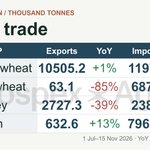
🌾 Common wheat exports edged up as imports fell sharply. Barley and durum wheat exports dropped, while corn led the grains tracked in both import volume and year-on-year import growth.
🌼 In Germany, UFOP estimates winter rapeseed plantings for the 2027 harvest at 1.08–1.10 million hectares, down from 1.127 million hectares for 2026. High fertilizer costs and poor yields after summer heat and drought held back sowing, though crops are generally in good condition for this time of year.
💬 What factors are you watching for EU rapeseed and rapeseed oil imports in the months ahead?
#Rapeseed #EUTrade


🇺🇸 November WASDE – Wheat Stocks Exceed The Trade Range As Soybeans Tighten 📊
📊 According to USDA’s November WASDE, global wheat ending stocks came in 4.38 MMT above the analyst average, exceeding even the highest pre-report estimate. Corn stocks were 0.50 MMT above the average, while soybean stocks were 1.23 MMT below. Both stayed within their respective trade ranges.
🌾 Wheat faced the clearest bearish surprise. USDA raised its crop forecasts for Australia and Argentina by 1.5 MMT each and lifted exports from both origins. It cut projected exports from russia and Ukraine by 1 MMT each as Black Sea shipments continued to lag long-term averages. The bigger global stock cushion eased the balance from October, though inventories remain below last season and global trade was revised lower.
🌽 Corn sent a mixed signal. Lower feed use helped lift global stocks from October, even as the U.S. balance tightened. USDA cut U.S. yield by 1.6 bu/acre to 179.6 bu/acre, and the smaller crop pulled projected U.S. stocks lower despite cuts to domestic use and exports. Argentina and Brazil each gained 2 MMT in projected production, while Argentina’s export increase only partly offset cuts for the U.S., Ukraine and India.
🫛 Soybeans had the most supportive balance revision. A slightly smaller global crop and higher crush tightened the outlook, with import demand revised up mainly in Algeria, Colombia, Thailand and Japan. USDA raised U.S. exports by 25 million bushels and cut U.S. ending stocks by 15 million bushels to 300 million, despite a larger crop. The U.S. soybean price forecast rose to $12.10/bu, while the soybean oil forecast fell to 68 cents/lb.
💬 Which of these revisions do you expect to have the most influence on near-term prices?
#WASDE #AgMarkets


7
536
🇨🇳 China Lifts Corn Demand Forecast As Soybean And Edible Oil Outlooks Hold Steady 🌽
🌽 According to the November CASDE, China raised its forecast for industrial corn use and lifted last season’s estimate by 1 Mt to 86 Mt. Firm feed demand and state reserve buying could keep prices steady as harvest supplies increase.
🫛 Soybean imports are still forecast below last season’s revised level. Domestic trade remains slow as growers hold out for higher prices and processors buy cautiously.
🛢️ CASDE nudged last season’s edible oil production estimate up to 32.45 Mt, with higher rapeseed oil output offsetting a decline in sunflower oil output. Thin palm oil import margins and lingering Black Sea logistics disruptions weighed on imports.
💬 What factors are you watching for China’s grain, oilseed and vegetable oil imports in the coming months?
#Corn #CASDE

🇲🇾 Malaysia’s Palm Oil Stocks Hit A Record Despite An Export Rebound 🌴
📦 According to the Malaysian Palm Oil Board (MPOB), palm oil inventories rose for a seventh straight month in October. Crude palm oil output set a record, and crude stocks grew faster than total inventories.
🚢 Exports rebounded to a one-year high and beat expectations in a Reuters poll, while total stocks came in below the poll forecast of 3.75 million tonnes.
📉 Benchmark Malaysian palm oil futures traded at their lowest in more than eight months. Sunvin Group’s Anilkumar Bagani said palm oil may need to trade $100–$120 per tonne below soybean oil to keep attracting buyers.
💬 Which indicator will you watch most closely in Malaysia’s November palm oil data?
#PalmOil #MPOB

🇳🇱 Prospex*Agro at ECE Rotterdam 2026 🌾
📍 On 5–6 November, our brokers attended the 66th European Commodities Exchange at Rotterdam Ahoy, where grain and feed professionals from across the world came together to exchange market insights and make new connections.
👥 Representing Prospex*Agro in Rotterdam: Diana Karamanova, Mariia Panchuk, Natalia Logginova, Vlada Zhehulska, Nataliia Zakharova, Daria Keidaliuk and Olena Senkevych.
🤝 Thank you to everyone who took the time to meet with our team. It was great to catch up with familiar faces and meet new ones. We look forward to continuing the conversations started in Rotterdam!
#ECERotterdam26 #GrainTrade


4
309
🇪🇺 EU Corn Harvest Hits A Three-Decade Low As Imports Rise 🌽
🚢 According to the European Commission, EU corn imports rose sharply year on year while exports barely grew. Soft wheat exports edged up as imports fell, while durum wheat and barley both saw lower exports and higher imports.
🌽 USDA estimates the 2026/27 EU corn crop at 48.0 million tonnes, the smallest since 1994/95. Heat and drought during pollination hit France and Hungary particularly hard. The European Commission also cut its estimate of usable corn production from 48.3 to 47.0 million tonnes.
🌻 Sunflower seed imports rose sharply even as sunflower oil imports fell. Rapeseed imports held steady, while rapeseed oil was the only major vegetable oil to post an import gain. Soybean, soybean oil and palm oil imports all declined.
🌼 Looking ahead to 2027/28, Expana expects EU rapeseed plantings to fall 5% to 6.1 million hectares, with drought-hit France driving the downgrade. It also cut its estimate for this season’s EU soybean harvest to 2.1 million tonnes, down from 2.6 million tonnes in August.
💬 How do you expect EU corn imports to develop over the rest of the season?
#EU #CornImports


1
5
1,501
🇺🇦 Smaller Corn Crop Drives Ukraine’s Grain Export Forecast Lower 📉
🌽 According to APK-Inform, a smaller corn crop prompted the consultancy to cut Ukraine’s grain harvest forecast to 63.7 million tonnes and its 2026/27 grain export forecast to 29.7 million tonnes. Corn accounted for most of the export downgrade.
🌾 Fieldwork is largely complete for wheat, barley and rapeseed, while sunflower and soybean harvests are nearing completion. Corn still has the most ground left to cover.
🚢 As of 6 November, Ukraine had exported 6.8 million tonnes of grains and pulses, down 31% year on year. Wheat and barley shipments fell 39% and 56%, respectively, while corn exports rose 6%.
🚆 Ukraine exported 378K tonnes of rapeseed in October, below planned volumes. According to PUSK, rail bottlenecks affecting corn shipments also delayed rapeseed loadings.
🛢️ Rapeseed oil trade moved in a different direction. European Commission data show that EU imports from Ukraine rose 44.9% year on year to 182,690 tonnes through 25 October, lifting Ukraine’s share of EU imports to nearly 82%.
💬 How do you see Ukraine’s corn and rapeseed shipments developing in the coming weeks?
#Ukraine #Corn
