
Collaborative center committed to research, development, training, and dissemination in augmentative and alternative communication (AAC), funded through NIDILRR
- Tweets550
- Following267
- Followers950
- Likes775







ALT Two men walking in park enjoying a conversation.


ALT [Image: AAC users Lateef McLeod (left) and Lance McLemore (right) present on stage at the Future of AAC Research Summit in May 2024. Lateef and Lance type on communication devices. Across from them, the backs of two audience members’ heads are visible. They appear to be listening attentively.]

ALT Picture of Jordyn Zimmerman presenting at the Future of AAC Research Summit, and text that reads “There must be deep understanding around our needs, desires, and pain points—with the goal of designing and developing in ways that efficiently address them." Beyond access: the intersecting role of AAC, literacy, and technology Zimmerman (2025)

ALT Picture of endever* corbin. Screenshot of text that reads “I want everyone who struggles with speech – no, every disabled person period – no, every single human – to have an opportunity to explore multiple robust, culturally and linguistically appropriate, queer-friendly AAC options.” (corbin, 2025) corbin, endever*. (2025). Speech is exhausting. Augmentative and Alternative Communication, 1–3. https://doi.org/10.1080/07434618.2025.2513907

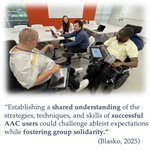
ALT Picture of (left to right) Tracy Rackensperger, Cynthia Blasko, Grant Blasko, and Kevin Williams. Screenshot of text that reads “Establishing a shared understanding of the strategies, techniques, and skills of successful AAC users could challenge ableist expectations while fostering group solidarity.”

ALT Picture of Janice Light and Jordyn Zimmerman, screenshot of text that reads “There is a long history of communities, marginalized by race, ethnicity, disability, gender, etc., that have called for leadership roles and full participation in all activities undertaken about them. Now is the time for the AAC field to fully embrace this challenge.” Blasko et al. (2025) Citation that reads Blasko, G., Light, J., McNaughton, D., Williams, B., & Zimmerman, J. (2025). Nothing about AAC users without AAC users: a call for meaningful inclusion in research, technology development, and professional training. Augmentative and Alternative Communication, 1–11. https://doi.org/10.1080/07434618.2025.2514748

ALT Picture of Ren Koloni, screenshot of text that reads “To be denied expression of the self should be unimaginable, but it is not. It is happening. It is our responsibility as researchers, as advocates, and as people to not only imagine it, but to find out why, how, where, when, and in what ways it happens—and to make it right” abstract, and link to article at Koloni, R. (2025). To include us in our own worlds: AAC is not optional. Augmentative and Alternative Communication, 1–4. https://doi.org/10.1080/07434618.2025.2515283

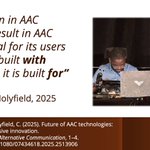
ALT text that reads "innovation in AAC will only result in AAC that is ideal for its users when it is built with the people it is built for" Williams & Holyfield, 2025 Williams, K., & Holyfield, C. (2025). Future of AAC technologies: priorities for inclusive innovation. Augmentative and Alternative Communication, 1-4. https:/.oi.tl/23 https://doi.org/10.108 /10.1080/074346', picture of Kevin Williams and Christine Holyfield

ALT Picture of Bob Williams and text that says People who need AAC should be afforded access to communication and literacy support at every stage of life – from the youngest young to the oldest old. Also, citation to the paper “Williams, B. (2025). Reading, writing, and AAC are fundamental. Augmentative and Alternative Communication, 1–3. https://doi.org/10.1080/07434618.2025.2508492”


ALT Picture of Patrick Regan, screenshot of abstract, and link to article at Regan, P. (2025). The first word in accessibility is “access.” Augmentative and Alternative Communication, 1–4. https://doi.org/10.1080/07434618.2025.2513912
ALT Picture of Patrick Regan, screenshot of abstract, and link to article at Regan, P. (2025). The first word in accessibility is “access.” Augmentative and Alternative Communication, 1–4. https://doi.org/10.1080/07434618.2025.2513912

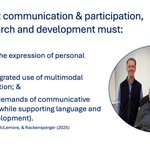
ALT Screenshot of David, Tracy and Lance, and Text quote that reads "• To support communication & participation, AAC research and development must: strengthen the expression of personal identity; •support integrated use of multimodal communication; & •reduce the demands of communicative interaction (while supporting language and literacy development). •McNaughton, McLemore, & Rackensperger (2025)

ALT Picture of Pancho and text that reads More than 21 years ago, I had a car accident that led to a brain stem stroke, leaving me paralyzed and unable to speak. I was desperate to communicate. One day, my sister wrote down the alphabet and pointed to each letter accordingly. I nodded, yes or no, and she wrote my message down. That way, they figured out what I wanted and what to do about it… The researchers from the University of California-San Francisco gave me a laser pointer and a letter board to communicate with them when I go out on my own. Whenever I need to say something to anyone, I just have them pull out my communication tools, and I am all set. Since I have the laser pointer and the letter board I dared to go to stores and do my grocery shopping.... I am currently enrolled in a clinical trial at the University of California, San Francisco to investigate brain computer interface to control a robotic arm and communicate… It feels like a dream, a fairy tale, but it is not.