

MD @z47_vc | Agenting agents | Building @DeVC_Global | past @DisneyPlusHS @Housing | 2X founder 3X CXO | Deep Learning Geek
Mumbai
Joined November 2009
- Tweets5K
- Following5.4K
- Followers3.2K
- Likes33.2K



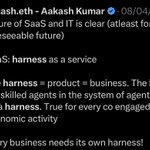


AFAIK (and honestly I know very little) venture capital is a business where a group of principals try and monetise their ability to underwrite risk to generate economic rewards for investors, who willingly gave them the money to manage…
But who am I to say anything, I know far too little than the girl next door with many Ks of followers ..
As for my meaningless and follower less world view: as someone who is in the business of venture investing I’ll price my risk and do my best to generate returns. Thats my ‘dhando’ and as a humble response to all critics, as a pleb I take my inspiration from favourite tag line of a hostel tee at iitb : “Tu 13 dekh” 🙏🏼
aacash.eth - Aakash Kumar retweeted

Eminem's fastest verse vs Smallest Pulse STT
The last verse of "Godzilla" is one of the fastest in mainstream rap. Pulse kept up with all of it: 296 words, 1.4% word error rate.
Just the raw audio, transcribed live.
If Pulse can handle Eminem, your customer calls are easy.
“The question was never about if you’d want to simulate or not.
You just need to question how well you’re able to get the simulations for the robot.”

Another major shift I saw in Robotics at Long Horizon was about simulation.
Teams that used to say ‘get it deployed first and will figure the rest later’ are now asking about simulation.
After a failed deployment, you learn what you couldn’t test beforehand.
And once a robot takes on more than one task, every new task is another thing that can get wrong.
The question was never about if you’d want to simulate or not.
You just need to question how well you’re able to get the simulations for the robot.
aacash.eth - Aakash Kumar retweeted

We will enter an age of abundance
If we can stop the communists for the next 5 years
aacash.eth - Aakash Kumar retweeted

The only way out is through.
They're calling it the Bugpocalypse. LLMs are being used to find long-hidden cracks in the software infrastructure, and it's happening at a furious rate. 3% of all compromises in computing history happened in the last week, claims one source? I believe it.
There are people saying public access to the frontier models ought to be locked out, or heavily guardrailed, over this. The problem with that idea can be summed up in one sentence: when lockpicks are outlawed, only outlaws will have lockpicks.
The lockpicks will be Chinese open-weight models, if nothing else. There's no way to stop those from becoming ubiquitous.
There are two futures in front of us. One in which only the bad guys have lockpicks, and security holes go undiscovered until they're exploited. Another in which everybody has lockpicks and is aggressively red-teaming their own software so it gets fixed before the holes are exploited.
The corpus of human code is huge but finite. The number of defects in it has to be finite too. We can fix those defects now; we have a million friendly robots to do it with.
The only way out is through.
aacash.eth - Aakash Kumar retweeted

it’s hard to explain the 2010s microservices fever dream to anyone who wasn’t there
every day on HN, we'd wake up to an article from a new startup about how they split their app into 300 services so they could infinitely scale (never mind that they only had 100 MAUs today)
so many companies never recovered from this
it turns out, replacing simple function calls with network calls that could randomly fail isn't great for shipping velocity

“- Martin: every bit of code doubles the ways a program can behave, which is why humans still own systems
- The real world is messier than AI's training data, self-driving took 20 years and $170B”

Engineering leaders told Grepr founder and CEO Jad Naous they spend 5 to 20% of their infrastructure budget on observability, and it's buying less and less reliability.
Jad, a former a16z partner, joins a16z's Martin Casado to discuss whether AI can run production systems as well as it writes code.
Grepr sits in a company's log stream, can scan a petabyte of logs a day, cuts observability costs by about 90%, and is building AI agents that use those signals to troubleshoot production issues.
How AI is changing engineering at Jad's 10-person company:
- A data lake feature that once took one engineer about six months took Jad 10 days
- The gap between okay and great engineers on his team "just multiplied 10X"
- He runs 3-4 agent sessions at once, with a "tech lead" agent reviewing every PR
Why running live systems is a harder problem for AI:
- Jad: AI can almost tune databases, but can't yet keep servers running on its own
- Martin: every bit of code doubles the ways a program can behave, which is why humans still own systems
- The real world is messier than AI's training data, self-driving took 20 years and $170B
0:55 From Stanford to a16z to Grepr
7:00 Why observability spend stopped paying off
11:00 From autocomplete to AI that trains engineers
13:10 Why AI widens the engineer skill gap
14:55 Syntax vs semantics
18:00 Inside Jad's AI workflow
22:55 Six months of work in 10 days
24:50 Can AI reason about how systems really run?
30:10 Why AI SRE tools start in the wrong place
32:30 Can AI run a distributed cluster yet?
37:35 Why engineers buy extra capacity over predicting
39:15 How AI could trace failures in production
43:45 Why AI for ops is harder than for code
49:55 Can AI do a VC's job?
52:05 Why self-driving took 20 years and $170B
57:05 Customers skipped the AI pitch for the 90% savings
YouTube: youtu.be/blkIGLlZePg
@jadtnaous @grepr_ai @martin_casado


I got a feeling once. Then I got it again. And feelings can’t be wrong. I agree with @TheIndianTruth_ that RBI governor should resign. I’m forming Jhingur Janta Party today! Domain registered.

First of many steps towards unleashing the harnesses=product=business maxim! Lfg 🚀@alokbishoyi97 and team @useRouterPlus

Getting your inference right shouldn't be hard.
@useRouterPlus (YC F26) is live: the right model and provider for your workload, at the best price.
check out : routerplus.com/capacity
aacash.eth - Aakash Kumar retweeted

AI agents are changing how we work and collaborate, but documents are still stuck in the pre-AI era.
Agents can now create beautiful, interactive decks, dashboards, and reports in HTML. But the moment you want to collaborate on them, everything breaks down.
Google Docs wasn’t built for rich, interactive HTML or AI agents. Feedback gets scattered across Slack and email. Every edit means going back to the agent, generating a new file, and sharing another link. No real-time collaboration. No single source of truth.
We built SlashDocs to fix this.
Think Google Docs, but built for AI agents and the documents they create. Host HTML and Markdown in one central hub. Share documents, manage permissions, and comment directly on the content, just like Google Docs.
Agents can read feedback and update the same document in real time. No duplicate files, no endless back-and-forth, and everyone stays in sync.
What started as a small internal experiment in one team has now scaled across @Razorpay. 28,000+ documents created. Over 50% of all documents generated at Razorpay now live on
SlashDocs.
And today, we’re opening it up to everyone. Self-hosted. Agent-agnostic. Fully open source.
AI agents have changed how we create documents. It’s time we changed how we collaborate on them.
Try it: razorpay.com/slash-docs/