

Race Reflections is a U.K. based social enterprise tackling inequality, injustice & oppression — join us in our quest to make society fairer & safer for all.
England, United Kingdom
Joined November 2020
- Tweets2.2K
- Following18
- Followers3.1K
- Likes770




A few words on the decolonial group on racial trauma
Yesterday’s decolonial group on racial trauma went ahead, slightly off schedule. We welcomed some new voices and people into the space, following the open invitation that I’ve made.
Today, I want to share some of the themes that transpired yesterday, and in particular the idea that so many people shared about confrontation, the real confrontation, the facing of racism and anti-Blackness in today’s world.
What does it mean for us as parents to see our children experience some of the struggles that we went through and thought, or hoped, were done and dusted?
At the same time, what does it mean for our children to support us through experiences of discrimination, of institutional violence, experiences that they may have had before, or are likely to encounter in the future?
And so I wanted to speak again to that circularity issue of racial trauma within the family, and the intergenerational component of racial traumatization, particularly in the context of witnessing for parents and children’s suffering.
One thing that we discussed was the reality that children sometimes will not speak to their parents about the experiences of racism that they have, because they want to protect their parents. Certainly, I remember doing that as a child, at times.
But there is also the reality that parents want to protect their children from racism, and sometimes they keep things quiet for that purpose so they may not name the racism they themselves experience. Sometimes they may inadvertently minimize or silence.
And even though the impulse to preserve the child’s innocence is understandable, it can cause more damage in the long term when the child is not prepared, when the child is not offered the space to process and the words to speak to what they are encountering.
And so yesterday, we dwelt on this issue within the family, and it was quite moving,
if I’m honest, because you see people who are pioneers, people who are established in their fields, in their scholarship, in their anti-racism and justice work, and they come to the humbling realization that actually, there is no escaping this stuff, even at home.
And so it was a session where we were connected to grief and to loss then someone asked about pain…What do we do with the pain? It has crystallising effect.
And I want to say that there were people from different countries so this question of how we manage the pain of racial injustice, of violence or othering echoed across continent, across diasporas. It is something that I want to leave you with. And it remains unresolved, of course.
Of course, we can look after ourselves, we can practise self-care, we can resist alongside the pain.
And I’m always conflicted, because I do think that there is sometimes some artificiality or pressure in trying to remain “positive” in the face of injustice, brutality and violence that can be unrelenting.
But I am always conflicted about that, about whether I am imposing a superficial positivity when perhaps the mood or state is one of grief and mourning and pain which should be honoured.
Thank you to those who always bless me with their experience, with their thoughts, with their understanding, and also with their vulnerability. I take those offerings very seriously and receive them with gratitude. They continue to make me think and grow as well.
So today the reflective direction was more intimate, more personal in some sense, more affectively engaged. And this is part of the dance when engaging with racial trauma, the movement between the personal and the professional, or the sociopolitical, and the psychic, the individual, and the Group.
We still welcome members so feel free to reach out if you are interested.
racereflections.co.uk/new-re…
My good people,
A few more words on the Afroanalytics methodology
I need to return to writing for the last push very soon. I tried hard not to edit, to give my head a break, but in reality the brain is always working on your research when you do research.
This is part of my methodology.
Note that since giving myself a break I further wrote about intuition, on inheritance, on marking criteria, on decolonisation and racial trauma, on Fanon ect…even when I was not actively writing for my thesis. This in the past 2-3 weeks.
Most of this will end up in the thesis or help refine it, so pay attention.
You give your brain a problem and all resources converge to solve or consider it even when you do not actively or consciously seek to.
This can get sidelined as distraction, but the Afroanalytic methodology makes space for these spontaneous digressions and associations. It takes them very seriously indeed.
It was in fact when I started to really pay attention and note what came to me, what lingered in my mind, what got activated in and the sensations and embodiment of these mind and body creations that Afroanalytics really started to come into being as research methodology.
The recurring and initially distressing images of the impenetrable forest, of floating bodies, certain memories like the pit-bull incident, my trip to Elmina, my son writing Sadness: the poem about war and the death of his grandfather.
These were spontaneously generated, often felt viscerally and before I started to collect data, even before I started the PhD.
This is why I ask us to rethink the temporality of knowledge and ‘white time’ when it comes to research.
These momories, evocations, associations and embodied reactions continued have shaped the study’s processes and findings. They have been treated as data. Not as extraneous information to bracket out as we have been taught under Eurocentric empiricism.
If we do not pay attention, we lose fundamental opportunities to understand non-linearly and non-rationally the phenomenon under investigation.
That takes us to the question in my preface: when did I know what I came to understand as knowledge?
It seems simple enough, right but I say it provides a radical opening and reorientation of how we may understand knowledge thus data in the context of research including
1) that some research knowledge does not require exposure to empirical data as we understand it at least
2) that the direction of empirical endeavours may be partly shaped by this pre-verbal, embodied, intuitive material
3) that there is no accident in the research process whether we consider associations, evocations, recollections or who and what the researcher will eventually encounters as data —understood in the traditional sense including participants' stories.
These ideas which are central to the Afroanalytic methodology push really hard against formations of research as discovery arguably a colonialist perspective, and sets the scene for understanding research as reclamation, the perspective of the colonised. A perspective which finds ontological and epistemic foundation, once more in African metaphysics
I use the expression mind or body creation often but I really do not like the idea of creation which is too cognitive, too agentic and too individualistic, but I cannot find better terms, you have to remember English is not my first language and sometimes I do struggle to find the language, but this is not only a linguistic problem of course. It is also an epistemic one, often I am timited to dominant terms because alternative do not exist conceptually, both issues are at play.
I remember one thing, to help people understand how it felt behind the wheel when I was driving without understanding rationally how to drive, it felt as though I was following the rhythm, in flow…and coordinating with this flow, this is how it felt. Like I could anticipate change in gear/movement based on the patterns of a tempo.
It is vague that is all I can say to describe the experience.

A little bit more about intuition via autoethnography
I want to share is that my experience of learning to drive speaks to some of the dilemmas and dynamics that I am grappling with in relation to intuition, which I discuss in my thesis and which is also a foundational tenet of African philosophy and cosmology.
I have shared this story before, but I want to share it again in a new light, because when I first told it, I wasn’t as academically invested in these questions as I am today, having since developed Afro-analytics.
When I first started learning to drive, things were going well. This was in England, perhaps 15 or 20 years ago.
I had a very experienced driving instructor, and I must have had perhaps five sessions with him. After just two or three sessions, he let me onto the road.
It hadn’t taken him very long to explain the gear changes to me, as he thought I was going to learn by doing. I didn’t quite understand what he was explaining, but somehow I was able to drive straight away and change gears.
I could feel my feet going through the motions, making the necessary movements, but I wasn’t really using my head. I wasn’t consciously concentrating on what I was doing.
Things were going so well after a single session, in fact, that the driving instructor told me he was extremely surprised at how quickly I had mastered changing gears, particularly given that it was the first time I had been behind the wheel of a car.
I knew nothing about cars, nothing about gears, and certainly nothing about how to drive a car safely. Never been interested.
He was congratulating me and was very enthusiastic. He said it was probably the first time he had seen someone master the process so quickly in my particular circumstances.
And so I became puzzled.
I was puzzled to the point where, when I got home, I became a little scared. I was thinking: I have absolutely no idea what it is that I’m doing, yet I’m driving. I’m driving without thinking, as though I were operating a piece of machinery that I had operated for years.
For reasons that I cannot quite fully explain, I was fearful that, without understanding what I was doing, I might not be able to replicate it. So I became increasingly scared and anxious.
I didn’t know how I had acquired this ability so quickly. I couldn’t explain the movements I was making. There seemed to be absolutely no conscious mind-body connection in what I was doing.
It was almost as though I was simply flowing.
Of course, at the time, I wasn’t nearly as attuned to questions of epistemology, intuition and intuitive knowing as I am today.
I simply thought: here I am, apparently able to perform something that this man is telling me I’m doing extremely, extremely well, and yet I don’t know what the hell I’m doing!
It almost felt as though I was making random decisions. But, of course, they couldn’t have been random, since what I was doing required highly coordinated action, anticipation and decision. Otherwise, I wouldn’t have been able to remain on the road and drive the car well and safely.
So I went home and started thinking about it. And I still couldn’t explain to myself how I was doing it.
I then said to myself: Okay, at the next session, I’m really going to pay attention. I’m going to concentrate on precisely what I’m doing.
And so, at the next session, I got into the car and started driving very mindfully.
I paid attention to the movements of my hands. I paid attention to my feet. I tried to coordinate everything consciously, to operate the car rationally, deliberately, which is how I imagined most people would learn to operate a car.
Everything fell apart.
I couldn’t keep the car straight on the road. I became completely uncoordinated. Not only could I still not explain what I was doing, but now I could no longer drive either.
It became so dangerous that the instructor grew worried for my safety and that of others 1/2
I had apparently been operating the car through a different learning pathway, and when I tried to replace that pathway with a consciously rational one, everything collapsed.
I went home, and after another session I think, whatever I had been able to do during those first two or three sessions seemed to have disappeared completely.
The instructor kept telling me, “You were doing it! What is happening? Why can’t you just do it again?”
I couldn’t.
Eventually, the driving instructor recommended that I not go back behind the wheel.
And that, my friends, is the story of my attempt to learn to drive all those years ago.
But I am sharing it because I think it tells us something important about different ways of knowing, learning and doing.
There is a lot at stake. Firstly something here about allowing space within our systems and structures, particularly within our educational systems, for people who have different styles of learning and ways of processing, which once more challenge linear, rational or conscious boundaries.
And I use conscious here with a high level of caution, because I do think that intuition is a fundamental analytic problem, certainly in the way that we have come to think about the unconscious.
When I mastered gear changes instantly, we cannot simply speak about memory, because this was not a task I had previously mastered.
Nor can we simply speak about mirroring or imitation of something I had previously observed. I had never been particularly interested in cars, and I had certainly never paid much attention to what people were doing when they drove, I was not interested, once more.
We cannot easily say that my unconscious was in operation when I grasped driving, because what anxiety would it have been trying to keep at bay? What would have been the psychic pay off? And, more importantly, how would the unconscious, understood in this way, explain apparent procedural knowledge?
And yet I was clearly mastering something through what seemed to be a different process, a different system of learning.
So I am going to ask you to think.
What interests me is that this knowing appeared to function remarkably well until I attempted to bring it under conscious, rational control.
The moment I tried to understand and reproduce the process through deliberate thought and action, the ability fell apart.
This is where the experience connects, for me, with the dilemmas of intuition and with questions I have explored in developing Afroanalytics.
What forms of knowing are we failing to recognise because they do not conform to our dominant models of conscious, rational cognition?
And what happens when we insist or internalise that people must be able to explain, in a particular way, how they know what they know or how they do what they do?
That is all I will say for now. Thoughts welcome.
Race Reflections retweeted
My good people,
The Black Leader Power Matrix™
I have spend much time thinking about scholarly things, thesis things, metaphysics and all the rest, as I walk these last few steps to the finish line but I do not forget we exist within material and structural realities.
I want to remind you that we are here still in the real world, still operating in the clinical space, and still supporting the workplace.
To that end, I want to introduce to you to The Black Leader Power Matrix™
A programme designed to address some of racially specific experiences and challenges Black leaders navigate and the racialised structural dynamics that shape their workplace experiences and influence:
- Does your leadership programme addresses widespread resistance to Black authority/expertise and associated sabotage or envy?
- Does it recognise the ways group processes such as horizontal violence can lead to Black (and Brown) employees marginalising and being hostile to leaders who look like them?
- Does it speak to the impact of code switching and assimilation pressures on Black health and wellbeing?
- Does it make visible intergenerational stories around wealth, power & associated conflicts around community loyalty/ betrayal?
These are just a few of the issues a targeted Black Leadership Programme needs to delve into but which are still not mainstream and yet can influence career trajectories and workplace engagement.
Drawing on the RACE Matrix™, the Black Leadership Programme equips participants with greater clarity, confidence and practical strategies to lead effectively while Black within complex organisational systems.
Ultimately, the programme aims to support Black leaders in strengthening their leadership, expanding their influence and safeguarding their wellbeing, while creating the conditions for sustainable professional growth.
We’ll be planning an open day later in the week.
You can already read more about the programme here;
racereflections.co.uk/the-bl…

My good people,
Re: Complimentary invitation
We are holding a session this evening on (de) coloniality and racial trauma. It sits slightly outside our published schedule, which is why I’m reaching out specially.
I’d like to warmly invite you to join us — whether you’ve been hesitating, considering, or simply curious.
Come and see how we engage with critical theory, and what it means to hold systems to account especially around white norms and colonial formations of traumatisation, how we reflect on change and the impact of doing this work.
Tonight at 6:30pm London time.
If you’d like to come, please DM me directly or send me an email ([email protected])
A small group is already gathering, and we would absolutely welcome newcomers, fresh voices, and anyone whose heart is still undecided so please don’t hesitate to reach out.
I hope to see some of you on Zoom this evening.
xitter.gq/racereflections/status…
NEW REFLECTIVE
GROUPS ON RACIAL
TRAUMA
Reflecting on racial trauma together — a sustained, decolonial reflective community for those who carry this work.
Starting next week? Want to rethink, justice, intersectionality, inheritance, resistance and all things racialisation and mental health ….
More details below:
racereflections.co.uk/new-re…

In particular I want to bring your attention to one of the questions I have been asked to think about;
How do you heal a wound that was inherited and not your own? Who carries it, and who is allowed to put it down?
There are a lot of Eurocentric faulty *thought* lines or assumptions in this question, which I look forward to speak on. I am hoping that I have shared enough about Afroanalytics that you can anticipate the sources of the problematics.
Healing in the Circle of Life
An International Conference on African-Centred Wellbeing & Psychology
Portsmouth, Dominica
13th - 16*h April 2027
Call for conference contributions.
We are living through a convergence of crises that conventional health systems were not designed to address. Globally, mental health conditions now affect one in eight people, and rates of anxiety, depression, and trauma continue to rise — accelerated by climate anxiety, social dislocation, and the psychological weight of persistent inequality.
For Black, indigenous, and diaspora communities in particular, these pressures are compounded by the unresolved legacies of colonialism: the fracturing of cultural identity, the erasure of ancestral knowledge systems, and the long-term psychosocial harm of structural exclusion.
Community fragmentation — the severing of intergenerational bonds that once sustained wellbeing;
- has left many people without the roots and relational networks that sustain mental and spiritual health. Yet across these same communities, something is stirring. There is a powerful and growing global movement returning to indigenous knowledge — not as nostalgia, but as a living, rigorous, and deeply relevant framework for healing.
HEALING IN THE CIRCLE OF LIFE | Call for Submissions
Dates 13"'-16" April 2027 •
African-centred psychology is emerging as a respected and expanding international field, challenging Eurocentric models and offering community-rooted, culturally congruent approaches to wellness.
This conference answers that moment. It brings together the wisdom keepers, the researchers, the practitioners, and the communities who are not waiting for permission to heal - and creates the platform for that knowledge to be honoured, shared, and amplified.
I shall deliver one of the keynotes…perhaps I will be joined by some of you?
drive.google.com/file/d/1kaN…
My good people,
The Black Leader Power Matrix™
I have spend much time thinking about scholarly things, thesis things, metaphysics and all the rest, as I walk these last few steps to the finish line but I do not forget we exist within material and structural realities.
I want to remind you that we are here still in the real world, still operating in the clinical space, and still supporting the workplace.
To that end, I want to introduce to you to The Black Leader Power Matrix™
A programme designed to address some of racially specific experiences and challenges Black leaders navigate and the racialised structural dynamics that shape their workplace experiences and influence:
- Does your leadership programme addresses widespread resistance to Black authority/expertise and associated sabotage or envy?
- Does it recognise the ways group processes such as horizontal violence can lead to Black (and Brown) employees marginalising and being hostile to leaders who look like them?
- Does it speak to the impact of code switching and assimilation pressures on Black health and wellbeing?
- Does it make visible intergenerational stories around wealth, power & associated conflicts around community loyalty/ betrayal?
These are just a few of the issues a targeted Black Leadership Programme needs to delve into but which are still not mainstream and yet can influence career trajectories and workplace engagement.
Drawing on the RACE Matrix™, the Black Leadership Programme equips participants with greater clarity, confidence and practical strategies to lead effectively while Black within complex organisational systems.
Ultimately, the programme aims to support Black leaders in strengthening their leadership, expanding their influence and safeguarding their wellbeing, while creating the conditions for sustainable professional growth.
We’ll be planning an open day later in the week.
You can already read more about the programme here;
racereflections.co.uk/the-bl…
Reflections on Embodiment, Memory Bearers & recognition
Just met a man — likely Arab — who stopped me to say: “Any husband of mine should thank God every day he has me, for he can tell I am ‘special’.” He added: “You may think I’m crazy, but I can feel things. Protect your heart, as people will take advantage.” Then he walked away.
Remember the man who stopped me in the middle of Paris to say he could see a blue light all around me, stuttering as he tried to speak to me? Just two months ago, another stranger aggressively pursued me on public transport because “he could tell” I was gifted. Whatever is at work, it demands some attention?
Even if we take the view that this is all projection, then still: why do I ‘attract’ these kinds of projections? Projections, even in the classic psychoanalytic sense, do not happen in a psychic or intersubjective vacuum.
For context, these encounters began when I was in my mid-to-late teens, and they almost always come from people who want nothing from me, know nothing about me, and have no obvious reason to communicate this to me or think I would be interested.
For me, this line of thinking leads back to the Congo, and my spiritual understanding of the body as an archive. It also brings to mind that unsettling experience at the art market with Congolese art dealers — for those who have followed my work — where I wrote about a moment of mutual recognition. I was offered the sculpture Dancing Woman — a gesture I understood to mean: we see you; we are keeping things gentle; you have nothing to fear. I was undeniably shaken — by the weight of their gaze and the biographical relevance of their offering. When I frame this through Congolese metaphysics, it points toward a kind of energy that certain people are able to sense, perceive, and connect with.
In my framework of Afroanalytics, those who carry this kind of sensitivity are what I frame as memory bearers. I’m taking some theoretical shortcuts here, but the core idea is: memory bearers, and who I see as community knots, tend to hold this heightened perceptual capacity.
This is where it becomes fascinating intersubjectively: memory bearers and community witnesses can recognise each other perhaps through energetic attunement, a shared sensitivity to the unseen and the immaterial.
It turned out that the man who saw that blue light was a central figure in his community, I discovered, after I started interrogating the experience.
He occupied that role in a material sense. It seems he possessed that ability to perceive some things in the realm of the immaterial, something not visible to the naked eye, and indeed to all eyes. This is what Kongolese spirituality would invite us to conclude.
These ancient African conceptions we can find in the work of Carl Jung and Analytic Psychology — a connection I discovered earlier this year. Though it is not attributed to Africa, sometimes to indigenous belief systems. There is of course a point about extraction and sanitisation, which I also raised at the time. Jung did not articulate things exactly as I do, but there is a resonance in the idea that some people have a distinct, differentiated perceptual capacity to engage with the immaterial, unseen world.
So though I am not the first analytic thinker to engage with these phenomena, I may be the first to trace their genealogy through Kongolese metaphysics, and from there, to consider their function from a distinctly communal perspective — as something with a community purpose.
This thinking forms a core part of the argument I developed in my thesis, working toward a decolonial reformulation of how we understand (racial) traumatisation, inheritance and embodiment. Returning to the source, and taking seriously indigenous and indeed African, in this case Kongolese ways of understanding the world; arguably the most decolonial and radical form of knowledge production or I should say KNOWLEDGE RECLAMATION.
Intuition, transmission, and Afroanalytics
This morning, I reflected that I had not done much cultural exploration since being in Paris, so I planned to go and see some art.
My heart I wrote, was pulling me towards Africa — which brought to mind my Afroanalytic methodology.
I recalled my visit to the Musée des Cercles Africains in Pointe Noire, Congo.
I presented part of that experience during a talk at the University of Liverpool a year or two ago.
On my way to the museum, I had miscalculated the time, arrived only an hour before closing. I was having palpitations, frustrated by my own mistake and the thought I wouldn’t ‘have time’.
I knew I needed to ground myself, so I closed my eyes and told myself: calm down, then let your heart guide you.
I opened my eyes and walked straight to Thinking Man — I felt magnetically attracted to the piece of art that would become central to my thinking.
It embodies the idea that the heart is the centre of intelligence and ethical reasoning in the Kongo. I unpack the significance of this discovery in my thesis.
A point of note… I wrote art instead of heart at first, as I am still grappling with the relationship between art and the heart from an epistemological perspective.
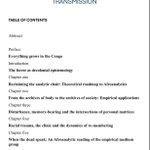
The discovery of Thinking Man was the moment that marked the beginning of my understanding that this thesis is about transmission. There is a fundamental challenge to dualism (which I elaborate on in the thesis) but there is also a call to take intuition seriously.
The figure of Thinking Man has a head shaped like a heart, with a hand resting over his chest.
Uncanny, right?
Not only because of the circumstances of the discovery…when I had just told myself to follow my heart but because years earlier, in my writing The world does not need more intelligent men, I argued that the real test for intelligence is ethical and moral courage.
In a nutshell I had already been writing about ancient Kongolese epistemology, without knowing I was writing about ancient Kongolese epistemology.
I wrote that piece nearly two years before that museum visit, long before I had deeply engaged with African metaphysics.
That moment was a turning point. Things started to fall into place, and this is also when the forest as epistemology started to be illuminated. I am no longer a huge fan of the language of “illumination” due to its colonial and modernist connotations but when I was lost in the forest repeatedly, it was dark.
Almost pitch black.
I could just make out the outline of trees. And each time I felt the urge to run away. Because I could not explain especially in supervision what was happening, I had no language or reference points.
My morning reflection led me to make another important link (I will need to include in my final draft) to confronting the mass, the framework I created to describe the affective reality of decolonial work as mourning work starting from the confrontation of indistinguishable bodies at sea forming a mass.
The forest, and the indistinguishable trees in the darkness, echo the shapelessness of the mass of bodies floating at sea, but also that urge to run, the projection of terror, are analogous.
And it is precisely what I argue in confronting the mass in my reformulation of mourning and melancholia. It is the shapelessness of the object — not necessarily that the object is obscured by the ego or repressed — that creates internal disturbances.
That internal disturbances arise because of the violence of the archive and the obscuring of the lost object, resulting in that mass becoming phobogenic and attracting projections of terror. In the same way I intuited that I needed to see, smell, kiss, feel, touch the body of my dead mother in order to let her go.
The Afroanalytic methodology strives to capture and legitimise: the associative, embodied, non-linear, spontaneous ways significant knowledge comes into being. I offer this an Illustration Afroanalytics in action.