

News and #Research from Amanda Randles's Biomedical Engineering Lab @DukeU. We are using #HPC to address #biomedical questions. #AcademicTwitter #innovation
Durham, NC
Joined May 2022
- Tweets798
- Following2.7K
- Followers1.2K
- Likes2.6K


Congratulations to Japneet Kaur Mavi on passing her preliminary examination! 🎉
Japneet’s research combines patient-specific blood flow simulations, wearable data, and cardiovascular digital twins to study how blood flow changes over time and how those changes may inform our understanding of cardiovascular disease.
Her thoughtful presentation and strong responses to challenging questions demonstrated the depth of her knowledge and the care she brings to her research. We’re proud of her hard work and excited to see her dissertation research take shape!
Please join us in celebrating this milestone! 👏
Randles Lab Duke University Duke University Pratt School of Engineering Duke BME #PhD #DigitalTwins #CardiovascularResearch

Want to know what Duke is doing in Computational Health? Check it out at BMES!
Members of Duke’s Center for Computational and Digital Health Innovation are sharing their work through 19 presentations at #BMES2026—from spatial omics and wearable health analytics to vascular simulation, biomaterials, and biotechnology education.
Join presenters from the Randles, Dunn, Hickey, and Grill labs, along with our Associate Director of Education, Cameron Kim, October 22–24 in Orlando.
📍 Find presenters, times, and locations in the flyer.
💡 Stop by the Duke BME booth to explore the Center’s interactive display!
Come meet our researchers and see what we’re building together.
#DukeEngineering #ComputationalHealth #DigitalHealth


Heading to BMES 2026? Come learn what we’re working on in the Randles Lab—from blood flow in carotid arteries to flow through porous scaffolds.
Shea Middleton will present “Quantifying Morphology-Driven Hemodynamic Changes in the Carotid Bifurcation Through Simulated Forward Head Posture,” exploring how changes in head posture can influence carotid artery geometry and blood flow.
Shihab Kabir will present “Identifying Minimum Spanning Sets of Granular Material Distributions to Capture Fluid Flow Behavior,” a poster highlighting an approach to identifying representative flow behavior in porous scaffolds while reducing simulation costs.
You can also explore an interactive display from the Duke Center for Computational and Digital Health Innovation (CDDHI) at the Duke BME booth. Stop by to see our work in action and talk with us about computational and digital health research!
#BMES2026 #RandlesLab #DukeBME #CDDHI #ComputationalModeling #BiomedicalEngineering
🤖 Made with AI

📚 CCDHI CompHealth Corner — What are we reading this week?
Can AI recognize when its predictions might be uncertain?
A new study published in npj Digital Medicine, co-authored by Evan Calabrese, a member of the Center for Computational and Digital Health Innovation, explores how AI can segment meningiomas on brain MRI while estimating confidence in its predictions.
The model achieved high segmentation accuracy, and its uncertainty maps highlighted difficult tumor boundaries and other areas where predictions were less reliable. The researchers also translated this uncertainty into ranges around tumor volume measurements, which could help distinguish meaningful tumor growth or treatment response from measurement variability.
The approach was externally validated using MRIs from 353 Duke patients, where it maintained high segmentation performance.
This work points toward more transparent AI tools for monitoring brain tumors, with uncertainty estimates that could help clinicians identify predictions needing closer review.
Read more and access the paper: comphealth.duke.edu/publicat…
Duke University | Duke University Pratt School of Engineering | Duke BME


🇩🇪 Randles Lab is heading to FTC 2026 in Germany!
What does it take to make a digital twin reproducible at exascale?
Randles Lab’s Ayman Yousef will present “Towards Trustworthy Exascale Computing: Deterministic Algorithms for Reproducible, GPU-Accelerated Digital Twins” at FTC 2026 in Berlin. The work profiles two parallel approaches to determinism in large scale scientific computing.
Reproducibility helps researchers debug, validate, and share their codes across computing environments.
Join Ayman on October 15, 11:30 AM to 12:45 PM, in Computing Session 1, Rooms 2+3. If you’re attending, come talk with us.
Conference details: saiconference.com/FTC
#FTC2026 #HPC #GPUComputing #DigitalTwins #Reproducibility

The best way to understand what our labs are working on? See it for yourself.
At our first Demo Day for the Center for Computational and Digital Health Innovation, visitors tried interactive demonstrations, explored posters and short presentations, and talked directly with the researchers behind the work. Students also had a chance to learn about research opportunities and connect with labs.
A big thank you to Samreen Mahmud and Nusrat Sadia Khan, who served as the event’s main organizers, and to all the participating labs and attendees who made the day such a success.
Read Samreen’s reflections on Demo Day:
comphealth.duke.edu/demo-day…

What will it take for the next wave of AI advances to change everyday patient care?
The Center for Computational and Digital Health Innovation hosted lightning talks and a lively panel at the Duke Summit on AI for Health Innovation on Thursday, October 8 that I was fortunate to moderate.
Boyuan Chen shared advances in physical AI and robotics, Jessilyn Dunn discussed how wearables can capture health beyond clinic visits, Cameron McIntyre explored computational models that guide deep brain stimulation, and Dan Ma highlighted how quantitative MRI can reveal tissue properties that conventional images miss. Ajit Menon PhD brought an industry perspective on deploying AI at scale.
The discussion explored how healthcare is evolving across these areas and the practical questions that come with that progress. What makes a model trustworthy enough to guide treatment? How do we distinguish meaningful changes from noisy data? And how do we move a successful research tool into routine care?
One memorable takeaway was the call to rethink R&D as 'Research and Deployment'. There is exciting work ahead, and getting it into the hands of clinicians and patients matters.
We were delighted to participate in the summit for our third year. Thank you to our speakers, the summit organizers, and everyone who joined the conversation for such thoughtful questions and an engaging session!
#AIforHealth #DigitalHealth #HealthInnovation
🤖 Made with AI

📚 CCDHI CompHealth Corner — What are we reading this week?
What does it take to become a better mentor?
Mentoring is a skill we can develop and a new study in Biomedical Engineering Education explores how intentional training can help.
Co-authored by Cameron Kim, Associate Director of Education at the Center for Computational and Digital Health Innovation, the study examines a Duke course that prepares graduate students to mentor high school researchers through the Duke Research in Engineering Program (DukeREP).
The course brings together teaching, leadership, community-building, and wellbeing with hands-on mentorship practice. Graduate student reflections indicated greater confidence and stronger teaching, communication, and leadership skills, helping them create more supportive, student-focused learning environments.
The paper got us thinking about the many ways people share their experience and support one another at the Center. At our recent Espresso Chat, Thomas Shepard offered advice on changing roles, taking advantage of opportunities, and showing what you can contribute through hard work and initiative. Cameron Kim also brought students together for a Community of Practice session to share ideas and learn from each other about AI tools.
These experiences offer different forms of mentorship, but share a common thread: making time to help others grow.
What advice from a mentor has stayed with you?
Sharing experience helps others grow.
duke.is/mentoringwell
#Mentorship #CompHealth


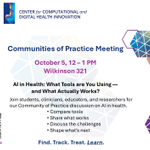
📣 Today! Join our AI in Health Community of Practice from 12–1 PM in Wilkinson 321.
Students, clinicians, and educators: come compare AI tools, share what’s working, discuss challenges, and explore resources available through Duke. Bring your questions and ideas to help shape what’s next!
Register and contact Cameron early to get lunch!

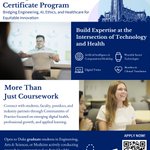
Calling all Duke graduate students interested in the future of healthcare!
The Duke Computational and Digital Health (CDH) Certificate Program offers interdisciplinary training at the intersection of technology and health, bringing together computational modeling, AI, wearable sensor technologies, digital twins, bioethics, and clinical translation.
Beyond the classroom, students participate in Communities of Practice, connecting with faculty, fellow students, postdocs, and industry partners while exploring emerging challenges in digital health and developing valuable professional skills.
The program is open to Duke graduate students in Engineering, Arts & Sciences, or Medicine who are actively engaged in research related to computational or digital health.
Interested in expanding your research and developing the skills to help shape the future of digital health? Scan the QR code to explore the program, learn more, and apply today!

📚 CCDHI CompHealth Corner: Could gut protection start before radiation exposure? A study co-authored by John Hickey found that blocking LATS1/2 before radiation promoted intestinal regeneration and improved survival in mice. duke.is/gut-radiation-protec…


Five milestones, one Randles Lab celebration! 🎉🥂
Yesterday we celebrated Ayman’s progress report and Guin, Jorik, Shihab, and Shea’s prelims, all completed over the last few months!
We’ve started doing big celebrations each semester, and we had so much to celebrate that we split this one into two! First papers and major publications a few weeks ago, then PhD milestones yesterday.
Everyone gets a signed bottle of champagne or sparkling grape juice, and I keep the cork with their initials. My box of corks is slowly filling up 😊
So proud of this group for having so much to celebrate, and so excited to see everyone progressing through their PhD journeys! ❤️
#RandlesLab #DukeBME #DukeEngineering #PhDLife #LabLife #ResearchMilestones


Meet our featured researcher, Hanting Ye, a Postdoctoral Associate in Duke’s Intelligent Interactive Internet of Things (I3T) Lab, led by Center Associate Director of Extended Reality Maria Gorlatova.
Hanting leads the development of WordPlay Party, a multiplayer XR rehabilitation game designed for people with Parkinson’s disease that brings physical and cognitive activities into a shared experience with a therapist. He is also exploring how smart glasses and AI could support health monitoring and rehabilitation in everyday life.
In our latest interview, Hanting shares what motivates his research and his vision for personalized support beyond the clinic.
Read the full interview: comphealth.duke.edu/featured…
#DigitalHealth #ExtendedReality #DukeResearch
Today’s the day! 🎉 Join CCDHI Demo Day at Duke’s Wilkinson Building, 3–6 PM. Meet the Randles, Big IDEAs, I3T, Hickey, Grill, and Injury Biomechanics labs, plus Duke Innovation Co-Lab. Come see what the teams are building and chat with the people behind the work!


Our software has a new look. We’ve updated the logos for HARVEY, HarVIS, and HarVI and would love your thoughts: do they feel connected while still giving each tool its own identity?
Explore the updated software page: randleslab.pratt.duke.edu/re…
🤖 Made with AI


Today! Join us for the next Computational & Digital Health Seminar featuring Rishikesan Kamaleswaran, PhD, Associate Professor at Duke University School of Medicine.
Forecasting Patient Trajectories: Next-Generation Foundation Models Using Irregularly Sampled Multimodal Time Series
Dr. Kamaleswaran will discuss foundation models that integrate continuous physiological telemetry, electronic health records, and medical imaging to forecast patient trajectories and provide a predictive, whole-patient view of hospitalized patients.
📅 Today, September 23, 2026
📍 Join us: duke.is/CompHealthSept2026Se…
#DigitalHealth #ArtificialIntelligence #MachineLearning #FoundationModels #HealthcareAI #ClinicalInformatics #DukeUniversity

How can AI forecast a patient’s health when clinical data arrives at irregular intervals?
Join us today at 3:00 PM ET for a virtual CCDHI seminar with Rishi Kamaleswaran, PhD, Associate Professor at Duke University School of Medicine. He’ll discuss how multimodal time series can be used to build clinical foundation models and forecast patient trajectories.
📅 Wednesday, September 23
🕒 3:00–4:00 PM ET
💻 Virtual seminar: duke.is/CompHealthSept2026Se…
We hope to see you there!

Want to see what’s next in computational and digital health at Duke? Come experience it firsthand.
The Duke Center for Computational and Digital Health Innovation (CCDHI) invites you to our inaugural Demo Day 2026—an interactive showcase of the research, technologies, and ideas emerging across our community.
Explore live demonstrations, try new tools and models, view research posters, and meet the faculty and students behind the work. Featured groups include the Randles Lab, Duke BIG IDEAs Lab, I3T Lab, Hickey Lab, Grill Lab, Injury Biomechanics Lab, and Duke Innovation Co-Lab.
Whether you’re interested in discovering a new area of research, finding a lab or collaborator, or simply seeing what’s being built across Duke University, there will be plenty to explore.
📅 Friday, September 25, 2026
⏰ 3:00–6:00 PM
📍 Wilkinson Building Lobby
Come curious. Leave with a new idea, a new connection, or perhaps your next research opportunity.


Most of you know that one of the things I’m most passionate about is bringing people across disciplines together to use cutting edge technology to tackle some of the biggest challenges in health care.
The vision driving our Duke University Center for Computational and Digital Health Innovation is find, track, treat: find signals of disease earlier, track how health changes over time, and develop more precise ways to treat patients.
I’m incredibly fortunate to work with colleagues on our Executive Committee (Maria Gorlatova, Jessilyn Dunn, Boyuan Chen, Monica Agrawal, John Hickey, and Cameron Kim) who bring expertise in XR, AI, HPC, and wearable technology to that vision for both research and education, alongside our broader community of members and remarkable trainees. There is so much exciting work happening across the Center, and I look forward to sharing it at our upcoming Demo Day on September 25!
Our Fall newsletter offers a look at what this community has accomplished over the past few months, from new initiatives and student projects to publications and awards. It also highlights upcoming events and ways to connect with us.
Take a look, and sign up for our mailing list if you’d like to follow the work or find a way to get involved!
📰 Newsletter: lnkd.in/eE6JzmkY
📬 Sign up: lnkd.in/eEGeSK4y
📚 CCDHI CompHealth Corner — What are we reading this week?
Can Machine Learning Make Noninvasive Coronary Artery Assessment Faster and More Accurate?
A recent study published in Cardiovascular Engineering and Technology from the lab of CCDHI Director Amanda Randles explores how machine learning and physics based modeling can work together to improve the assessment of coronary artery disease.
Fractional flow reserve, or FFR, helps clinicians determine whether a narrowing in a coronary artery is significantly restricting blood flow. Although FFR is the clinical gold standard, measuring it typically requires an invasive pressure wire procedure. Computational models offer a noninvasive alternative, but detailed simulations can require substantial time and computing resources.
Using data from 132 patients across two medical centers, the researchers developed an efficient approach that combines one dimensional blood flow simulations with a machine learning feedback loop. The simplified steady state simulations closely matched more computationally demanding pulsatile models while reducing computational overhead by approximately half.
In the held out test set, machine learning refinement improved diagnostic accuracy from 77.8% to 92.6% and increased specificity from 73.3% to 100%. The greatest improvements appeared in the diagnostically challenging FFR “gray zone,” where clinical treatment decisions can be especially difficult.
Importantly, this work demonstrates how machine learning can strengthen efficient, physics based models without sacrificing interpretability. By combining patient specific simulations with targeted data driven refinement, this approach could help make noninvasive cardiovascular assessment faster, more scalable, and better suited for clinical use.
Authors include Center members and alum: Cyrus Tanade, Japneet Kaur Mavi, Guinevere Ferreira, Sam Schwaller, and Amanda Randles.
Read the paper: comphealth.duke.edu/publicat…
#CardiovascularHealth #MachineLearning #DigitalHealth #ComputationalMedicine #BiomedicalEngineering #CompHealth
