
Options seller & systematic trader. I share my highly profitable strategies on YouTube.
New York, NY
Joined September 2025
- Tweets128
- Following373
- Followers1.4K
- Likes7.4K




Options With Ravish retweeted

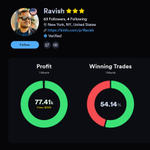
Only 1 red day in September for @RavishOptions 👍
- $46K on the month
- 79% win rate
- $529K lifetime
Kinfo Verified ✅


Options With Ravish retweeted

We hit our second 100k+ pod on @Kinfo in what must less than 30 episodes.
A third episode due to hit 100k soon.
Great results, proud of this and happy to be back on another podcast after Steady Trade.

Options With Ravish retweeted
Congatulations on this one @RavishOptions my records internally say 75k and it looks like we'll hit 100k!
That's 100 thousand people better educated thanks to your transparency on @Kinfo pod.
Thanks for giving back man - I'm proud of this one.
Options With Ravish retweeted
Traders pay theta every day without realizing it.
@RavishOptions explains how calendar spreads flip the equation and get time working in your favor.👇
Link to the full ep in the comments.
Options With Ravish retweeted
Thanks @RavishOptions for being such an amazing guest.
I absolutely loved learning your two option concepts.
Great watch for anyone interested in options or just for those seeing what’s outside small cap land.

10 year options education in 60 seconds 💥
Thanks so much @RavishOptions for verifying and giving so much value with your presentation 🔥
Link in the comments.

Options With Ravish retweeted
New episode! 🚨
10 years of options trading experience in 60 minutes.
@ravishoptions presents two strategies to generate consistent 10k per week returns:
→ Delta neutral trading
→ Calendar spreads
Watch it here 👉 youtu.be/mnDFfC1QhZ4

Options With Ravish retweeted

Everyone's talking about the iron condor martingale,
let's look at actual trades.
What follows is the series of trades leading up to Captain Condor's Christmas Eve blow-up.
They add context & teach two lessons:
1. The price isn't always "right"
2. Don't sell them blindly

Options With Ravish retweeted
$50 million+ of retail funds blown up on the Christmas Eve running martingale on 1DTE SPX Iron Condor.
1,000+ people lost their life savings following his degenerate gambling “strategy” which was sold to them using deceptive sales tactics. He touted himself as Captain Condor 🤦♂️


Casinos ban certain strategies to protect their edge. There are interesting parallels between how casinos manage risk and how traders can think about probability.
Most traders approach markets without a statistical framework. They pick directions, chase setups, and hope they’re right more often than wrong.
Casinos operate differently. They rely on probability and statistics to maintain consistent advantages over thousands of transactions.
Looking at how casinos manage risk offers useful educational comparisons to options trading. Here are a few concepts that I think stand out:
#1: The Martingale approach is based on scaling position size after losses.
Casinos restrict this model with table limits. The mechanics are simple:
- Bet $10 and lose → next bet is $20
- Lose again → next bet is $40
- Continue scaling until a win
The model is designed so a win could offset earlier losses, but this assumes unlimited capital... something neither casinos nor traders have. Table limits exist to prevent this approach from being feasible.
While markets don’t impose table limits, traders still face natural constraints like capital, volatility, and risk tolerance.
#2: Card counting estimates when probabilities shift.
The MIT Blackjack team used card counting to identify when the deck statistically favored the player. Casinos eventually restricted this behavior.
In options trading, probability estimates appear directly in the options chain. Traders can evaluate different strikes and expirations using those estimates — similar in spirit to how card counters evaluated deck composition, though market dynamics are far more complex.
#3: Small statistical advantages become meaningful over large samples.
Casinos profit from a small percentage edge across thousands of transactions.
In options trading, probability estimates help traders structure defined-risk positions. Higher-probability trades typically offer smaller potential returns, while lower-probability setups may offer asymmetric outcomes. Nothing is guaranteed, and performance varies, but sample size and position sizing matter.
#4: Structural rules shape what strategies are viable.
Casino table limits prevent infinite scaling. This constraint defines which betting strategies remain possible.
Markets operate with different structural rules. Traders adjust position size based on available capital and risk management preferences. Understanding these differences helps clarify which concepts translate across environments... and which don’t.
The bottom line?
Casinos operate on statistical edges and disciplined probability management. Markets offer probability-based frameworks too, though outcomes remain uncertain. Recognizing how different environments manage risk can offer helpful context for thinking about trading in a probability-informed way.
Educational only. Not investment advice. All trading involves risk.