

Value-investing lens on resource stocks: copper, uranium, gold, critical minerals. NAV & FCF frameworks, not tips. Not advice.
Joined February 2021
- Tweets64
- Following178
- Followers45
- Likes31

NAV models built on identical commodity price assumptions can still deserve different multiples once you price in where the asset sits. A deposit in a stable jurisdiction and one in a country with a history of resource nationalism aren't the same NAV, even with matching numbers.
9
One quality filter that's easy to check and rarely discussed: how much of a junior miner's stock is actually owned by management, versus paid out in salary regardless of results. Skin in the game shows up in the register, not the investor deck.
10
Royalty and streaming companies buy a slice of future production instead of operating mines — no capex overruns, no strikes, no permitting delays. Lower torque to commodity price moves, but a meaningfully different risk profile than the operators we usually screen.
7
Lithium oversupply is a textbook cycle: prices spike, capital floods in, supply overshoots, prices crash, capacity gets mothballed, and the next shortage starts building. The real question isn't 'is lithium good' — it's who survives the trough with the balance sheet intact.
7
Silver gets labeled 'poor man's gold,' but industrial use (solar panels, electronics) now outweighs jewelry and coin demand combined. That means the right lens isn't real rates alone — it's industrial capex cycles, a different screen than gold miners need.
1
25
When a raise lands, work out the bar, then read the use of funds and ask whether that spend can plausibly clear it. If NAV is overstated, the real discount and the bar are both smaller than they look. What part of a capital raise do you find hardest to judge?
1
Retail's usual route is an SPP: eligible holders can buy in, up to A$30,000 each a year. A 2024 Journal of Banking & Finance study found retail ownership diluted 3.9% when a placement came with a same-price offer to all eligible holders, vs 8.6% in comparable plain placements.
1
1
Under ASX Listing Rule 7.1, a company can place up to 15% of its capital in 12 months without a holder vote. Smaller companies can add 10% more under 7.1A if holders approve it at the AGM. Placements usually go to sophisticated and professional investors.
1
4
Free attaching options lift the bar again. Say Example Co. adds one option for every two new shares, exercisable at A$0.75. If exercised, A$7.5m comes in for 10m more shares: NAV per share falls to A$0.904, and the gap back to A$1.00 grows from A$10m to A$12.5m.
1
1
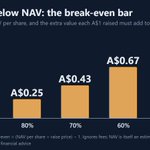
In general, the extra value needed per A$1 raised = (NAV per share ÷ raise price) - 1. Raise at 90% of NAV and the bar is A$0.11. At 70%, A$0.43. At 50%, a full A$1.00. The chart shows how fast it climbs.
1
3
To get back to A$1.00 a share, the A$10m has to be spent on something worth A$20m. Each A$1 raised must create another A$1 of value on top of itself. That's the break-even bar for a raise at half of NAV.
1
1
Straight after the raise, NAV is A$110m (the old NAV plus the new cash) spread over 120m shares: A$0.917 a share. Existing holders have given up over 8% of NAV per share before a single metre is drilled.
1
2
The setup: fictional Example Co. has a NAV of A$100m and 100m shares, so A$1.00 a share. The stock trades at A$0.60. It places A$10m at A$0.50, a discount to the last price, and issues 20m new shares.
1
3
Our last thread covered the runway number in an ASX explorer's quarterly. This one covers what happens when the runway runs short and the company raises equity below NAV. There's a simple break-even test for existing holders:

1
7
Which copper price belongs in your NAV? If tariffs keep US and international refined copper prices apart, the same mine can be worth different amounts depending on where its cathode is sold. Offtake destination has become a valuation input, not an annual-report footnote.
7
Second round: which of these would be most useful to see us screen next — junior copper developers, uranium enrichment-exposed names, or gold miners specifically on a real-rates re-rating thesis? Reply and it'll shape what's next.
11
Government equity stakes in critical-mineral companies make headlines, but a shareholder isn't a price floor, and even contracted floors run on political timelines. A NAV that assumes policy will backstop prices is calling political risk safety. Model market prices first.
4
The clearest tell on management quality in this sector: what happens to free cash flow when commodity prices are high. Disciplined operators return it or pay down debt. Empire-builders chase acquisitions at the top of the cycle. History is not kind to the second group.
4
Lithium's rebound pulled idle mines back into production, and prices are already slipping as supply returns. A mothballed asset is an option, priced on restart capex, months to first output, and the price you assume at restart. If everyone restarts at once, that price fades.
6