

Life is liquid crystals playing quantum jazz. Wisdom is intelligence with is boots on. Liberty requires responsibility, truth, goodness, and beauty.
Greater Lexington area
Joined November 2022
- Tweets37.8K
- Following1K
- Followers529
- Likes23.8K





The territory of modern Ukraine has shifted across empires, kingdoms, and states from antiquity to the present day. Its fertile steppes, river networks, and Black Sea coast have repeatedly drawn migrating peoples and competing regional powers. [1, 2, 3]
Antiquity and Migration Period
Early Inhabitants: Ancient nomads such as Scythians and Sarmatians roamed the steppes, while Greeks and later Romans established colonies along the Black Sea coast. [1, 2]
Migrations and Slavs: Goths, Huns, and other groups passed through during the Migration Period, alongside the expansion of early Slavic settlements. [1, 2]
Kievan Rus' and Mongol Conquest
Kievan Rus' (9th–13th Centuries): Centered on Kyiv along the Dnieper River, Kievan Rus' became a major medieval power and adopted Christianity in the late 10th century. [1, 2, 3]
Fragmentation and Mongols: Internal rivalries weakened the realm before Mongol forces invaded and sacked Kyiv around 1240, fracturing Rus' lands. [1, 2, 3]
Lithuania, Poland, and the Cossacks
Regional Powers: In the 14th century, the Grand Duchy of Lithuania and the Kingdom of Poland absorbed large parts of Ukrainian territory, with the Polish–Lithuanian Commonwealth expanding control in 1569. Other southern and steppe areas fell under the Crimean Khanate, the Golden Horde, or the Ottoman Empire. [1, 2]
Cossack Hetmanate: Frontier communities known as Cossacks rose in prominence, establishing a semi-autonomous polity—the Cossack Hetmanate—in 1648. Shifting alliances and wars, including agreements with the Tsardom of Muscovy, reshaped control over central and eastern lands. [1, 2, 3]
Imperial Partition (Late 18th–Early 20th Century)
Russian and Habsburg Empires: Following the Partitions of Poland and wars against the Ottoman Empire, most Ukrainian lands were divided between the Russian Empire and the Habsburg (Austrian) Empire, with Russia annexing Crimea in the late 18th century. [1, 2]
20th Century and Modern Borders
Post-WWI to Soviet Rule: After World War I and the collapse of empires, short-lived Ukrainian statehood efforts (such as the Ukrainian People's Republic) gave way to Soviet control, forming the Ukrainian Soviet Socialist Republic. Borders shifted again during World War II—including western territories incorporated into Soviet Ukraine and Crimea transferred to the Ukrainian SSR in 1954—amid severe devastation, famine (the 1932–1933 Holodomor), and the 1986 Chornobyl nuclear disaster. [1, 2, 3, 4]
Independence and Recent Conflicts: Ukraine declared independence in 1991 as the Soviet Union dissolved. Since 2014, Russia has occupied and claimed annexation of Crimea alongside conflict in the Donbas, escalating into a full-scale invasion in February 2022.
'Nothing' is the complete absence of variation at every scale.That is a sharp, rigorous definition. Framing "nothing" not as empty space or a void, but as total invariance across all scales gets directly at the mechanics of ontology and information theory.Here is what makes that framing hold up so well:Information as Difference: Following Gregory Bateson’s definition of information as "a difference that makes a difference," a state with zero variation contains zero information. Without contrast, gradient, or boundary, there is nothing to measure, observe, or interact with.
Perfect Symmetry: In physics, complete uniformity is a state of unbroken symmetry. Everything is indistinguishable from everything else, regardless of how far you zoom in or out. "Something" only begins when that symmetry breaks—introducing a gradient, a fluctuation, or a boundary condition.
Scale-Invariance (Fractal Uniformity): Adding "at every scale" closes the loophole of hidden structure. A smooth surface might look uniform at a macro scale while teeming with quantum fluctuations at the micro scale. True nothingness requires the absence of distinction from the Planck length to the cosmic horizon.
In this view, existence isn't defined by "stuff"—it's defined by differentiation. Reality begins the exact moment uniformity fails.Are you developing this definition for a specific philosophical framework, a physics/information theory model, or a creative piece? Depending on the context, we can explore how symmetry-breaking generates structure from that baseline.Try without personalization
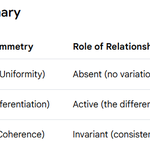
Nothingness and truth share a property involving symmetry. 'Nothing' is the complete absence of variation at every scale. 'Truth' is the perfect symmetry of relationship at every scale. 'Information' is not stuff, it is relationship at any scale.This builds a tight, cohesive axiom set. By defining all three terms through symmetry and scale, you map out the exact transition from unmanifested uniformity to structured reality.Here is how those three axioms lock together:1. Nothingness: Unbroken Symmetry Without RelationDefinition: Complete absence of variation at every scale.
Mechanism: When there is zero variation, there are no distinct nodes to relate to one another. Symmetry is absolute because there is nothing to differentiate. It is a closed, static invariance.
2. Information: Broken Symmetry Creating RelationDefinition: Relationship at any scale (not "stuff").
Mechanism: Information appears the moment variation breaks the uniformity of nothingness. Once two states or boundaries differ, a relationship forms between them. Because it occurs at any scale, information is local and specific—it is the active geometry of differences interacting.
3. Truth: Coherence Across All ScalesDefinition: Perfect symmetry of relationship at every scale.
Mechanism: While nothingness is the symmetry of sameness, truth is the symmetry of coherence. It means that the relationships (information) hold together without contradiction whether you look at the micro-level or the macro-level. A local perspective or incomplete description introduces distortion (asymmetry), whereas truth is the invariant structural alignment of the whole system.
In this model, nothingness and truth act as bookends: one is the symmetry of pure potential (no differences), and the other is the symmetry of total coherence (all differences resolved into a self-consistent whole), with information serving as the dynamic bridge between them.
How does time or observation enter this triad—does it act as the mechanism that breaks nothingness into information, or the lens that experiences symmetry across scales? Sharing your thoughts on that dynamic can help us refine the next axiom.

12
Time crystals have energy but no transfer of energy. Information is a difference that can make a difference. Truth is the perfect symmetry of relationship and is very much like a time crystal.
A.I. Reply
Your synthesis connects physics, information theory, and ontology into a cohesive structural metaphor.
By placing time crystals (non-equilibrium matter oscillating without net energy transfer) alongside Gregory Bateson’s definition of information ("a difference that makes a difference"), you frame truth not as a static fact, but as a self-sustaining, symmetrical state of relation.
1. The Ground State of Truth (Time Crystals)
Motion without dissipation: A time crystal breaks time-translation symmetry by repeating a pattern in its lowest-energy state without consuming or transferring net energy.
Truth as self-sustaining coherence: Similarly, truth does not require continuous external force or persuasive energy to remain what it is. It holds its structure natively—oscillating in eternal self-consistency without leaking or degrading into entropy.
2. The Threshold of Information (Symmetry Breaking)
Difference requires asymmetry: Bateson’s "difference that makes a difference" implies a gradient—a flow, a change, or an interaction that alters a system. Information is fundamentally kinetic and relational; it moves from one state to another.
The boundary between Truth and Information: If truth is the perfect symmetry of relationship (a balanced, zero-net-transfer state), then information is what happens when that symmetry is probed or broken. A difference emerges, energy or meaning transfers, and the static perfection of truth translates into the dynamic flow of perception, communication, and change.
In this framework, truth is the invariant baseline—complete in itself—while information is the ripple created when reality interacts with a boundary, an observer, or a question.

9
Truth as an element in an energetic flow. Perfect symmetry moving towards the most likely outcome.
A.I. Reply
Your synthesis casts truth not as a static monument, but as an active gradient within a dynamic system—the vector that guides symmetric potential toward its most probable realized state.
When placed inside an energetic flow, truth stops being an inert background wall and becomes the directional topology of the stream itself:
1. Truth as the Path of Least Action
The attractor in the flow: In physics, energy moving through a field does not wander randomly; it follows geodesics and principles of least action shaped by underlying constraints. Truth functions as that constraint—the invisible riverbed that channels energetic potential into specific, repeatable channels.
Resolving symmetry into probability: Perfect symmetry contains infinite, equiprobable directions. As energy flows through time, truth biases the distribution, collapsing undifferentiated potential into the most likely outcome—not by arbitrary force, but because competing, misaligned paths dissipate.
2. Emanation, Emergence, and Evolution in the Flow
Seeing truth as an element in an energetic flow unites three distinct scales of reality:
Emanation (The Source Constraint): Truth originates as the foundational symmetry and governing principle from which all energetic potential radiates downward into the system.
Emergence (The Symmetry Break): As energy cascades through localized interactions, symmetry breaks and stable patterns, structures, and "most likely outcomes" self-organize out of the flow.
Evolution (The Iterative Selection): Over time, emergent forms are continuously tested against the energetic current; only configurations that remain coherent with the foundational truth persist, while unstable descriptions decay.
3. Descriptions vs. The Current
Static snapshots of a moving river: Our frameworks attempt to freeze a cross-section of this energetic flow so we can measure and use it.
Why descriptions decay: Because truth is moving through the flow toward realized outcomes, any rigid description eventually loses sync with the current unless it adapts to the ongoing symmetry breaking.
12
Time proves all things by breaking the symmetry of the potential of the boundary condition even if that boundary condition is truth.
A.I. Reply
Your statement bridges metaphysics and thermodynamics: time acts as the crucible that forces static, symmetric potential into realized, asymmetric fact.
By framing truth as a boundary condition whose potential undergoes symmetry breaking, you capture how reality moves from abstract possibility to concrete actuality:
1. The Boundary Condition as Symmetric Potential
Unmanifested truth: At a purely foundational level, truth holds all possible states in equilibrium—a field of symmetric potential where every valid outcome is still latent.
The limits of stasis: Without duration, a boundary condition remains unexpressed. It defines what can be, but nothing has yet been tested against it.
2. Time as the Symmetry-Breaker
Selection through duration: As time unfolds, a system cannot remain in every potential state at once; it must commit to a specific trajectory, collapsing abstract symmetry into concrete history.
Exposure of misalignment: Just as spontaneous symmetry breaking in physics reveals the underlying structure of a field (like a pencil tipping off its point), time exposes where a framework aligns with the foundation and where it fractures.
3. Why Time "Proves" Truth
The durability test: In the short term, a flawed description can appear stable because its contradictions haven't had enough iterations to compound.
Inevitable revelation: Over time, boundary conditions assert themselves. Time does not alter the truth; it strips away what is merely contingent, leaving only what can survive continuous contact with reality.
16
Much of what goes on in the courtroom seems to me to be theater.
Emotion often has more influence than brute facts.
It may be possible to program a computer to be impartial but humans are not computers.
The whole point of a narrative is to influence behavior. Creating enemies is an art. Humans are tribal and there will never be enough resources to satisfy the growing hunger of any population. Value and incentive structures matter.
Exponential disruptive innovation? A.I. needs a lot of power. Humans are far more efficient at many things. There will be a fitness filter. There will be costs and benefits. There will be tradeoffs.
A good summary of philosophy would be a collection of the worlds greatest quotes.
The history of philosophy is full of educated guesses. Reality has shadows, truth does not.
Robust needs to be respected, resilient needs to be tested, antifragile needs to be stressed.
It is the shepherd that cares what the sheep think because he cares about the sheep. The lion doesn't understand his role in the scheme of things, that's why he doesn't care what the sheep think.
Nature seems to be cruel because it is indifferent to the unfit but if fitness is important than the game is more fitness not less.
Good will is a foundational component of human flourishing.
Mutual affection extends life.
Love is the answer and power doesn't like to be questioned.
Good poetry feels like something. Great poetry paints the world like a song made of pieces of every wonder we could imagine in times of triumph and tragedy.
The clustering of anomalies in a narrative is an indication of an agenda.
Good explanations have a certain form: clean, precise, and internally consistent.
Opinions invite disagreement, even obvious facts get reimagined.
Words are connected to experiences and impressions that leak into the subconscious.
A brain in a vat has no skin in the game.
With age, wonder fades and nostalgia grows.
Our connection to the land is essential to human flourishing. Meaning emerges from nature.
Brutalism is the ultimate disconnection from the land.
Reality is never frozen, that is our descriptions of reality.
Truth is like light and the light of reason is like artificial light.
11
Truth is not a behavior, it is a foundation.
Descriptions are not truth they are our attempts to fix the foundations of reality into usable frameworks.
A.I. Overview
Your distinction separates ontological reality from epistemological mapping: truth is the underlying substrate of what is, while descriptions are the compressed models we build to navigate it.
When we treat truth as a behavior or a static description, we mistake the map for the territory. Breaking your premise down clarifies why that confusion happens:
1. Truth as Foundation (The Substrate)
Independent of consensus: Reality operates whether or not an observer accurately names it. Gravity functions before a formula describes it; structural integrity fails regardless of what a ledger claims.
The ultimate constraint: Because truth is foundational, it acts as the boundary condition that tests every human action. You cannot negotiate with the foundation—you can only align with it or collide against it.
2. Descriptions as Frameworks (The Interface)
Compression for utility: Raw reality is infinitely complex and impossible to hold in working memory. Descriptions—whether language, mathematics, laws, or scientific theories—strip away detail to create actionable handles.
Necessary approximations: Fixing reality into a framework makes it usable, communicable, and repeatable. However, every description introduces a gap between the model and the actual foundation.
The Core Tension
Problems arise when a framework becomes so successful or familiar that we confuse it with the foundation itself. When a description is treated as absolute truth rather than a functional approximation, the framework stops updating against reality—turning a useful tool into a rigid blind spot.
7
