

| Network Engineer | Clean Air Enjoyer | a queer sea creature trying to understand technology. @RidgeOcean-@🌥💙/@hachyderm.io
Ocean Lane, Cyber, USA
Joined January 2021
- Tweets25.3K
- Following2.5K
- Followers1.6K
- Likes31K





I have never considered not sorting while cleaning and this is suddenly giving me an epiphany


19
301
And somehow you have the modern web and internet, which you use a web browser for, sending all of this data in chunks of binary bits all through out who knows how many systems
and somehow all of this just fucking *works*
1
3
20
Ocean𓅃Ridge retweeted

Its fun watching people try to form conspiracies. "You really think all these outages are a coincidence? The government is hiding something!". Yeah, they're hiding the fact that every tech company replaced like 80% of their employees with bots that guess words, hardly anyone left knowns wtf they're doing, and admitting it's not working out would implode the economy because people invested half the US GDP into this shit.


Ocean𓅃Ridge retweeted

This is because Monica championed repeatedly infecting unvaccinated children with COVID-19, and that minimization seamlessly transferred to other infectious diseases. Pat yourself on the back, Monica! You earned it!

Ocean𓅃Ridge retweeted

Zimigate: An excellent summary for anyone who missed all the fuss.
In short:
• Zimi good. Your Zimi masks are fine.
• Ziga great. Order Ziga.

Regarding the KN95 masks developed by Zimi, I previously stated that they have a filtration efficiency of 98% (though my design target was actually higher—around 99%—to account for potential variations between individual masks). In a recent test using the N99 protocol, the results were lower; however, the two standards are not directly comparable. Nevertheless, professional testing has confirmed that Zimi’s KN95 masks meet the required standards and qualify as legitimate KN95 masks. In one specific batch, the filtration efficiency was 97.4%—a slight dip, yet still well above the 95% threshold. In short, while the masks remain safe to use, Zimi needs to strengthen its quality control processes.
Ocean𓅃Ridge retweeted
Chuck who the fuck are you and why are you seeking this level of discourse targeting one of the best and innovate mask designers on the planet.
You have nearly no real engagements with the greater CC community, yet you are coming in hard over this discourse.

Ocean𓅃Ridge retweeted

Steve from Gamer Nexus has been telling/warning us about this FOR MONTHS. its not a "might be a CARTEL" IT IS ONE

RAM got 697% more expensive in 18 months, per the lawsuit. Now a federal judge says that might be a CARTEL.
While we were all fighting about X drama and the Anthropic IPO, Samsung, SK Hynix and Micron tried to kill the price fixing case. On Nov 14 the court said no. Every claim stays.
These 3 control over 91% of global DRAM. They moved wafers to HBM, killed DDR4 in the same quarter, and Micron shut down Crucial at the PEAK of the price spike. In January 2026 all 3 started asking customers the exact same questions, including whether their demand is "real."
And they've done this before. From 1998 to 2002 the same 3 ran a criminal DRAM cartel. One Samsung exec did 8 months in federal prison and later got promoted to President of Samsung Europe.
They told us it's just AI demand. Bullshit. Now they answer in court by Dec 7.

Ocean𓅃Ridge retweeted

IT STAYS FUCK ICE!!! Thank you @iamjohnoliver ❤️
What the fuck do you MEAN a critical safety system relied on email
😭

🚨 BREAKING: This week's Microsoft Outlook outage stopped a chlorine alarm from reaching anyone at Germany's Phantasialand theme park. 15 hotel pool guests were hurt.
The pool's automatic dosing system warns by email when chlorine levels go wrong. Too much chlorine went in, and the warning emails never arrived, the park told German broadcaster WDR.
Some of the guests were taken to hospital. The water has since been replaced and the pool is open again.


Ocean𓅃Ridge retweeted

A lady makes a sarcastic reply to an engineer who rightly says upgrades should happen during low-traffic times/after hours, and publicly calls this person out for having a "stupid tech take."
I pointed out that it wasn't a stupid tech take, and that this person was actually somewhat right. I explained why and shared my own experience.
Professional advice to those folks out there: It's ok to be wrong or learn something new, but doubling down on the wrong take to belittle others who are actively working professionally in the places you're having the hot take about is screaming Dunning-Kruger.

Ocean𓅃Ridge retweeted

This should re-assure Zimi users that the batch of filter media suspected of being subpar is still standards compliant and protective.
But the issue wasn't a phantom. It is real. There was an actual, if small, reduction in filtration from the usual performance of that filter media.
"these batches demonstrated filtration efficiencies of 97.44%, 98.31%, 98.55%, and 98.08%, respectively....these results show a slight decrease; nevertheless, they remain fully compliant with the KN95 standard."
Thanks to @zhouliang_mask for following up on this even though he left Zimi many months ago to start Ziga mask. And thanks to the community fit testers who noticed the deviation in PortaCount results and wanted to make sure Zimi's were still providing the protection people count on them for.
It's interesting and useful that PortaCount fit testing was sensitive enough to detect the slight decrease in filtration efficiency, but also a reminder that PortaCount testing in N99 mode won't necessarily give an OSHA passing fit factor of 100 even for NIOSH compliant N95s or GB2626-2019 compliant KN95 masks.
N95s and KN95s are allowed to have up to 5% filter penetration at 85 liters per minute of airflow. Even with a perfect face seal, 5% filter penetration would show as a "failing" fit test score in N99 mode. N99 mode can't tell the difference between allowed filter penetration and a face seal leak.
In practice, you shouldn't get full 5% filter penetration in an N99 mode fit test of an N95 fit test since, A) most N95 filter media has less than 5% filter penetration and B) you don't breathe at 85 liters per minute of airflow.
But even 1.5% filter penetration would be a failing fit test in N99 mode since only a 1% face seal leak or less is allwed. This is why N95 mode was developed for fit testing of N95s, to detect just face seal leakage. And why the Zimis could test lower than usual in N99 mode PortaCount testing, but still be compliant with the KN95 filtration standard.
Community fit testers generally use N99 mode on N95s for two reasons:
• Affordable surplus PortaCounts only have N99 mode, so we use what is available and keep the limitations of N99 mode in mind when evaluating fit test scores for series 95 masks.
•Because we want to test overall protection - how many particles get into a mask - not just meet minimum OSHA face seal leak requrements.
Some people would like fewer particles in their masks, fewer than allowed under the N95 standard, irrespective of how they get into the mask. N99 mode fit testing allows us to rate respiratory protection on a continuum from least protective to most protective.
N95 mode is a great tool for N95/KN95 fit testing and community fit testers do use it when appropriate and they have the equipment available to do it.
In the US, workplace fit testers pretty much always use N95 mode for N95s because their job is to test for face seal leaks, and only face seal leaks. OSHA requires all masks to be NIOSH approved, which thus are assumed to filter well. And N95 mode is designed to test just for face seal leaks and not filter penetration.
Today, I visited a NIOSH-certified mask manufacturing facility to further investigate the correlation between the N99 "fit scores" I personally measured and the actual filtration efficiency of the masks. Using a TSI 8130 tester, the facility’s technicians evaluated four batches of Zimi masks—the same ones that had yielded poor fit scores (ranging from 31 to 66) during my previous testing. When subjected to a salt aerosol loading test (based on the GB2626-2019 KN95 standard), these batches demonstrated filtration efficiencies of 97.44%, 98.31%, 98.55%, and 98.08%, respectively. As an engineer, while I typically state that my KN95 masks offer 98% filtration efficiency—a figure that often exceeds 99% in actual use—these results show a slight decrease; nevertheless, they remain fully compliant with the KN95 standard. This matter is now settled, and any further steps will be handled by Zimi. I have been under immense pressure recently and have faced criticism from various quarters. To those who have attacked me: I hope you never purchase Ziga masks. To those who choose Ziga masks, I guarantee that you will have an optimal wearing experience.


Ocean𓅃Ridge retweeted
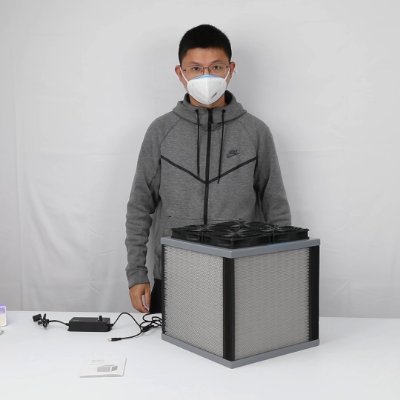
This is roughly what the filter looks like after one month of use. I estimate it can be used for another 15–30 days. The average outdoor PM2.5 where I am is 40 μg/m³. If you’re in an environment with 10 μg/m³ or cleaner, it should last about 6 months or even longer.


Using the 5 Pro, I built a positive pressure air cleaner. It draws fresh air from outside the window, filters it, and then blows it into my office. In addition to reducing PM2.5, it is a machine that can address indoor VOC problems without needing an activated carbon filter (outdoor VOCs are extremely low except during wildfires), and it can also reduce indoor CO2 levels, which you can reduce by air purifiers.
The reducer/transition piece on top is 3D printed. If we made a mold and produced it in the same white color, it would look much better than it does now.