

Policy & migration researcher | SSHRC Doctoral Fellow @LSESocialPolicy | Fellow @policy_school | Running experiments on policy, trust, and social cohesion.
London, England
Joined October 2015
- Tweets1.8K
- Following886
- Followers2.3K
- Likes10.1K







Pinned Tweet
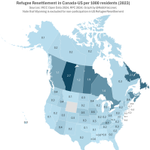
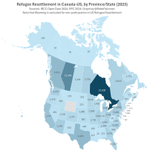
A map of refugee resettlement by US State and Canadian Province/Territory for 2023.
Darker shades correspond to higher numbers in absolute terms.

My father is in Kyiv right now and sending Air Alert updates to the family group chat in the same way he shares a cool item he found on Facebook marketplace, like it's nbd.
3
832

Private sponsors in Alberta resettled more refugees than New York or Pennsylvania combined last year, in a province that is 1/8 their population.
xitter.gq/robbfalconer/status/17…

One reason I like to parse the resettlement statistics from asylum claim numbers and other forms of immigration is that it provides (imo) a sort of barometer for intentional goodwill by governments (and people, when allowed to sponsor) to worldwide need.

For the curious, the blue represents what US refugee resettlement would look like adjusted to the per capita rate of Canadian private sponsors alone.
This is entirely possible, btw! I am very optimistic that US civil society could accomplish something on-par with this.


I am pleased to announce that in 2023...
1) Canada set a new record for refugee resettlement.
2) It was beaten by the United States in a serious way for the first time in 5 years.

Shout out to the folks at @MigrationPolicy and @NiskanenCenter for covering the US recovery in refugee resettlement, especially @MLaCorte_.
Also to the folks at @sponsorship_hub, @theGRSI and @Pathways_Intl for their work to expand resettlement pathways in the US + elsewhere.
5
566
Compare 'economic migration' to fare evasion in the asylum system.
You can set up faregates (visas) and step-up enforcement (STCA), but the ROI is bad and it creates hassles for riders (genuine claimants).
The solution is to rely on proof-of-purchase (timely claim processing).
A 42% approval rate means that 2 in 5 claimants have a credible fear of persecution in Mexico. Even if that's at the lower end of by-country approval rates that still a huge number of at-risk people.
theglobeandmail.com/opinion/…

230
A 42% approval rate means that 2 in 5 claimants have a credible fear of persecution in Mexico. Even if that's at the lower end of by-country approval rates that still a huge number of at-risk people.
theglobeandmail.com/opinion/…
If a baby boom occurs in a country with an overly regulated daycare sector, it is still correct that increased demand is affecting prices, even if daycare spots are inelastic.
Pointing out does not provide normative insights into the value of babies, or what to do about prices.
It’s actually 34%.

"But the immigrants!!!!!"
bro, we need more houses and as soon as we build them greedy fucks buy them so they can profit off them, not live in them: betterdwelling.com/canadian-…

1
7
623
There's good and bad in this article, imo.
The good is it correctly defines a highly inelastic supply of housing as a contributor to high housing prices, something which immigrants are absolutely not responsible for. Reducing immigration is unlikely to address inelasticities.

Investors, not immigrants responsible for housing crisis: “The real issue is that investors and builders are building fewer homes to keep prices high,” write Syed Hussan and Mary Gellatly: thestar.com/opinion/contribu…
I think the feds are understating the decrease in student permits. My guess is it's closer to 45% given we just have Jan-Nov 2023 numbers, which are 579,075, and there's almost always a December bump that will likely put us around 630,000 total student permits for 2023.


It’s an interesting concept only because Hardin got the “Commons” wrong, and Susan Cox published a much more interesting rebuttal that covers the mix of regulations, pigovian taxes, and repeated interactions to govern the Commons.
dlc.dlib.indiana.edu/dlc/bit…

Likewise the “Tragedy of the Commons” guy, Garret Hardin, whose seminal work is just a misanthropic, eugenicist screed.
233
Likewise the “Tragedy of the Commons” guy, Garret Hardin, whose seminal work is just a misanthropic, eugenicist screed.


Contrary to this piece, I think there are some simple answers to the immigration and housing question, but they require a frank discussion of trade-offs that is sometimes disguised by ‘complexity’.
cbc.ca/news/politics/housing…


Anchoring immigration levels to housing completions is just adding another set of principal-agent problems and moral hazards to a system full of them, so why not?
The percentage change in GDP per capita between Canada and the top 10 source countries for workers under the International Mobility Program.

2
3
523
The Roman government utterly botching the resettlement process and the Goths refusing to starve to death doesn’t constitute an invasion.

we can debate what caused the fall of rome if that's fun for you, but this has nothing to do with a racial framing. noting that the Gothic invasions likewise began with labor and refugee migration is not a racialist argument at all.
1
2
355