
Using Payroll Adjusted Performance (PAP) to connect on-field performance with payroll and contract efficiency. Sport analytics through a financial lens.
Joined December 2025
- Tweets308
- Following223
- Followers1.2K
- Likes2.7K




Pinned Tweet
WAR helps measure how good a player is.
PAP adds context to what that production is worth.
A thread on Payroll Adjusted Performance (PAP)

According to my Roster Economics Player Adjusted Performance (PAP) model, Tommy Pham was far from overpaid.
Across 11 seasons, Pham earned $39.1M while generating $66.8M in estimated surplus value.
While wRC+ is just one of hundreds of variables incorporated into PAP, his career 110 wRC+ and average PAP of 5.59 highlight his overall value.
Much of that surplus came while under team control, which is an entirely separate discussion about MLB's compensation structure.
Pham earned every penny he made and then some.
Note: Pham did not qualify for a 2026 PAP score due to limited plate appearances.


A quick correction: I previously posted that Tarik Skubal's 2026 PAP score was 5.05, when it was actually 5.55. Please enjoy this improved graphic!
More on Skubal's 9-year, $450M price tag:
Using Roster Economics' valuation model, I believe the equilibrium point for a financially efficient nine-year contract lies at approximately $39.8M AAV.
Now, I'm fully aware that Skubal was never realistically going to sign for $39.8M annually. Paying a premium is the reality of acquiring a superstar in free agency, where market competition often drives prices beyond projected financial value.
Given Skubal's injury history, it's entirely possible that a few seasons throughout this nine-year commitment will be impacted by injuries. However, during the first four to five years, Skubal has as good a chance as anyone in baseball of justifying that $50M annual price tag.
Not every contract needs to be financially efficient to be organizationally effective. If Skubal helps deliver a World Series to New York, that premium would be well worth paying.

Trevor Rogers to the Cubs for 5 years, $120M is a fantastic deal for Chicago.
I'm surprised Rogers didn't opt for a shorter, three-year deal at a slightly higher AAV and hit the market again around age 31-32.
At $24M annually, I believe this contract has the potential to age beautifully for the Cubs. That's a bargain for a pitcher of Rogers' caliber.
According to the PAP model, Rogers is projected to generate over $8M in surplus value throughout the contract, something increasingly difficult to achieve in free agency, where competitive bidding often leads to inflated contracts.

RosterEconomics retweeted

TREVOR ROGERS TO THE CUBS!
I believe Trevor Rogers is an excellent arm and can even improve much more, getting into elite territory (Cy Young votes!).
Read about it in my Substack post below!

The Chicago Cubs are interested in Trevor Rogers!
Rogers has had extreme ups and downs the past two years. What makes him good and how can he get better?
Read⬇️
nateroper.substack.com/p/tre…

What if the Blue Jays could significantly improve their 2027 roster without breaking the bank?
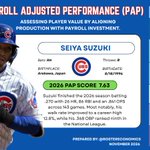
Using Roster Economics' Player Adjusted Performance (PAP) model, a Python-based valuation framework combining advanced performance metrics, contract efficiency, and team-specific payroll context, I've identified two potential targets:
Kris Bubic: 3 years, $43.5M ($14.5M AAV)
Seiya Suzuki: 5 years, $127.5M ($25.5M AAV)
While Suzuki will likely provide his greatest value during the first three years, that doesn't necessarily make the final two years a bad investment.
Toronto would be paying for Suzuki's prime remaining production during its current competitive window. Even if his performance declines below his $25.5M annual salary in years four and five, the immediate wins he could help generate may outweigh that future inefficiency.
Combined with Bubic, these moves could significantly raise Toronto's competitive floor while preserving flexibility to add bullpen help.

Real life people told me David Bailey was going to be a bust…. Makes no sense.
Dude has been a baller his entire collegiate career, with the athletic profile to project as an All-Pro level edge rusher.
He now has 9.5 sacks through 10 NFL games.

1
10
888
TARIK SKUBAL TO THE METS?!
9 years. $450 MILLION. $50M AAV.
If finalized, this would be a historic investment in one of baseball's premier arms.
PAP valued Skubal closer to $40M AAV, meaning New York would be paying roughly a $10M annual premium for his services.
A price worth paying if he can help lead the Mets to their first World Series Win since 1986.

Even with a record $32M arbitration salary and an injury-shortened 2026 season, Tarik Skubal slightly outperformed his contract, posting a 5.05 PAP.
Looking ahead to free agency, PAP estimates his fair market value around $40M AAV, but projects his deal to exceed that figure and set the new pitcher AAV record.

Getting non-tendered doesn't mean your career is over.
Just ask Cody Bellinger.
After being non-tendered by the Dodgers in 2022, Bellinger secured:
2023: 1 year, $17.5M (Cubs)
2024: 3 years, $80M (Cubs)
2026: 5 years, $162.5M (Yankees)
With the 2027 non-tender deadline now behind us, who has the best chance to follow Bellinger's path and turn a career setback into generational wealth?


I'd put the chances of the Rams franchise tagging Puka Nacua next year at 99%.
Nacua is simply too valuable on the field for Los Angeles to seriously consider trading him right now. Not to mention, trading him amid the current uncertainty would likely mean selling low on one of the NFL's premier receivers.
However, the off-field concerns, combined with his recovery from a serious knee injury, should give the Rams reason to pause before committing to a $40M+ annual extension, which he was likely on track to command.

Breaking: #Rams WR Puka Nacua has undergone knee surgery and is likely done for the season, per HC Sean McVay.

Wowza! I actually really like this for both sides.
Colorado acquires a solid 3-4 pitcher in Martin, and they were likely not going to spend anyways on another FA, so taking on Castillo’s contract isn’t the end of the world for one season. If he also miraculously turns it around, then they can flip him for assets at the deadline.
While the White Sox can use the extra financial flexibility to add to an already talented roster.
BREAKING: The Colorado Rockies are acquiring right-handers Davis Martin and Luis Castillo in a trade with the Chicago White Sox, sources tell ESPN. Rockies are taking on Castillo’s full salary. Two prospects are headed back to the White Sox.
7
2,035
RosterEconomics retweeted
The Chicago Cubs are interested in Trevor Rogers!
Rogers has had extreme ups and downs the past two years. What makes him good and how can he get better?
Read⬇️
nateroper.substack.com/p/tre…

The Cubs Have "Shown Early Interest" in Lefty Trevor Rogers
bleachernation.com/cubs/2026…

The Jeffery Simmons trade is a fascinating example of NFL Roster Economics.
With over $20M of his contract restructured by Tennessee this offseason, Simmons carries just a $7.9M cap hit for Chicago in 2026.
Despite monstrous sack numbers through Week 10, his PAP valuation is slightly weighed down by his advanced run defense metrics, ranking in “only” the 65th percentile in run stop and run stuff rate.
With Caleb Williams still on his rookie deal, Chicago had the financial flexibility to acquire an elite defensive talent.
With Simmons clogging up the middle and providing $16.7M in cap hit surplus value, the Bears have a legitimate shot at the Lombardi Trophy this season.

One of the NFL’s highest-paid interior defensive linemen… and still underpaid?
Dexter Lawrence recently signed a one-year extension with Cincinnati and has been everything the Bengals could have hoped for since acquiring him from the Giants.
But how much of a bargain has he been?
• AAV: $28M
• 2026 Cap Hit: $15.3M
• PAP Valuation: $34.8M
According to Roster Economics’ Payroll Adjusted Performance (PAP) model, Lawrence is generating $6.8M in annual surplus value for the Bengals.
Elite players can carry elite price tags and still be bargains.

Part of the reason the Cowboys’ defense continues to struggle? Contract inefficiency.
Kenny Clark, Rashan Gary and DaRon Bland carry a combined AAV of roughly $60M, but Roster Economics’ Payroll Adjusted Performance (PAP) model values their current production at just under $9M.
That represents nearly $51M in negative annual surplus value for Jerry Jones' Cowboys.
While their combined 2026 cap hit is only $20.8M, Dallas is still receiving significantly less production than its financial commitments would suggest.

Héctor Gómez reports the Blue Jays are “intensifying” talks for Ketel Marte.
While Toronto is a logical landing spot, the reported 4-year, $135M extension ($33.75M AAV) makes little sense.
Marte’s production declined in 2026, and he remains under contract through 2030 on a reasonable deal, with a player option in 2031. Why extend him now?
PAP supports acquiring Marte at closer to $20M AAV, but the proposed extension could significantly limit Toronto’s future payroll flexibility.

1
14
3,089
VC Sports Group played this perfectly.
Following Jake Bauers’ breakout 2026 season, they secured their client a 4-year, $58M deal with Boston.
While the $14.5M AAV falls below the $23.15M qualifying offer, Bauers would have needed to secure another 3-year deal at $11.62M AAV next offseason to match that guaranteed money.
Given his age and previous production, PAP suggests that would have been difficult.

PAP is officially coming to the NFL!
Excited to introduce Payroll Adjusted Performance to the football world, starting with the QBs outperforming their contracts through Week 10.
Teams getting high-level QB production on rookie contracts or affordable veteran deals have a significant competitive advantage, allowing them to allocate valuable cap space toward strengthening the rest of their roster.

Spending big doesn’t always mean spending smart.
Introducing the 2026 MLB Franchise PAP Rankings.
Payroll Adjusted Performance (PAP) evaluates on-field production relative to contract cost and team payroll context.
Which front offices are getting the most value out of their roster?

