

I mostly share history, art, culture, food, attire, traditions, and heritage of the Indian Muslim community. Sometimes I delve into politics & current affairs.
Joined December 2023
- Tweets12.8K
- Following122
- Followers29.3K
- Likes14.6K





Rajputs, Brahmins and other upper castes of Awadh would neither consume nor cultivate potatoes during the Mughal and Nawabi periods, condemning them an inferior food [as they grew underground as tubers].
This changed in the British Raj..

🥔 आलू नहीं खाते, तो मूँगफली क्यों खाते हैं? क्या इसका कारण सिर्फ जमीन के अंदर उगना है? जैन धर्म में आलू जैसे कंदों के त्याग के पीछे सूक्ष्म जीवों और अहिंसा की भावना से जुड़ी मान्यता है, जबकि मूँगफली एक बीज है।
#Jainism #JainFood #JainDiet #JainAahar #JainLifestyle
Indian Muslim Archives retweeted
This khayal bandish was composed by Naimat Khan, a descendant of Nuabat Khan for Khalifah Muhammad Shah Bahadur:
"O charming Muhamad Shah! O my beloved, charming Muhammad Shah! Now that you are absent, my beloved, neither the days nor the nights hold any charm for me."
Grandson of Khalifah Bahadur Shah 'Zafar' and the son of Mirza Jawan Bakht.. he received 5400 rupees per annum as pension (could buy 3.7 kg of the 24-c gold).
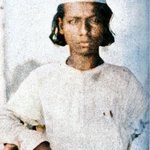
Pic 1 (box) - Mirza Jawan at the age of 17yr
Pic 2 & 3: Mirza Jamshed (Jawan's son)
These hostage-pics don't do justice


Some will tell you that Khalifah Muhammad Shah was nicknamed Rangeela, as though it were an insult.
They are victim of ignorance of terminological evolution (eg: laundiya meaning slave girl to a young girl).
Rangeela was a compliment:
Romantic / Charming
This khayal bandish was composed by Naimat Khan, a descendant of Nuabat Khan for Khalifah Muhammad Shah Bahadur:
"O charming Muhamad Shah! O my beloved, charming Muhammad Shah! Now that you are absent, my beloved, neither the days nor the nights hold any charm for me."


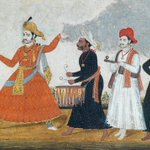
What exactly are you trying to prove by misattributing Mirza Abbas's photograph to Aurangzeb, when your own Chhatrapatis and Maharajas looked like this?


These whitewashed mosques, common across India, are far more elegant than they appear.
Decades of neglect have obscured much of their original beauty.. limewash was a desperate attempt to stave off further structural deterioration.


Naubat Khan, son of Raja Samokhan Singh of Kishangarh, married Miyan Tansen’s daughter, and together they founded the Seniya gharana.
Their family was a giant of Mughal court music, from which Ras Baras Khan, author of Shams al-Aswat, also descended.

Qawwali, as a distinct and reputable music genre, originated strictly under the Hindustani Muslim gharanas.
The first record of the word "qawwali" itself is from the book 'Shams al-Aswat' by Ras Baras Khan (circa 1690s) of Senia gharana. He describes it as a desi music (not Persian as is common in popular narrative).
Ras Baras Khan was a descendant of Naubat Khan (a Rajput convert), who was the son-in-law of Hazrat Tansen (a Brahmin convert), placing him within one of the most distinguished hereditary musical lineages in the world.
Amir Khusrau is incorrectly portrayed as a qawwal. He was a high-ranking nobleman, whereas qawwals and their music occupied a comparatively low social position even in the time of Ras Baras Khan, as music historian Katherine Butler Schofield's research illustrates.
If Qawwali originated in Pakistan, then produce a literary source from that region that mentions qawwals, or a composition from that region explicitly identified as being sung as qawwali.
(And yes, after Ras Baras Khan's testimony, you can't even attach it to the Persians to silently attribute or declare it a shared heritage).

Also, we do not mock ‘z’ and ‘j’. We are not tang-dast miskeen with a fixed borrowed vocabulary.
There is an entire genre of Hindustani music called thumri (heavily patronised by the Urduvi gentry) that followsed this usage.
Sanjay Leela Bhansali, in his film Heeramandi, romanticises a Pakistani prostitution area and, as always, attributes (Hindustani Awadhi) Indian Muslim aesthetics to it to make it bearable to watch: "Nazariya Ki Maari, Mari Mori Guiyyan…"
This clip below is from the film Pakeezah (just don't want to bring that filthy film to your timeline).
What I am saying is that, once again, we are not miskeen. Our literary tradition is far too vast for the borrowers of the Lakhnawi register to comprehend.


The imposition of Urdu in Pakistan, as noted by Sir John Lawrence in 1851, later Lieutenant Governor of Punjab.
He stated that Urdu was an alien tongue in the region, but since most EIC officials were familiar with it, they chose to promote it as the lingua franca.


