

Climate & energy analyst @theBTI | Chemical and energy engineer | Science is cool!!
Washington, D.C.
Joined January 2016
- Tweets1K
- Following707
- Followers405
- Likes1K



Pinned Tweet
Grain-oriented electrical steel (GOES) is a pinch point in America’s transformer supply chain. Every transformer’s core is made of GOES, yet the US only has one steel mill that makes it. Folks assume expanding GOES production can onshore manufacturing and reduce multi-year transformer lead times. They’ve only told you half the story
In reality, our current crisis stems from decades of protectionism and technological stagnation made worse by a loophole in 2018 Section 232 tariffs. The US doesn’t need more GOES; it needs more of the right kind of GOES and a paradigm shift in industrial policy for the steel sector 🧵

I’m in IEEE Spectrum commenting on protectionist EU policies meant to “safeguard” European steel
makers against imports of grain-oriented electrical steel (GOES).
GOES is used to make the cores of electric transformers. Though GOES is a type of steel, it is far from a commodity—Japan and South Korea produce higher qualities of GOES than anywhere else. Transformer manufacturers in the US or EU must thus import GOES from Japan or South Korea to make energy efficient transformers.
Yet the EU now joins the US in placing tariffs on GOES imports, an inappropriate use of trade policy that assumes all GOES is made equal.
Link to the fully story is commented below


PJM straddles the state-federal nexus. And it gets the worst of both worlds
FERC rejects some of PJM’s late load interconnection plan, saying it infringes on state authority

FERC rejects most of PJM’s large load interconnection plan
PJM Interconnection’s plan for curtailing large loads that don’t have matching new generation intrudes on state jurisdiction and may be discriminatory, FERC.
utilitydive.com/news/ferc-pj…

Ryan Alimento retweeted

Never doubted my goat.


✅ We're in on permitting reform!
"We’re proud to endorse the Bipartisan American Affordability and Jobs Act, and we’re excited to mobilize our grassroots volunteers in full support," said CCL’s Executive Director Ricky Bradley.
citizensclimatelobby.org/blo…

Ryan Alimento retweeted

Fun fact - while I worked at OIRA in the Biden admin for (ardent environmentalist) Administrator Revesz, CBD's Brett Hartl sent us this charming public comment:
Folks should listen to experts focused on the benefits (huge) & costs (small) of the permitting bill, not dogmatists.


How old is the electric grid?
According to Wood Mac, Amazon, TIME, Reuters, and GE Vernova: "70% of transmission lines and transformers are over 25 years old"
According to yours truly: That statistic is 20+ years outdated. Stop circulating it
ryanalimento.substack.com/p/…
Ryan Alimento retweeted

A valuable substack post from my colleague @RyanAlimento on why AI-accelerated materials discovery has potential, but is still far away from skipping straight to technologically-viable materials. Impurities/doping and polycrystalline structure remain difficult to predict, while a key test remains whether materials are robust under a brutal gauntlet of conditions over expected life. But capabilities are advancing fast!
ryanalimento.substack.com/p/…
We really oughta introduce students to nuclear science as early as middle school. No reason that kids who learn abt abstract concepts like the Big Bang and black holes can’t understand radioactive decay and EM at the same age
Saw a based comment on public fears abt nuclear: “I’d rather be afraid with cheap electricity than not without it”
So simple yet so true lol
Excerpts from the Army Corps of Engineers's guidance on how to define a wetland's borders
150 pages of on-site tests and referring companies to review academic literature. Reads like a NIST standard. Just to know if you maybe need a CWA 404 permit and long before an EA or EIS


Ryan Alimento retweeted

David E. Lilienthal in a 1930 article for Electrical World, the electric industry journal, arguing for a synthesis of engineering and law in that particularly odd corner of business, the public utilities. This was a few years before joining TVA, and shortly before he moved to Wisconsin to join a Progressive-led Public Service Commission, around the time he was developing notoriety for expertise on public utility law.
"As was said at an earlier point, the managerial and technical personnel of the public utility industry has recognized the necessity for an understanding of those principles of the law which touch and affect the daily activities and the general policies of their business. What of the other side of the medal? Have the lawyers, the legislators and the commissioners (predominantly lawyers), the judges (always lawyers), and "the law" (viewed as an institution), recognized the necessity for understanding the engineering and economic facts which should govern legal conclusions?"
babel.hathitrust.org/cgi/pt?…


Here's one I like a lot: real vs. normal electricity prices
How much of electricity price increase is attributed to a loss in value of the USD?


Okay, @Arnold_Ventures and @OurWorldInData (@_HannahRitchie) have released what can only be described as a life-changing tool for energy nerds. I've spent the last three days obsessively playing with this, and it's INCREDIBLE.
usenergydata.org/

So the Army Corps of Engineers has a whole class of CWA 404 permits for cranberry farming. Same document has stuff like "cleanup of hazardous and toxic waste"

"If only it were that easy to undo decades of systemic underinvestment in a transmission network long enough to stretch from Earth to the Moon. GETs are near-term complements to, not substitutes for, an expensive and extensive transmission buildout."
substack.com/home/post/p-213…

Software Won’t Expand the Grid
A practical take on grid-enhancing technologies
breakthroughjournal.org
A really important new banger piece from @RyanAlimento for @TheBTI on grid-enhancing technologies (GETs). Let's dive right into the technical insights.🧵
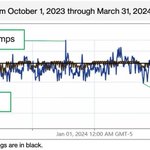
First, dynamic line ratings don't always increase rated capacity--sometimes they decrease it. In this example from Ohio, more accurate ratings actually decreased the line's rating relative to its static rating (black straight line), because this line is shielded by vegetation and actually experiences less wind cooling than the static rating accounted for.
So dynamic line ratings should not be thought of as *synonymous* with increased headroom. But they *do* provide better information for safe and efficient grid operation regardless of the direction they point in.

Ryan Alimento retweeted
Melt spinning: a materials processing technique that looks ridiculous, but is actually key for producing amorphous metals (metallic glasses or metglas) used in some high-efficiency grid distribution transformers and other power electronics.
This example video from NASA Glenn Research Center of their planar flow caster was posted in 2016.
(h/t to my colleague @RyanAlimento for explaining this process to me!)
Most decarb progress will be a series of least worst tradeoffs

Net zero is important. But here’s a significant subset of climate folk who take a very Machiavellian ends justify the means argument on it. That’s a problem and terrible PR for the cause. I’ve come to realise that what’s even more important than net zero is how we get there.
Drilling in the North Sea is the perfect example of an issue that needs to be understood in terms of its second order effects.
Generally speaking, more drilling = bad for climate. However consider that demand is the factor that’s locked in. Britain reducing supply has no effect on domestic demand, because that demand still has access to foreign supply. A few things follow from this:
1) British consumers end up paying into sovereign funds of Middle Eastern countries or Norway, instead of generating tax revenue for the UK exchequer. Consequently, less fiscal space to fund demand substitution programmes like electrification.
2) Emissions are higher because converting gas into LNG and shipping it from the Middle East comes with a lot of losses and methane is a potent greenhouse gas.
3) Offshore expertise and jobs are lost in the UK. That same expertise is transferable to the offshore wind and CCS industries.
4) Britains production is less than 1% of world total so the additional supply is unlikely to induce more demand globally by meaningfully impacting the marginal price. However it is large enough to generate meaningful tax receipts *for the UK*
As far as I see there’s only downsides to limiting UK production. No wonder the public is turning against climate action. I am begging fellow climate folk to think beyond what needs to be done and consider how it needs to be done.
Ryan Alimento retweeted

I basically think all questions about climate change and industry need to be answered with what general rules we want all industries to abide by. We can't block industry that's obeying these rules even if the majority doesn't like it. Unpopular industries obviously, obviously need to be allowed to exist. Everything else I think about data centers and climate flows from that.
Ryan Alimento retweeted

I've been beating this drum. dynamic capacity is not real capacity in any kind of planning sense in deferring build (because you can't be situational on wind).
But it's great if you need to sell on a PPA though and you can get someone else to pay for it
A really important new banger piece from @RyanAlimento for @TheBTI on grid-enhancing technologies (GETs). Let's dive right into the technical insights.🧵
First, dynamic line ratings don't always increase rated capacity--sometimes they decrease it. In this example from Ohio, more accurate ratings actually decreased the line's rating relative to its static rating (black straight line), because this line is shielded by vegetation and actually experiences less wind cooling than the static rating accounted for.
So dynamic line ratings should not be thought of as *synonymous* with increased headroom. But they *do* provide better information for safe and efficient grid operation regardless of the direction they point in.
A post I’ve wanted to make for a while: what are grid-enhancing technologies, and how much can we rely on them to meet load growth without raising energy prices? 🧵

Practical takes on DLRs:
(1) DLRs are more accurate, but accuracy can mean more or less capacity. In the figures below, a trial in AEP Ohio found a DLR lower than static and ambient ratings bc vegetation was shielding the line from wind. This is still important to know for safe grid operation, even if it doesn’t “unlock new capacity”
(2) DLR benefits vary by geography, mostly because of different wind speeds across the US. Wind usually cools lines more than colder temps. That DLRs incorporate wind into ratings is a big reason why they improve on other rating methods. This also means a utility in Texas or Oklahoma would likely find DLRs more impactful than a utility in Virginia or Georgia. It’s not appropriate to extrapolate a localized case study to the entire country. A highly-cited Brattle study from 2021 does just that, and its numbers are almost certainly dramatic overestimates. The map of wind speeds across the US is a rough analogue to think about how DLR potential varies across the US.
watt-transmission.org/wp-con…


