

S&P Global enables businesses, governments, and individuals with trusted data, expertise and technology to make decisions with conviction.
Global
Joined February 2010
- Tweets30K
- Following497
- Followers48.2K
- Likes2.2K






From @EnergySPG: The copper market is under increasing pressure as mine disruptions, declining ore grades, and lengthy project development timelines constrain supply, while electrification, power grid investment and artificial intelligence infrastructure drive demand.
Read more: okt.to/0CMNvs

India’s rice trade outlook for 2027 is in focus, with El Niño-driven production risks threatening to tighten export availability and likely to push prices higher in the coming months.
Read more from @EnergySPG : okt.to/2nExqd

Flash loans, which were pioneered by Aave, are an innovation unique to DeFi, as they solve a core problem of traditional finance: capital efficiency and access.
While in traditional systems, one needs to provide collateral or credit score to borrow, flash loans eliminate these barriers by relying on smart contracts. Flash loans enable users to instantly borrow substantial funds from a protocol without collateral beyond what is needed to cover transaction costs.
Read the full research: okt.to/xq2auM

Data centers have become one of the most visible symbols of the global AI investment boom. But turning ambitious plans into operational capacity will depend on far more than demand for computing power.
In this episode of The Decisive, host Kristen Hallam speaks with three @SPGMarketIntel experts about the economic, construction, policy and security risks shaping the expansion of AI infrastructure.
Listen now: okt.to/8GBxoC

Japan hopes to see predictability and stability in Australia’s domestic gas reservation scheme amid ongoing discussions.
Read more from @EnergySPG. okt.to/9rP5Hw

From @EnergySPG: El Niño conditions in the Pacific Ocean have intensified, with a greater than 83% chance of a very strong event during January-March 2027, according to NOAA.
Market experts warned of potentially significant effects on farm productivity across several regions. Read more: okt.to/F3C7lE

The Middle East and Russia account for about half of global net diesel exports — about 2 million barrels/day of that supply has disappeared. Global food prices are impacted in two ways: diesel is an important input cost for farmers, and farmers may direct acreage away from food production to feedstock for biofuels.
The Gulf is a critical chokepoint for global fertilizer supplies. The limitations on passage through the Strait of Hormuz in the spring and summer reduced the amount of fertilizer available, and ongoing shortfall puts new planting seasons at risk. The challenge is particularly acute for sulfur, a key fertilizer input.
Read our latest research from the S&P Global Institute: okt.to/Nnu6a0

From @EnergySPG: Chemical Week editor-in-chief Mark Thomas and S&P Global Energy Platts senior price reporters Mujidah Yahaya and Archit Singh join the podcast to discuss key takeaways from the European Petrochemical and Chemical Association's (EPCA) annual meeting 2026.
Topics include securing supply for Europe amid disruptions, the shrinking European petrochemical industry and how Europe can develop policies to springboard growth for the rest of the decade.
Listen to the latest Chemical Week podcast episode:
okt.to/wgbZrf

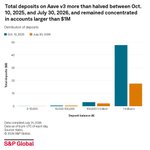
Concentration risk, measured by large user deposits or borrowings, is more likely to have significant influence on the underlying DeFi lending systems, including Aave, a prominent DeFi lending protocol operating on Ethereum and other blockchains.
Read the full research: okt.to/5aiNcw

Data center completion risks are likely to come into sharper focus over the next 12 months as construction progresses.
Explore the full analysis from @SPGlobalRatings: okt.to/0uQ752

Data centers are becoming critical to the GCC region's digital and AI ambitions, as governments and businesses seek to build the computing infrastructure needed to support the rapid growth of AI and cloud services. In just a few years, GCC countries have moved from hosting relatively small enterprise colocation facilities to announcing some of the world's largest AI-focused data center campuses.
Gain deeper insights with @SPGlobalRatings:
okt.to/j6PA2r

In the base-case scenario, gasoline demand in India's transport sector continues to rise into the 2040s as economic growth, rising household incomes and continued urbanization drive increased passenger vehicle ownership.
Despite increasing adoption of EVs, the expansion of the light-duty vehicle fleet and relatively low car ownership per capita compared with developed economies support ongoing growth in gasoline consumption.
Explore our full collection of research: okt.to/EqJMv6

China's approach to its digital renminbi is unique. The country's e-CNY is now interest-bearing and can be held within the banking system. @Spglobalratings anticipates these tokenized deposits will likely keep growing, creating new revenue opportunities for banks.
Explore the full analysis: okt.to/hkAwF2

From @SPGMarketIntel: The four largest US banks are set to kick off third-quarter earnings season next week, with Visible Alpha consensus estimates pointing to continued revenue growth but a more uneven earnings picture.
Read more: okt.to/Q5BYtd

Solar power is booming in South and Southeast Asia. Battery storage is not. @Spglobalratings thinks that will change. We anticipate that if countries are to meet their renewable energy goals, they will invest more in battery energy storage systems (BESS). These systems help balance the grid, ease transmission bottlenecks, and prevent the loss of power.
Learn more: okt.to/6Vj2Ck
Decentralized finance (DeFi) lending leverages blockchain technology to power protocols that enable users to borrow and lend digital assets. These DeFi lending platforms allow permissionless, overcollateralized transactions that enable users to earn interest on their digital assets.
Aave is a prominent DeFi lending protocol operating on Ethereum and other blockchains. As of September 2026, Aave had over $19.2 billion in TVL, most of which was held in its most popular version, Aave v3.
Read the full research: okt.to/LjArN9

India achieved its 2030 Nationally Determined Contribution target of 50% cumulative installed capacity from non-fossil sources ahead of schedule; the 2035 target is 60%. But early progress on capacity targets also changes the nature of the challenge. It is now moving from clean capacity creation to ensuring supply mix, reliability, flexibility and procurement.
Explore our full collection of research: okt.to/ustbnC

Middle market collateralized loan obligations (MM CLOs) have seen remarkable growth in recent years, and middle market warehouse lines have expanded alongside them. At the start of 2020, just before the arrival of the COVID-19 pandemic, S&P Global Ratings had ratings on 86 MM CLO transactions and five warehouse line transactions. By mid-2026, those figures had increased sharply: we now rate more than 330 U.S. MM CLOs and 47 U.S. middle market warehouse transactions. These warehouses come from 12 managers and represent about $41.9 billion in assets.
These warehouse transactions serve a useful purpose in allowing direct lenders to scale their businesses, and their growth has also drawn investor attention. We routinely field questions from investors in the U.S. and Japan about how these transactions work, how they differ from MM CLOs, and how we rate them. This article is intended to answer those questions and provide a starting point for discussions. We’ll start with the basics and then move on to how we analyze CLO warehouses.
Read more with @SPGlobalRatings: okt.to/kTQ89G

Which default trends could signal broader stress? Read the full analysis from @SPGlobalRatings. okt.to/t3XyJb

From @SPGMarketIntel: The 2026 US midterm elections are shaping up to be one of the most consequential cycles in recent history. Americans will head to the polls to vote for House, Senate, gubernatorial, and local candidates, as well as decide on a host of ballot issues. With control of both chambers of Congress at stake and a slate of competitive races across the country, the political advertising landscape is in overdrive.
The latest MediaTalk podcast episode offers a rare behind-the-scenes look at the mechanics of political advertising, blending data-driven forecasts with real-world strategy.
Listen here: okt.to/rec4FS
