A new Science #Robotics study shares the AI drone racing approach developed by TU Delft researchers that made MonoRace a winner at the 2025 Abu Dhabi Autonomous Drone Racing Competition. scim.ag/4zzo8O7
A bicycle robot combines the strengths of wheeled and legged systems to perform acrobatic maneuvers.
Learn more in Science #Robotics: scim.ag/4B9XJb8 @rai_inst
New in Science #Robotics: @CIS_Penn researchers introduce an event camera representation that enabled robust perception across a robotic car, quadruped robot and flying platform in different lighting and environmental conditions. scim.ag/4yZkWeH
How did a one-camera drone with no external motion tracking system beat out its autonomous rivals and three champion human pilots on an indoor track?
Learn more in Science #Robotics: scim.ag/4zzo8O7
New in Science #Robotics: The Ultra Mobility Vehicle bicycle robot leverages its own inertia and momentum to perform jumps, track stands, wheelies and other athletic moves. @rai_inst scim.ag/4B9XJb8
The October 2026 issue of Science #Robotics is out!
This month’s cover depicts a drone deployed with MonoRace, an onboard framework that enables aerial robots to race autonomously at speeds of up to 100 km/h.
Learn about this research and more: scim.ag/4i2T4iM
A new Science #Robotics study introduces ALBATROSS, a hybrid aerial-marine robot that could someday be useful in ocean sensing and disaster response. @sutdsg
scim.ag/4d2c3Iu
Inspired by the novel Hole in the Sky by Daniel H. Wilson, @robinrmurphy cautions that robot demonstration videos sometimes imply greater autonomy or reasoning than facts support.
Read more in Science #Robotics: scim.ag/3VNIPXU
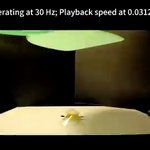
A 185-milligram robot flies freely without a transmission, powering its cone-shaped wings with an electrostrictive actuator. It also stands up to crushing impacts. @UCLAengineering
Read more in Science #Robotics: scim.ag/4Avt7R7
This bioinspired robot can autorotate after aerial deployment to make a soft landing on water and convert to a sailboat—using only three actuators and three primary sensors. @sutdsg
Learn more in Science #Robotics: scim.ag/4d2c3Iu
New in Science #Robotics: Robot demonstration videos pose issues of reproducibility and legal liability for the community if they imply more autonomy than the facts support. scim.ag/3VNIPXU
New in Science #Robotics: This tiny robot flies freely without a transmission, using components that are less rigid than in most micro aerial vehicles #MAVs, and could be scaled to create a microrobot swarm. @UCLAengineering scim.ag/4Avt7R7
A new Science #Robotics study introduces ALBATROSS, a hybrid aerial-marine robot that could someday be useful in ocean sensing and disaster response. @sutdsg
scim.ag/4d2c3Iu
Inspired by the novel Hole in the Sky by Daniel H. Wilson, @robinrmurphy cautions that robot demonstration videos sometimes imply greater autonomy or reasoning than facts support.
Read more in Science #Robotics: scim.ag/3VNIPXU
A 185-milligram robot flies freely without a transmission, powering its cone-shaped wings with an electrostrictive actuator. It also stands up to crushing impacts. @UCLAengineering
Read more in Science #Robotics: scim.ag/4Avt7R7
This bioinspired robot can autorotate after aerial deployment to make a soft landing on water and convert to a sailboat—using only three actuators and three primary sensors. @sutdsg
Learn more in Science #Robotics: scim.ag/4d2c3Iu
A new Science #Robotics study highlights an AI-based tracking approach that can isolate millimeter-scale magnetic robots signals from actuation-induced interference, enabling precise localization in preclinical models. scim.ag/3V3IQH2
A new study highlights a helical brace that can anchor a telerobotic catheter to stabilize endobronchial optical coherence tomography imaging in live pigs, improving precision and maneuverability in the presence of the dynamic movements of the lungs. scim.ag/4h4Ddkr
A new AI-driven system can precisely track tiny wireless magnetic robots within tight spaces in the bile duct and spinal cord in preclinical models, which could improve future minimally invasive medical applications. scim.ag/3V3IQH2
A new Science #Robotics study demonstrates the potential of electrical impedance myography that can measure real-time changes in muscle dynamics for use in the control of noninvasive assistive wearable devices. @KJakubowski26
scim.ag/4xAXjrk