

Veteran Naval Captain & Master Mariner | Real-time analysis of naval warfare, Hormuz, Indian Ocean security & seafarer issues | Straight talk from the Bridge
At Sea
Joined November 2014
- Tweets31.8K
- Following2.6K
- Followers6.3K
- Likes85K






Pinned Tweet
I am a Naval Veteran and Merchant Navy officer, and this is why I think @RahulGandhi is wrong on Great Nicobar.
From an Indian national interest standpoint, Great Nicobar is not a “scam”; it is a strategic port located astride one of the most critical maritime chokepoints on earth, close to the Strait of Malacca, where a huge share of global trade moves every day. India cannot afford to treat Great Nicobar as a sentimental issue when it is a rare natural asset for maritime power, deterrence, and economic security.
Yes, Great Nicobar is ecologically sensitive. India respects that. But national strategy is about balancing environmental safeguards with long-term security, logistics, and sovereignty. The current project is designed around an international container transshipment terminal, a dual-use airport, power infrastructure, and a planned township -all of which strengthen Indian Navy’s ability to monitor international sea lanes, improve military response times, and reduce commercial dependence on foreign transshipment hubs.
To dismiss this as “destruction dressed in development’s language” is politically convenient, but strategically shallow. This kind of language suits our adversaries rather than us. India’s maritime future cannot be secured by empty slogans. It will be secured by developing ports, airfields, logistics nodes, surveillance, and persistent military presence in the Indo-Pacific. That is exactly why Great Nicobar matters.
The real question is not whether development should happen, but how to execute strategic development responsibly while protecting our National interest. We can and should demand strict environmental compliance, tribal safeguards, and transparent implementation not reject a project that strengthens India’s maritime security simply because it is complex and uncomfortable.
Great Nicobar is not just an island. It is a test of whether India can step up to its destined role as a great maritime power or remain trapped in slogan politics.

I travelled through Great Nicobar today.
These are the most extraordinary forests I have ever seen in my life. Trees older than memory. Forests that took generations to grow.
The people on this island are equally beautiful - both the adivasi communities and the settlers - but they are being robbed of what is rightfully theirs.
The government calls what it is doing here a “Project.” What I have seen is not a project. It is millions of trees marked for the axe. It is 160 square kilometres of rainforest condemned to die. It is communities that have been ignored while their homes have been snatched away.
This is not development. This is destruction dressed in development’s language.
So I will say it plainly, and I will keep saying it: what is being done in Great Nicobar is one of the biggest scams and gravest crimes against this country’s natural and tribal heritage in our lifetime.
It must be stopped. And it can be stopped - if Indians choose to see what I have seen.
Ajai Shukla argues that larger, more continuous production runs and limiting design changes improve efficiency, as China has shown with the Type 052D and 055 ships. But the suggestion that India could simply copy the same approach and close the gap understates the real sources of China’s naval ship building advantage.
China’s speed and lower unit costs come mainly from its dominant commercial shipbuilding industry, tight military-civil fusion, heavily subsidised supply chains, and top-down state direction.
Cost comparisons of roughly about 900 million dollars for a Chinese Type 055 cruiser, versus roughly 1 billion dollars for an Indian Vishakhapatnam class destroyer and 2.5 billion dollars for a US Arleigh Burke destroyer, also overlook differences in indigenous content, financing costs, reliability, quality, and overall system capability.
India’s naval shipbuilding pace is already picking up, recently reaching around one ship every 40 days, with a growing pipeline that includes the seven Project 17A frigates and the new eight ship corvette order. Bigger batches would help, but they will not by themselves create Chinese scale yards or dual use industrial depth. That deeper industrial base has to come first.
Ships are complex platforms and credit must be given to Indian Naval planners who have ensured that the Indian Navy is today a Builder’s Navy with our ships being built in Indian yards with high indigenous content.
ajaishukla.com/2026/11/what-…

Good question. The ship which was hijacked by pirates was intended to be used as 'mothership' for hijacking larger merchant ships which could have been carrying Indian seafarers. Therefore this preemptive action was very much in order.
Piracy by the law of nations, in its jurisdictional aspects, is ‘sui generis’ (one of its kind). Though statutes may provide for its punishment, it is an offence against the law of nations; and as the scene of the pirate’s operations is the high seas, which it is not the right or the duty of any nation to police, he is denied the protection of the flag he may carry, and is treated as an outlaw, as the enemy of mankind (hostis humani generis) whom any nation may in the interest of all capture and punish.
Thus it is an international obligation as a responsible maritime nation for India to fight piracy on the high seas.
#Piracy #IndianNavy

🇮🇳 just pulled off an impressive 48 hour joint Indian Navy–IAF operation to rescue 20 Iranian crew from pirates at a distance of 3,000+ km from Mumbai (INS Kolkata + C-17 MARCOS airdrop), proving once again the ability to carry out long range special ops and further enhancing India’s reputation as the net security provider of the Indian Ocean
Maybe the IRGC can return the favour by stopping the limpet mines, RPGs and projectile attacks on tankers carrying Indian seafarers in the Strait of Hormuz?
Friendship works better when it’s not one-sided. @Iran_in_India

The Embassy of the Islamic Republic of Iran in New Delhi expresses its sincere appreciation to the Government of India, the Indian Navy and the Indian Air Force for their successful operation to rescue the 20 Iranian crew members of the fishing vessel Azini from pirates.
We highly commend the professionalism, courage and effective coordination demonstrated by the Indian Armed Forces, reflecting India's strong commitment to Humanitarian Assistance and Disaster Relief (HADR) and its role in saving lives beyond borders.
This humanitarian operation stands as a testament to the spirit of friendship, solidarity and cooperation between Iran and India.
We extend our sincere gratitude to all those involved in ensuring the safe rescue of the Iranian crew.
MSV Al Jusufi, an India flagged cargo vessel about 52 metres long, was struck by an unidentified aerial object or projectile roughly 9 nautical miles northeast of Limah, Oman on the evening of 2 November.
One Indian seafarer from Gujarat lost his life after sustaining injuries while the remaining 13 crew members were safely rescued by the Omani Coast Guard.
This incident matches the pattern of attacks we have seen repeatedly in the southern approaches to the Strait of Hormuz over recent months. The location, method and timing are consistent with Iranian Revolutionary Guard Corps style operations using missiles or drones against commercial shipping. No group has claimed responsibility so far.
Indian seafarers continue to face serious risks in these waters as free and unimpeded navigation remains disrupted by the ongoing conflict. @MEAIndia has rightly condemned the attack and called for de escalation.


“other actors….” and “…We have not minced any of words…” in one sentence is poor form.
@MEAIndia name and shame United States too which has carried out attacks on unarmed merchant ships leading to death of Indian seafarers.

"Indian seafarers have faced attacks not just from Iranian actors, but from many other actors as well...We have not minced any words to condemn it, which every party.", Foreign Secretary Vikram Misri @VikramMisri at IISS Manama Dialogue 2026 on West Asia war

Pakistan’s energy crisis worsens.
Iran has attacked a Pakistan-bound Qatari LNG tanker near the Strait of Hormuz.
Pakistan spot market prices up 3 times from pre war level.

BREAKING: Iran has reportedly struck a Pakistan-bound Qatari LNG tanker near the Strait of Hormuz despite receiving direct clearance and safe-passage approval from Tehran just hours earlier, per Bloomberg.
The Marshall Islands-flagged Al Mayeda came under attack while carrying Qatari gas to Pakistan after Islamabad negotiated safe transit with Iranian officials. Qatar’s gas transport company Nakilat confirmed the vessel was hit by “unidentified objects.”
The attack threatens to shatter Pakistan’s backchannel corridor that had quietly escorted Qatari energy cargoes through the mined chokepoint, leaving Islamabad facing crippling spot market prices up 3x pre-war levels.
Captain Manoj Rawat🇮🇳 retweeted
Well explained.
Can you pls confirm that NSG is a unique force in the world where SF officers on deputation work under a police officer? @braddy_Codie05

SPECIAL GROUP (SG) , SFF, and NSG ARE NOT SPECIAL FORCES.
There is a Huge Myth and wrong perception that has been created around the Special Group, Special Frontier Forces (SFF) and NSG calling them or Referring them as Special Forces. These aren’t Special Forces. Here are some of the Reasons why they aren’t Classified as Special Forces. In India there are Only 3 Special Forces PARA (SF) of Indian Army, MARCOS of Indian Navy and GARUD of Indian Air Force.
>> Deputationist Forces Can’t be Special Forces - No Special Forces in the World are Deputationist Forces. These Forces like SG, SFF and NSG are Deputationist Forces in which Officers from Infantry, Special Forces, Armoured Corps, Engineers, Artillery etc. go on Deputation for a said period of time and then they return back to their Parent Arms and Services. Though they keep wearing the SG Insignia on their Uniform but they aren’t allowed to wear Special Forces Tab and they don’t get Special Forces Allowance. Special Forces in India like PARA (SF) and MARCOS are those Special Forces in which Officer and personnel are Chosen through a Strict process of Probation and those Chosen are required to serve. In many cases those who aren’t deemed Fit and Considered Suitable to Match the Standards of the Special Forces are sent Back to their Parent Arms and Services.
>> Probation and Continued Training - Special Forces like the PARA (SF) and MARCOS have Probation that is of 3-6 Months and thereafter the Training Pipeline is a Continuous Process. Within Special Forces Training never ends and as they say the Only Easy Day was Yesterday so is in most of the Cases with PARA (SF) and MARCOS wherein to Nurture a Skilled Multidomain PARA (SF) Operative one needs at Least 4-5 Years of Continuous Operations and Training and these things aren’t Possible in Deputationist Forces like NSG,SG, SFF.
During the Training Pipeline Specialised Three Dimensional Infiltration and Exfiltration Skills are taught to Special Forces that includes Para Jumps both HAHO and HALO , Combat Diving Training for Infiltration through Water Bodies, and Land Infiltration Skills and Techniques. There are Qualifications like Combat Free fall Qualification, Combat Diver Qualification and Officers and Troopers have to Maintain these Qualifications as they Serve in their Respective PARA (SF) Battalion or Units on MARCOS.
>> No New Raising Legacy- SG was Raised by an Officer of 10 PARA (SF) under Project Sunray in 1982. Post Operation Blue Star a Specialised Intervention Unit like NSG for Internal Security and Internal Security Crisis Management was Raised. NSG is also not Categorised as Special Forces rather it’s an Intervention Unit or a Federal Contingency Force. What remains to be known is that all these SG and NSG were initially Raised by the Officers of PARA (SF) who were chosen to Raise these Specialised forces but No Officer from SPECIAL GROUP (SG) has been further chosen to raise any Forces.
>> Now those who claim SG to be a Special Forces, there are Many Officers from Infantry,Engineers, Artillery who go on Deputation to SG (Special Group) But they aren’t chosen to Command any Special Forces Battalion of PARACHUTE REGIMENT. One Reason being is that none of these Infantry,Engineers, Artillery officers hail from Parachute Regiment. Second If SG is Such Tier-1 Special Force then why MARCOS doesn’t send their Operatives to SG ?
During IPKF (Sri Lanka) SG was under the Command of 9 PARA (SF) not Vice Versa.
>> Now those who claim SG to be a Special Forces, When Special Forces Ad-Hoc Cell was Raised During Op Pawan at Army HQ why No Non-PARA (Commando) Officer From Special Group/SG was part of it ?
When the Special Forces HQ and SFTW (Later SFTS Nahan) were being Raised no Non-PARA (Commando) Officer from SG was Deputed for the Task.


Captain Manoj Rawat🇮🇳 retweeted

Thanks Sir and Unfortunately Yes Sir. But as Someone who’s a Army Officer and has served in NSG told me once that When NSG were being raised the Government wanted the Army Leadership basically a Lt Gen Rank Officer from the Indian Army to Take command of the NSG but for Unknown Reasons presumably Due to the Human Resources Issues and Other Professional Reasons of Army Getting too much involved in Internal Affairs the Army Leadership denied the Offer. Idealistically most Intervention units like GSG-9 are led Police Officers.
Well explained.
Can you pls confirm that NSG is a unique force in the world where SF officers on deputation work under a police officer? @braddy_Codie05
SPECIAL GROUP (SG) , SFF, and NSG ARE NOT SPECIAL FORCES.
There is a Huge Myth and wrong perception that has been created around the Special Group, Special Frontier Forces (SFF) and NSG calling them or Referring them as Special Forces. These aren’t Special Forces. Here are some of the Reasons why they aren’t Classified as Special Forces. In India there are Only 3 Special Forces PARA (SF) of Indian Army, MARCOS of Indian Navy and GARUD of Indian Air Force.
>> Deputationist Forces Can’t be Special Forces - No Special Forces in the World are Deputationist Forces. These Forces like SG, SFF and NSG are Deputationist Forces in which Officers from Infantry, Special Forces, Armoured Corps, Engineers, Artillery etc. go on Deputation for a said period of time and then they return back to their Parent Arms and Services. Though they keep wearing the SG Insignia on their Uniform but they aren’t allowed to wear Special Forces Tab and they don’t get Special Forces Allowance. Special Forces in India like PARA (SF) and MARCOS are those Special Forces in which Officer and personnel are Chosen through a Strict process of Probation and those Chosen are required to serve. In many cases those who aren’t deemed Fit and Considered Suitable to Match the Standards of the Special Forces are sent Back to their Parent Arms and Services.
>> Probation and Continued Training - Special Forces like the PARA (SF) and MARCOS have Probation that is of 3-6 Months and thereafter the Training Pipeline is a Continuous Process. Within Special Forces Training never ends and as they say the Only Easy Day was Yesterday so is in most of the Cases with PARA (SF) and MARCOS wherein to Nurture a Skilled Multidomain PARA (SF) Operative one needs at Least 4-5 Years of Continuous Operations and Training and these things aren’t Possible in Deputationist Forces like NSG,SG, SFF.
During the Training Pipeline Specialised Three Dimensional Infiltration and Exfiltration Skills are taught to Special Forces that includes Para Jumps both HAHO and HALO , Combat Diving Training for Infiltration through Water Bodies, and Land Infiltration Skills and Techniques. There are Qualifications like Combat Free fall Qualification, Combat Diver Qualification and Officers and Troopers have to Maintain these Qualifications as they Serve in their Respective PARA (SF) Battalion or Units on MARCOS.
>> No New Raising Legacy- SG was Raised by an Officer of 10 PARA (SF) under Project Sunray in 1982. Post Operation Blue Star a Specialised Intervention Unit like NSG for Internal Security and Internal Security Crisis Management was Raised. NSG is also not Categorised as Special Forces rather it’s an Intervention Unit or a Federal Contingency Force. What remains to be known is that all these SG and NSG were initially Raised by the Officers of PARA (SF) who were chosen to Raise these Specialised forces but No Officer from SPECIAL GROUP (SG) has been further chosen to raise any Forces.
>> Now those who claim SG to be a Special Forces, there are Many Officers from Infantry,Engineers, Artillery who go on Deputation to SG (Special Group) But they aren’t chosen to Command any Special Forces Battalion of PARACHUTE REGIMENT. One Reason being is that none of these Infantry,Engineers, Artillery officers hail from Parachute Regiment. Second If SG is Such Tier-1 Special Force then why MARCOS doesn’t send their Operatives to SG ?
During IPKF (Sri Lanka) SG was under the Command of 9 PARA (SF) not Vice Versa.
>> Now those who claim SG to be a Special Forces, When Special Forces Ad-Hoc Cell was Raised During Op Pawan at Army HQ why No Non-PARA (Commando) Officer From Special Group/SG was part of it ?
When the Special Forces HQ and SFTW (Later SFTS Nahan) were being Raised no Non-PARA (Commando) Officer from SG was Deputed for the Task.
Unfortunate incident. Luckily no casualties.
Kesari is used for carrying tanks and troops for amphibious operations and is an important ship of the Eastern Fleet based at Vizag.
Captain Manoj Rawat🇮🇳 retweeted

While everyone is talking about the Rafale M making its maiden landing on INS Vikrant, a far more important development is taking shape on the engineering front. France’s Safran, the company behind Rafale’s engine, and India’s GTRE are working towards a joint programme to develop a new 120 kN-class engine for India’s indigenous stealth fighter, the AMCA! The proposed engine would be developed in India, with nine prototypes planned and serial production targeted around 2035. The early AMCA Mk1 prototypes will use GE F414 engines while India works on the longer-term solution.
In my opinion, engines are the real story in any fighter programme, and India knows it. Let's see if the collaboration comes through.

Congress condemns BJP Government on "ill-treating" military chiefs !!
Let’s contrast the ‘punishment’ styles of Congress and BJP
The Congress:
• Making 1971 war hero Field Marshal Sam Manekshaw wait over 30 years for his full pension allowances.
• Bypassing Gen Thimayya’s military advice until he felt forced to resign.
• Dragging Army Chief Gen V.K. Singh all the way to the Supreme Court over his birth date.
• Fast-tracking Navy Chief Admiral D.K. Joshi's exit in a matter of hours.
The BJP :
• ‘Cancelling’ golfing out of Air Chief
Clearly BJP has lots of catching up to do in this field and deserves strong condemnation by Pawan Khera ji.

Is this the BJP government's way of punishing the Chief of the Indian Air Force, Air Chief Marshal A. P. Singh, for raising uncomfortable questions in the national interest?
Since assuming office on 30 September 2024, he has repeatedly raised red flags about India's defence preparedness and the government's strategic and operational shortcomings concerning the Air Force.
Some of the key concerns he has highlighted include:
- India's growing capability gap with China
- The gap between government promises and ground realities
- Delays in indigenous defence production
- Questions over the government's commitment to *Atmanirbhar Bharat* in defence
- Critical capability gaps in the IAF
- Shortcomings in defence research and development
- Shortages of skilled talent in the defence sector
If a decorated Air Chief Marshal raises legitimate concerns about India's defence preparedness, should he be penalised for speaking the truth - or should the government act on those concerns?
Is this how a nation honours its heroes?

“Don’t force everything into the same geographical model” is a strawman.
Theatre commands don’t permanently lock scarce squadrons. Bases stay the same. Control and tasking shift to the theatre commander, with the air component advising and assets able to move when needed.
Air power’s flexibility is real but it doesn’t make single-service commands optimal for a two-front war. Different characteristics are exactly why you put dissimilar forces under one Commander. 17 separate commands create silos. Temporary coordination has limits and it may work in short duration conflicts but has limits in long drawn campaigns. A Joint organisation ensures we get more combat power from the assets we already have.

Captain Manoj Rawat🇮🇳 retweeted

A major boost to India's maritime and logistics sector!
The Cabinet has approved the Container Manufacturing Promotion Scheme.
Key benefits include:
10-fold increase in domestic capacity to 7.5 lakh TEUs annually.
Financial support for new and existing manufacturers.
Globally competitive, quality-certified containers.
Reduced import dependence and stronger supply chains.
pib.gov.in/PressReleaseDetai…
Deeply saddened by the passing of my 76 NDA batchmate and dear friend, Captain Teghjeet Singh Malhotra, Sqn Ldr (Retd.).
After a distinguished career as a pilot in the Indian Air Force, he continued his love for flying as an international commercial airline pilot. Warm, humble, and always cheerful, he was a true gentleman both in and out of the cockpit.
Blue skies forever, dear friend. Our thoughts and prayers are with the Malhotra family. ✈️

Yesterday I had tweeted about the urgent need for resolving Theatre Command conundrum before the next war and how Theatre Command do not tie down assets within a geographical limit.
Today in his article, Admiral Arun Prakash has said what needed saying:
-Seven years of turf arguments over theatre commands is enough.
-The status quo of 17 single-service commands is already flat-footed for modern conflict. Theatre commands do not “divide” scarce squadrons or break centralised control of air power. Squadrons stay where they are. Control simply shifts to the theatre commander, with IAF component advice. That is how jointness is supposed to work.
-The next crisis will not wait for the services to finish negotiating. A settlement is overdue.


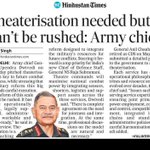
IAF’s institutional opposition to theaterisation leaves one scratching the head.
The IAF insists it supports jointness, yet keeps arguing against the one reform that would actually deliver it.
With limited tri-service assets against a two-front threat, India cannot keep operating 17 separate service Commands and hoping temporary coordination works when the shooting starts.
Theaterisation does not lock aircraft or other assets into fixed geographical bounds. If a theatre heats up, assets can be shifted. What matters is that all assets in a theatre operate under a single commander, ensuring 'Unity of Command'.
Calling every concrete proposal “not India-specific” has become a polite way to protect the status quo. What exactly is the 'India-specific model' the IAF has in mind?
Principles of Operational Art are universal. Campaign planning in a Theatre begins with a 'Commander’s Estimate of Situation (CES)' and a Joint plan. That requires an empowered Theatre Commander and a permanent joint planning staff.
Air power’s potency and flexibility are real. Using them as reasons to stay in single service silos is not. India will either fight its next war under unified Theatre Commands or explain why unity of effort was not optimised.
Captain Manoj Rawat🇮🇳 retweeted
IAF’s institutional opposition to theaterisation leaves one scratching the head.
The IAF insists it supports jointness, yet keeps arguing against the one reform that would actually deliver it.
With limited tri-service assets against a two-front threat, India cannot keep operating 17 separate service Commands and hoping temporary coordination works when the shooting starts.
Theaterisation does not lock aircraft or other assets into fixed geographical bounds. If a theatre heats up, assets can be shifted. What matters is that all assets in a theatre operate under a single commander, ensuring 'Unity of Command'.
Calling every concrete proposal “not India-specific” has become a polite way to protect the status quo. What exactly is the 'India-specific model' the IAF has in mind?
Principles of Operational Art are universal. Campaign planning in a Theatre begins with a 'Commander’s Estimate of Situation (CES)' and a Joint plan. That requires an empowered Theatre Commander and a permanent joint planning staff.
Air power’s potency and flexibility are real. Using them as reasons to stay in single service silos is not. India will either fight its next war under unified Theatre Commands or explain why unity of effort was not optimised.

'Need India-Specific Model': Air Force Chief On His Theaterisation Vision ndtv.com/india-news/need-ind…

Captain Manoj Rawat🇮🇳 retweeted

They have worked on the issues though. Expanded runways, more support platforms such as air to air refuelers, AEW&C, drones and now heavy 6th Gen aircraft with long range and endurance, so they don't have to take off from difficult terrain.


IAF’s institutional opposition to theaterisation leaves one scratching the head.
The IAF insists it supports jointness, yet keeps arguing against the one reform that would actually deliver it.
With limited tri-service assets against a two-front threat, India cannot keep operating 17 separate service Commands and hoping temporary coordination works when the shooting starts.
Theaterisation does not lock aircraft or other assets into fixed geographical bounds. If a theatre heats up, assets can be shifted. What matters is that all assets in a theatre operate under a single commander, ensuring 'Unity of Command'.
Calling every concrete proposal “not India-specific” has become a polite way to protect the status quo. What exactly is the 'India-specific model' the IAF has in mind?
Principles of Operational Art are universal. Campaign planning in a Theatre begins with a 'Commander’s Estimate of Situation (CES)' and a Joint plan. That requires an empowered Theatre Commander and a permanent joint planning staff.
Air power’s potency and flexibility are real. Using them as reasons to stay in single service silos is not. India will either fight its next war under unified Theatre Commands or explain why unity of effort was not optimised.
'Need India-Specific Model': Air Force Chief On His Theaterisation Vision ndtv.com/india-news/need-ind…