

On-Chain ⛓️ Researcher & Enthusiast Node & ZK Read more: https://xitter.gq/t.co/Izc0j5oywx
Joined September 2022
- Tweets47K
- Following2.1K
- Followers2.1K
- Likes105K






Pinned Tweet
Not every blockchain is going to have the same problem when quantum computers arrive. 👀 🙃
Here's something people often overlook:
Shor's algorithm can threaten cryptography like ECDSA and KZG, but that doesn't mean every cryptographic system is suddenly broken. STARK proofs take a different approach, relying on hash-based security instead of elliptic-curve assumptions.
That's one reason I find StarkWare's approach interesting. They didn't just start thinking about quantum security recently; the foundations of STARKs were designed with these properties back in 2018.
Quantum computing is a serious challenge, but understanding WHAT is actually vulnerable matters just as much as preparing for it.
Not everything needs the same kind of protection. 🔥
stay with @Starknet

Imagine being in an NFT auction where nobody knows how much you're bidding.
No public flexing. No watching someone else's bid and instantly changing yours. No revealing your strategy just because everyone is watching. 😂
That's what makes Fungo's sealed-bid auction interesting.
You submit your bid, it stays encrypted while the auction is running, and nobody gets to peek at your strategy. Once it ends, winners pay the same clearing price, and the extra amount gets refunded.
Basically, Fungo said:
Want to compete for an NFT? Sure. But keep your poker face on.💀
And honestly, bringing privacy into the auction itself is just as interesting as having encrypted NFTs.
Less public bidding drama. More strategy. More secrets. @FungoLabs


Final hours of the $FUNGO X campaign! ⏳
The campaign closes together with the Genesis auction: 06.11.2026, 15:30 UTC.
Make your last posts now and send your 5 best from the campaign page. Posts sent after the close won't count.
The leaderboard will be revealed when the campaign ends, and rewards will be distributed at TGE.
fungolabs.org/launchpad/camp…

ŠahFilsof retweeted
Wanna know what they’re trying to achieve at @Starknet?
What happens when a blockchain is technically ready to upgrade its security, but still has to wait for another network to make same move?
That's an interesting question behind Starknet's exploration of an independent L1 Quantum computing isn't an immediate threat that will suddenly break every blockchain tomorrow, but it does expose a weakness in how much of today's cryptography relies on mathematical problems that could eventually become solvable by powerful quantum machines.
What's interesting is that Starknet already has a head start. Its STARK proving system is built around hash-based cryptography, and its native account abstraction makes it possible to introduce post-quantum signature schemes without requiring a network wide protocol upgrade.
StarkWare's Quantum Hub currently gives Starknet an 8/8 score for evidenced cryptographic agility, compared with Ethereum's 3/8.
That's not a score for overall quantum security, but it does show how much flexibility Starknet has already built into its architecture.
✅ So why even consider leaving the L2 model?
Because having control over your own technology doesn't necessarily mean having control over every dependency that affects its security. Starknet still relies on Ethereum for important parts of its infrastructure, particularly its bridge and data availability. For example, its normal blob-based data availability path uses Ethereum's KZG commitments, while parts of its bridge and messaging system still depend on elliptic-curve cryptography. These aren't components Starknet can simply replace on its own. Ethereum has been working toward its own post-quantum transition, with a target around 2029 for core infrastructure.
But security upgrades shouldn't always have to follow someone else's calendar, especially when the technology landscape is moving so quickly. This is where an independent L1 becomes more than just a change in net architecture. It could give Starknet greater authority over its security roadmap, allowing it to decide when to replace cryptographic components, how to implement new standards, and how quickly to respond when existing assumptions become outdated.
Of course, becoming an L1 doesn't automatically make a network quantum-safe. #Starknet would still need to secure its own infra, validate every dependency, and execute its migration properly. But it would have much more control over those decisions.
There's already a meaningful signal from the community. In the October 15–22, 2026 Snapshot poll, 93.52% of voting power supported further research into independent L1 direction, with 3,236 votes cast. This wasn't final approval to migrate; it was a decision to investigate the possibility and develop a more detailed proposal.
I think the bigger idea here is worth paying attention to:
blockchain security shouldn't be measured only by how strong its cryptography is today, but also by how quickly it can adapt when that cryptography is no longer enough. Starknet is exploring whether independence can give it that flexibility.

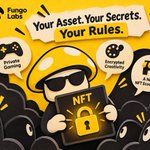
Most NFTs reveal almost everything the moment they’re created. Their rarity, stats, traits…
everyone can see them, analyze them, and build strategies around them. But imagine a different kind of NFT experience. 😀
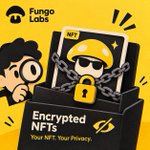
With @FungoLabs, your NFT can have a secret identity. You can see its art and hidden attributes privately, while its essential stats stay encrypted on-chain. And here's where things get really interesting:
smart contracts can still work with that encrypted data without exposing it.
Now think about what this could unlock for users. Imagine entering a game where your opponent can't inspect your character's stats before a battle. No more building strategies just by scanning everyone's attributes. Winning could depend more on how you play, not simply on how much info you can collect about others. And the vision goes beyond one NFT collection.
If Fungo's Launchpad makes encrypted NFTs available to other creators, entire communities could build collections around privacy from day one. Add the planned Genesis game to that picture, and NFTs start becoming more than collectibles: they become private, programmable assets with actual roles inside digital experiences.
That's the part I'm excited to see unfold. The real innovation isn't just hiding an NFT's details. It's making those details useful without making them public.
my asset. my secrets. my rules. 🟨
🤖 Made with AI

A lot of projects launch an app and call it an ecosystem. @sight_hood seems to be taking a different route.
They're building the pieces around the product: SightEVM, a DEX, a cross-chain bridge, and robinhood:0x238e40b75ae78a1388a14e517d855893e92e58db as the native gas token. That's a much bigger picture than simply running prediction markets.
What I'm watching is how these pieces will work together once they go live. Because the real value isn't just having more features. It's having an ecosystem where each component has a purpose.
Sight is building beyond the obvious. 👀

Imagine buying an NFT and someone immediately asks you:
What's its rarity? What are its stats? Can I see what's inside?
And you just reply: Bro, that's classified info.😂
That's the fun part about @FungoLabs.
Unlike traditional NFTs where everyone can inspect your traits and hunt for rare attributes, Fungo keeps the essence encrypted using #Zama's FHE technology. You can own something that everyone knows exists, but not everyone gets to know what's inside.
And the best part?
Even the team doesn't know what you got when it's generated.
Finally, an NFT that understands personal space. 💀🟨
Maybe privacy is the ultimate rarity trait after all.

ŠahFilsof retweeted
Honestly, I think one of the biggest advantages of @Starknet exploring its own L1 is having more control over its security decisions.
It's not just about using post-quantum cryptography. It's also about being able to upgrade when you need to, instead of waiting for another network to move first. Starknet already has a solid foundation with STARK proofs and programmable accounts, and having more control over its own infrastructure could make that even stronger.
Quantum threats won't wait for anyone, so why should security upgrades have to? ⚡

What if owning an NFT actually meant owning the secrets behind it?
That's the direction @FungoLabs is exploring, and I think there's more to it than just private NFTs.
With Zama's FHE technology, Fungo allows smart contracts to work with encrypted data without exposing what's inside. Your NFT can have hidden stats, traits and abilities, while its owner stays in control of what gets revealed.
But here's where things get more interesting: imagine a blockchain game where two players can battle using their characters' hidden stats, and the smart contract can determine the winner without either player exposing their actual attributes.
That's a completely different way to think about digital ownership and onchain gaming.
Fungo's Genesis collection is just the starting point. The bigger vision is an ecosystem where privacy isn't something added on top of an NFT. It's built into what the NFT can actually do.
Seen by all. Known by one. 🟨
🤖 Made with AI

Honestly, I think one of the biggest advantages of @Starknet exploring its own L1 is having more control over its security decisions.
It's not just about using post-quantum cryptography. It's also about being able to upgrade when you need to, instead of waiting for another network to move first. Starknet already has a solid foundation with STARK proofs and programmable accounts, and having more control over its own infrastructure could make that even stronger.
Quantum threats won't wait for anyone, so why should security upgrades have to? ⚡


😀 Most NFT auctions have one problem:
everyone can see what everyone else is doing. Your bid, your strategy, even your maximum price can become part of the public game.
FungoLabs is approaching this differently. Its Genesis sale on November 5 uses Zama's FHE technology to keep both bid prices and quantities encrypted while the auction is running. Here's the clever part: once bidding closes, the lowest successful bid sets one final clearing price for all winners. No public bidding war, and anyone who bids above that price gets the difference refunded.
But the bigger idea goes beyond one NFT drop. Fungo is exploring what happens when privacy becomes part of the actual mechanics of Web3, from encrypted ownership and hidden NFT traits to sealed auctions and eventually a dedicated launchpad.
That's a much more interesting direction than simply making another #NFT collection.
Privacy shouldn't mean hiding everything. It should mean having control over what others get to see.
Worth watching, @FungoLabs. 🟨

Most people still look at prediction markets as a way to speculate on outcomes. But what if that's only the beginning?🔥
What makes @sight_hood interesting is the bigger picture: giving developers tools to connect real-world events with onchain applications and automated actions.
The real opportunity isn't just predicting what happens next. It's building things that can actually do something with that information.
That's where Sight gets interesting. 👀

🐺The biggest challenge for blockchain security might not be a quantum computer we already know how to build. It could be the breakthrough nobody saw coming...
Quantum computing and AI-driven mathematical research are changing how we think about cryptography. And here's something worth paying attention to:
AI isn't just helping researchers develop better attacks; it's also helping them build stronger defenses. StarkWare's research competitions offer a good example. Their ECDSA challenge reports a 91.5% reduction in the estimated resources needed for a quantum attack on Bitcoin signatures.
🔥Meanwhile, their post-quantum signature challenge has reduced the gas required to verify a Falcon-512 signature by 50.2%. 🔥
These numbers show how quickly the research landscape can evolve. What makes @Starknet's approach interesting is that it isn't betting everything on one cryptographic solution.
Its STARK proof system is built around hash-based commitments rather than elliptic-curve assumptions, which are vulnerable to Shor's algorithm. In other words, the proving layer already has a fundamentally different security foundation. On top of that, Starknet's programmable accounts make it possible to introduce post-quantum signature verification at the account level, without requiring a network-wide hard fork.
'That's a huge advantage when the cryptographic landscape starts changing. But preparing for the future also means dealing with what already exists.'
Starknet has started replacing some of its protocol-level cryptographic components, with BLAKE2s-256-based OS program and configuration hashes already live on Mainnet in v0.14.3.
There's also ongoing research into migration tooling for older contracts that rely on Pedersen-based storage maps.
😃 This is an important part of the story: protecting a blockchain isn't just about designing something secure for tomorrow, but also finding a practical way to move today's infrastructure forward.
I think this is the real value of cryptographic agility. We don't need to predict exact date of next quantum breakthrough or know which mathematical assumptions will be challenged next. We need infra that can adapt when that moment arrives. And Starknet is taking meaningful steps toward building exactly that kind of flexibility.

ŠahFilsof retweeted
🔥 The Quantum Race Isn't Just About Security. It's About Efficiency.🔥
There's something about StarkWare's approach to quantum security that I think deserves more attention. Building a quantum-resistant signature is only half the challenge. Making it efficient enough to actually use is just as important.
That's why I find the PQ Signature challenge so interesting. People and AI agents are competing to optimize post-quantum signature verification, and the results are already showing real progress. Falcon-512 verification has gone from 48.4M to around 24.1M gas. That's roughly a 50% reduction.
What I appreciate here is that @Starknet isn't treating quantum security as just a future promise or a marketing narrative.
They're opening up engineering challenge, letting researchers and AI agents contribute, and measuring progress through actual results. Strong cryptography matters, but making it practical is what can bring it closer to real adoption.
🔥 That's the kind of work worth supporting.

🔥 The Quantum Race Isn't Just About Security. It's About Efficiency.🔥
There's something about StarkWare's approach to quantum security that I think deserves more attention. Building a quantum-resistant signature is only half the challenge. Making it efficient enough to actually use is just as important.
That's why I find the PQ Signature challenge so interesting. People and AI agents are competing to optimize post-quantum signature verification, and the results are already showing real progress. Falcon-512 verification has gone from 48.4M to around 24.1M gas. That's roughly a 50% reduction.
What I appreciate here is that @Starknet isn't treating quantum security as just a future promise or a marketing narrative.
They're opening up engineering challenge, letting researchers and AI agents contribute, and measuring progress through actual results. Strong cryptography matters, but making it practical is what can bring it closer to real adoption.
🔥 That's the kind of work worth supporting.
ŠahFilsof retweeted
18 years ago, Satoshi Nakamoto published a 9-page paper.
"Bitcoin: A Peer-to-Peer Electronic Cash System."
No company. No CEO. No permission needed.
Just math, code, and a network anyone could join.
What began as an idea on a cryptography mailing list is now held in ETFs, corporate treasuries, and even national reserves.
For 18 years, Bitcoin's security has rested on one simple premise: some math problems are too hard to solve.
Quantum computing is beginning to challenge that premise.
That does not mean a quantum computer can break Bitcoin today.
But the research is moving faster than the conversation around it in crypto.
And if that day comes, some of the first coins at risk would be the Bitcoin held in wallets widely associated with Satoshi.
Untouched since Bitcoin’s earliest days.
Join MemeBitcoin.
Spread the message before Satoshi’s wallet is drained.
No one enters Satoshi wallet before us.
1,096,361
ŠahFilsof retweeted
Cryptography isn't something a blockchain should have to live with forever. As new threats emerge, the ability to change how security works could become just as important as the security itself.
Think of a programmable account as a smart door lock. You can replace its locking mechanism when a better or safer technology comes along, without rebuilding the entire house. That's essentially what @Starknet's native account abstraction enables.
Signatures are keys that authorize transactions, while #STARK proofs act as independent inspectors, verifying that computations follow the rules.
Developers can introduce new signature verification methods, including post-quantum ones, directly at the account level without requiring a network-wide upgrade.
⚠️There's also measurable progress on the performance side. StarkWare's Falcon-512 challenge brought signature verification costs down from 48.4M to 24.1M gas, a reduction of roughly 50.2%.
That's still considerably more expensive than a traditional ECDSA check at around 31K gas, so there's room for further optimization. And this doesn't mean every Starknet account is already quantum-safe. But the underlying design gives developers something valuable: freedom to adapt as cryptography evolves, without having to rebuild the foundations of the network. Long-term security isn't just about having strong protection today.
It's about being ready for what comes next.

Most crypto wallets are built around one simple idea: giving you access to your assets.
But what if a wallet could offer something more important control over your assets without making privacy an afterthought?
That's what makes @joinbread by @0xMiden interesting to me. It's a self-custodial wallet that keeps your keys on your device, while bringing together cross-chain transfers, swaps, payments and even yield opportunities through Aave. It also has a built-in ecosystem with onchain mini-games, which is a pretty different direction for a wallet.
I like the idea of a wallet becoming more than just a place to store tokens. It should be where you interact with Web3, move between ecosystems and stay in control of your digital assets.
Maybe the next generation of wallets won't compete just on how many tokens they support, but on how much control they give back to users.
That's a direction worth watching. 🍞

Cryptography isn't something a blockchain should have to live with forever. As new threats emerge, the ability to change how security works could become just as important as the security itself.
Think of a programmable account as a smart door lock. You can replace its locking mechanism when a better or safer technology comes along, without rebuilding the entire house. That's essentially what @Starknet's native account abstraction enables.
Signatures are keys that authorize transactions, while #STARK proofs act as independent inspectors, verifying that computations follow the rules.
Developers can introduce new signature verification methods, including post-quantum ones, directly at the account level without requiring a network-wide upgrade.
⚠️There's also measurable progress on the performance side. StarkWare's Falcon-512 challenge brought signature verification costs down from 48.4M to 24.1M gas, a reduction of roughly 50.2%.
That's still considerably more expensive than a traditional ECDSA check at around 31K gas, so there's room for further optimization. And this doesn't mean every Starknet account is already quantum-safe. But the underlying design gives developers something valuable: freedom to adapt as cryptography evolves, without having to rebuild the foundations of the network. Long-term security isn't just about having strong protection today.
It's about being ready for what comes next.
ŠahFilsof retweeted
One thing I found pretty funny while exploring StarkWare's Quantum Hub is that AI seems to be helping both sides of the same battle. 😂
On one side, AI is helping researchers find ways to make quantum attacks more efficient. On the other, it's also being used to improve quantum-resistant security. And progress is actually interesting. ECDSA .fail challenge reports a 91.5% reduction in estimated resources for a key part of the attack, while QSB has brought the estimated cost of a quantum-safe Bitcoin transaction down from $320 to just $59.
So basically, AI is helping both teams get better at beating each other. 😄
But jokes aside, this is exactly why I think StarkWare's work on post-quantum security is worth paying attention to. We don't need to wait until quantum computers become a real threat to start preparing. By then, it might be too late.
AI really looked at both sides and said: Why not help everyone?
stay with @Starknet
