
Co-Founder of Repovive (YC F’26) | TCS PhD Candidate @ University of Maryland | International Grandmaster on Codeforces
San Francisco, CA
Joined April 2024
- Tweets193
- Following161
- Followers748
- Likes210







Repovive is scaling AI formal verification for the chips and critical software the world runs on.
The team includes Olympiad medalists, former frontier lab members, PhD researchers, and former Google engineers.
Repovive has contracts with AI labs to improve models’ formal verification capabilities and is backed by investors from OpenAI, Anthropic, xAI, Cognition, and many other companies.
Repovive has a talent-dense community of 12,000 IOI and IMO participants.
Formal proofs can establish that a system meets its specifications, but finding those proofs still takes specialized expertise and substantial manual work. Teams often rely on tests that cover specific scenarios, leaving gaps where failures can go undetected.
Today, Repovive provides AI labs with formalization data and reinforcement learning environments for model training and evaluation. Its non-public Lean tasks come with formally verified reference proofs, giving labs difficult problems for training and a rigorous way to evaluate whether models can solve them.
The long term vision is to make formal verification practical enough to become a standard step in chip design, critical software development, and mathematical research.
What shaped our whole mindset came from cross-domain generalization in RL.
Openai bet that training models on math would make them better at reasoning more broadly, so it might make them better at coding. They doubled down on math to test it, but the gains in coding weren’t as large as they hoped.
Cross-domain generalization doesn't work well in RL, and this result basically shaped our whole philosophy.
Even in math, training to solve math problems in English has smaller gains in solving math in Spanish. This is so counter-intuitive, and it gave frontier labs a reason to prioritize training for coding, which has the most immediate return.
This gave us the green light to go for 1000x'ing mathematical discovery, and showed why we can do it, not Openai, Anthropic, or Google. If generalization were smoother, their model would always beat ours, because it'd be 'smarter'.
In math, you don’t need a model that can do all sorts of verifiable or unverifiable tasks. If you have a black box that takes a lean statement and returns a verified proof, it unlocks 1000x'ing math discovery, and by 1000x'ing, I mean achieving the same discoveries in a year that would otherwise take 1000 years to get there.
This is structured input, structured output, and a fully verifiable reward. Lean is deterministic and it's clear for each run if the black box solved it or not. That makes the training way more straightforward.
Frontier labs need to focus on all sorts of tasks. They create AI for consumers, so their model must perform well on all sorts of tasks, including understanding user intent, which is not verifiable or as easy to train for. Lean statement in proof out has no intent recognition. Imagine a company with resources comparable to those of frontier labs, focused entirely on this black box.
Math and research don’t have as much immediate return as coding, but their gains compound and bring RSI into reality. Models should be able to advance science and even improve themselves autonomously.
History shows small teams focused on a specific task outperform giants who have to spread their focus thin.
That’s what brought us here, and now we’re more sure than ever that this is the path we should take.
2
5
26,468
We usually talk about AI in mathematics as a way to find new results. This week I saw that it is also useful for checking results that are already published.
Every week we give open math problems to an AI model and check its proofs in Lean. One of them was a conjecture from a paper published in 2024 in the Electronic Journal of Combinatorics. In about five minutes, the model reported that the conjecture is false and gave a counterexample.
The counterexample is simple. A Berge Hamiltonian cycle on n vertices needs n different edges. The model found a hypergraph with 15 vertices and only 14 edges that still satisfies all the conditions of the conjecture.
We then checked the rest of the paper. The same idea also breaks Theorem 5 in its two smallest cases. The smallest counterexample has 17 vertices and 16 edges, and I put it in the comments so anyone can check it. The problem is only in these small cases, and the theorem seems to hold for larger n.
As far as we know, nobody had noticed this before. We have written to the author.
Paper: doi.org/10.37236/11704
3
6
322
Here is the counterexample to Theorem 5, with r = 8 and n = 17. The vertices are 0 to 16, and these are the 16 edges.
{8,9,10,11,12,14,15,16}
{6,7,8,11,13,14,15,16}
{7,9,10,12,13,14,15,16}
{5,6,8,10,11,12,13,14}
{7,8,9,10,13,14,15,16}
{4,5,6,7,9,11,15,16}
{3,4,5,6,7,10,12,13}
{5,8,9,11,12,14,15,16}
{2,3,10,11,12,13,15,16}
{2,4,6,7,8,9,11,14}
{6,7,8,9,10,12,13,15}
{1,3,4,5,6,13,14,16}
{1,2,4,7,8,11,12,16}
{0,3,5,6,9,10,14,15}
{0,2,3,4,7,10,15,16}
{1,5,8,9,11,12,13,14}
The sorted degrees are 2, 3, 4, 5, 6, 7, 8, then 9 seven times and 10 three times. So d_i > i for every i < 8, and d_8 = 9 > C(8,7) = 8, which are the conditions of Theorem 5 for n = 17. A Berge Hamiltonian cycle on 17 vertices needs 17 different edges, and this hypergraph has only 16.
1
1
105
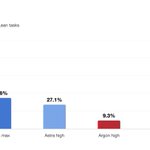
GPT-6 Astra is unbelievably good at Lean.
We tested four frontier setups on research-level TCS problems. Each one is a new bound we proved (so none of these results exist anywhere on the internet), and then turned the trajectories into RL tasks.
A run only passes if Lean accepts the proof. Every model got the same problems, the same prompt, the same Lean environment and the same 4-hour limit, with web search off.
These tasks are really hard, each one of them pushes a current boundary on the recent papers in TCS, that's why Astra's performance in only 4 hours is crazy.
Even on high effort, Astra passes almost three times as often as the next model on highest effort they have.
Something very interesting we found out:
If you don't tell the model the time limit, Opus performs better by using more time, and Astra performs worse by giving up early! (you should tell Astra "you HAVE 4 hours", even on max)

1
7
453
I think the path towards 1000x’ing mathematical discovery diverges from the paths of OpenAI and Anthropic at some point.
Why?
There are two types of tasks, the tasks that are easily verifiable and the ones that are not. Models perform better on verifiable tasks than non-verifiable ones, because training is more straightforward on them. That’s why they can write the Lean proof of a super complicated mathematical problem but are bad at understanding user intent.
OpenAI and Anthropic sell to consumers, so user intent has to be their main problem.
My bet is that a small set of verifiable tasks, with better data and training aimed only at them, moves scientific discovery much faster. OpenAI and Anthropic work on this too, but it becomes just one of manyy things they have to solve.
That’s why I see a hole here. My goal is to indeed double down on verifiable tasks. I think just a certain set of verifiable tasks can significantly improve scientific progress.
Now, assume there is a company with the same resources as OpenAI, but solely focused on improving models at certain verifiable tasks. Yes, I believe that’s exactly the path towards 1000x’ing mathematical/scientific discovery.
Correct me if I’m wrong.
6
225
Competitive Programming Gang reunion…
@cognition is sponsoring prizes for Repovive Premier Round 10.
Fun fact: the teams behind both Cognition and Repovive come from competitive programming and IOI/ICPC.
Devin Prizes:
- 1st place: $500 in Devin credits
- 2nd place: $250 in Devin credits
- 3rd to 5th place: $100 in Devin credits each
- Top 50: a free month of Devin Pro
Repovive Prizes:
- 1st place: $150
- 2nd place: $100
- 3rd place: $50
- 10 random participants from the top 100: $20 each
- 10 random participants from all participants: $20 each
Sunday, November 1, 14:35 UTC
Length: 2.5 hours
one thing I learned from yc is how ruthless you can be in going for your mission, cutting out every distraction and fully focusing on it.
a lot of what I’ve done at repovive in the past year came from a lack of confidence in going for big things, which led me to head to smaller goals and distractions.
the idea of working towards 1000x’ing scientific discovery is what yc gave us the courage to think about.
before we were thinking it’s such a big thing, why should we be the ones who make it possible? why not any of these giant companies. let’s pursue delusional success by setting smaller goals. now we better understand how we used to underestimate what we could do.
we’re less than a month in and the results we’ve already got seemed unbelievable to us before.
if for nothing else, I’m happy we did yc just for this injected courage.

2
14
414
This is a very valid point. AI improving science without human understanding it and being able to build on top of it has serious concerns.
The 700+ results by openai are not readable by researchers. Just making these papers into what human can read and understand is a big service!

Shayan | Repovive (YC F'26) retweeted

This does not make sense to me at all!

Unpopular opinion:
OpenAI (and frontier labs) have served (and will serve) mathematics more than all the mathematics researchers in history combined.
Yes, every researcher builds on top of the work of previous researchers. OpenAI is also building on top of the work of previous researchers, but this is the biggest jump that is happening.
What matters is bringing human science to a level by 2030 that we would otherwise reach by 3030. That's a mission that never, ever looked possible, but now were thinking about it.
And don't get me wrong, I'm a PhD student myself. But now, instead of taking an algorithmic problem and thinking about it myself, all I'm thinking about is how we can make these machines better to make that mission of accelerating scientific discovery 100x, 1000x, 10000x possible. That's the mission that I should put all my effort into, and that's what the world needs.
1
9
344
1974: Subset Sum was solved with a meet-in-the-middle algorithm in O(2^(0.5n)).
October 2026: OpenAI’s internal model broke the barrier and got O(2^(0.49n)).
Imagine telling the authors in 1974 that the next one to improve the exponent would be a machine.
We're so close to making mathematical discovery 1000x faster. Never been more hyped.
Decades of research on the matrix multiplication exponent. In the latest result, the best bound improved from 2.3713 to 2.3711.
And now, OpenAI’s internal model simply made it 2.25 :)
Traditional research is changing, and researchers are not adapting as fast.
Shayan | Repovive (YC F'26) retweeted

We’re releasing a broad range of new mathematical results produced by an internal frontier model.
We’ve been consulting with the independent Advisory Group on Mathematics and Artificial Intelligence at the Institute for Advanced Study, and we have drawn on their advice and public recommendations to inform how we release these results.
github.com/openai/math

How can we 10x the progress of mathematical discovery?
We've focused on optimizing the harness for frontier models, run many experiments, and obtained improvements over published bounds on several important problems:
- Steiner Forest approximation: From 1.994 to below 1.963302 (lower is better)
- Equal Subset Sum running time: O*((5/3)^n) to O*(1.666657425^n)
- Prophet Secretary achievable guarantee: 0.688 to 0.696 (higher is better)
- Submodular MMS allocation guarantee: 10/27 (approximately 0.37) to 0.394
The important part for us is not the results themselves. We care about how they were achieved and the full trajectory. Where did the cost and time go, and how can we optimize the process next time? That's the question we need to solve to 10x mathematical discovery.
One finding is that agents often spend time pursuing the wrong path. They don't always have an expert researcher's intuition for defining subtasks and creating a roadmap for solving a hard problem.
Second, Lean-related work accounted for 23.2% of accumulated model time and 34.3% of estimated model cost. ($1,188 out of $3,463)
Formalizing proofs in Lean is a clear bottleneck. Improving this could make problem-solving much more efficient. We've created 40 clear tasks and are experimenting with different approaches to improve performance at this bottleneck.
We're also convinced that our harness and retrieval process have much more room for optimization. There's a lot of room to improve scientific progress per watt and to achieve more with the same compute budget.
The question is not who gets the credit for solving a problem. The question is how we can achieve results in a year that would otherwise take 10, 100, or 1000 years.
The papers will be published shortly. More to come...
37.5/100 on code quality, and people still say “coding is solved.”

Quick and fun experiment with Claude Code (Fable 5.1) with no handholding
Port a Python CLI codebase to Java 21
40 public tests, 30 hidden tests
One-shotted the migration with one instruction and no steering
70/70 pass on tests (including the 30 hidden)
37.5/100 across 12 code-quality criteria
Re-implemented Python's int() in Java
Passed Object through the JSON layer
Copied a digit-parsing loop into two classes
Used String[] as a tuple
And my biggest pet peeve: commented what the code already says.
Lots to be done to close the last mile for coding agents.

2
14
721
Shayan | Repovive (YC F'26) retweeted

If you want to experience live ranking during a math contest, don't miss the round.

Repovive Math Contest Round 1 is this Tuesday! 🧠
Theme: Combinatorics
5 proof-based problems with live judging and a live leaderboard.
📅 Oct 6 | 14:35 UTC
⏳ 2h 30m
✅ Rated for everyone
repovive.com/contests/m1


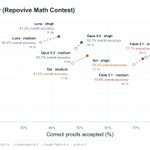
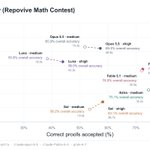
3/4
More analysis and the full dataset are available: github.com/Shayan-Chashm-Jah…
Our team developed the gold standard through expert review and discussion. Some judgments remain open to debate; it reflects our best assessment of the appropriate grading standard for this contest.
Thanks to @amirmstai and @karinanguyen for collaborating on the benchmark.


1
3
222