Shiling Liang | 梁师翎 retweeted
How does energy limit what chemical networks can do? To find out, researchers derived bounds on chemical concentrations and reaction driving forces, helping explain biological function and guide the design of lifelike artificial systems.
Read more: go.aps.org/4i2S4fK

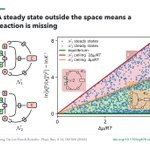
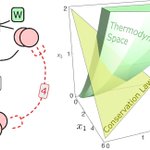
ALT A two-panel diagram illustrating how energy constrains a chemical reaction network. At left, clusters of pink shapes represent chemical species connected by reaction pathways within a blue network supplied with fuel by a chemical reservoir. Red and blue paths highlight those that set the thermodynamic limits. At right, a graph with logarithmic concentration axes shows a green band between a red upper bound and a blue lower bound. This bound is the thermodynamic space containing the possible steady-state concentrations. Its width increases with the nonequilibrium driving force, showing how a larger energy budget expands the network’s operating range.
Shiling Liang | 梁师翎 retweeted
For the 2026 APS March Meeting, please consider submitting your abstract to our new focus session on Cellular Sensing and Signaling (04.01.29), which aims to bridge theory and experiments to understand how cells sense and respond to environmental signals.
Shiling Liang | 梁师翎 retweeted
The response of an elastic shell made of a nonlinear material when indented by a point source yields scaling exponents useful for modeling the mechanical properties of biological samples such as cysts #biophysics go.aps.org/4jDil1J
Shiling Liang | 梁师翎 retweeted
Join us as a postdoc! The call for the ELBE Postdoctoral Fellows Program at the Center for Systems Biology @mpicbg & @mpi_pks is open now. Application deadline is February 14th.
More information: csbdresden.de/join-us/as-a-p…
Shiling Liang | 梁师翎 retweeted
In biological systems, optimal transduction strategies may boost information harvesting compared to the ideal case in which all the degrees of freedom are known
Letter: go.aps.org/4gWl7yN
Viewpoint: go.aps.org/4dGd8Dc
Shiling Liang | 梁师翎 retweeted
My paper on stochastic thermodynamics of replicators is out at J Chem Phys. It shows that fundamental thermodynamic bounds, like the one by J. England, do not constraint replicator kinetics
pubs.aip.org/aip/jcp/article…
Shiling Liang | 梁师翎 retweeted
You have a background in math/physics/computer science/ML and are looking for an interdisciplinary postdoc fellowship in life science, with free choice of host groups? Then join us at the CSBD as an ELBE postdoc, application deadline is 19. September!
csbdresden.de/join-us/as-a-p…
Shiling Liang | 梁师翎 retweeted
Here is a nice gif illustrating the main result of our [PRL 133 047401, go.aps.org/4cSrocC]:
Although perturbing the rates of an edge "i" yields nontrivial changes in its current "j_i", any other "j_e" will always be linear in "j_i", and the slope carries a lot of meaning.
Shiling Liang | 梁师翎 retweeted
... and we are out!
Thanks so much @dbusiello1, Hugo and Alexandra for the resilience in getting this through the finish line. Working on it I have really learned a lot, and, for me, it opens some pretty intriguing questions.
arxiv.org/abs/2406.19266
Shiling Liang | 梁师翎 retweeted
Final version of the long-standing Martingales tutorial review available in @tandfonline Advances in Physics tandfonline.com/doi/full/10.…
Shiling Liang | 梁师翎 retweeted
A novel theoretical framework unravels how processes in complex systems that occur at different timescales are coupled together at the functional level by sharing information.
Read go.aps.org/3VUUxOy
@gnicoletti09 @dbusiello1
#openaccess #PRXcomplex #PRXjustpublished
Shiling Liang | 梁师翎 retweeted
A theoretical study of self-assembly finds that hexagon-shaped building blocks can form large structures faster than triangular or square blocks.
Read go.aps.org/3vuEzA6
@PhysicsMagazine Synopsis go.aps.org/49lJQaW
#openaccess #PRXjustpublished #PRXsoftmatter
Shiling Liang | 梁师翎 retweeted
New work at @PhysReviewResearch. Using stochastic thermodynamics & linear algebra, we find link b/w entropy production and eigenvalues of rate matrix ➡ Tradeoffs for fast relaxations and oscillations. Great collaboration w/ @hadzukishi_phys + @ito_sosuke journals.aps.org/prresearch/…
Shiling Liang | 梁师翎 retweeted
Upcoming workshop: Dissipative Processes in Molecular Systems.
Physicists, chemists, theoreticians, and experimentalists are invited to join us in Padova on June 17-21 to discuss the new challenges of out-of-equilibrium physicochemical processes.
Info at sites.google.com/view/worksh…
Shiling Liang | 梁师翎 retweeted
A novel linear algebra method opens the way to efficiently study a broad class of responses for nonequilibrium systems go.aps.org/3S3Iivw
Shiling Liang | 梁师翎 retweeted
Open call for applications to @ictpnews Niš School 2024 on fundamentals of statistical physics and information theory, and applications to machine learning, biophysics and bioinformatics. Grants available with priority to developing countries. More info: indico.ictp.it/event/10484/o…
Shiling Liang | 梁师翎 retweeted
🔥 The (Post)Modern Thermodynamics Lecture Notes are out! 📚
Put together by a big team of motivated students and seasoned experts, it is a great resource for those curious about the many areas flourishing around nonequilibrium thermodynamics.
arxiv.org/abs/2311.01250
Shiling Liang | 梁师翎 retweeted
A universal relation between the asymmetry of cross correlations and the strength of disequilibrating thermodynamic effects can be regarded as a nonequilibrium generalization of the Onsager reciprocity
Letter: go.aps.org/3YBBiZG
Viewpoint: go.aps.org/3QMJS6d
Shiling Liang | 梁师翎 retweeted
... and it is out at last.
Thanks to the great collaborators who keep spoiling me with their great science.
nature.com/articles/s42005-0…
Shiling Liang | 梁师翎 retweeted
🔔#MOM2023 will take place ONLINE from June 20th to 22nd. Save the date or even better register now at lmu.de/mom2023❗⚠️Poster Registration Deadline JUNE 4th⚠️Event poster by @PriyankaObero16 🙌