

Shinkai lets anyone create advanced AI agents autonomous, tool-using, with memory. Local-first, with decentralized identity & payments.
Remote
Joined June 2023
- Tweets5K
- Following142
- Followers18.2K
- Likes1.6K







Pinned Tweet
Looking for an effortless AI agent setup?
Shinkai is perfect for non-developers seeking simplicity and speed, while ai16z (ElizaOS) suits those who enjoy deep coding control.
AI is moving beyond generating answers.
Agents can interact with services, execute transactions, and take actions across digital systems.
And they can do it at a scale humans can't easily match.
That creates enormous opportunities.
But also new responsibilities.
Permissions, accountability, and verification can't be afterthoughts.
What safeguards should every autonomous agent have?
Imagine hiring someone to help you organize your life.
They can read your messages.
Access your documents.
Review your finances.
Remember your conversations.
Now imagine having no control over where that information goes.
You'd probably think twice.
So why do we accept similar trade-offs from AI?
The more capable our agents become, the more important data ownership becomes.
The most interesting thing an AI can say might be:
"Done."
Not "Here's how you could do it."
Not "Let me suggest a few options."
Just a completed task, with a result you can verify.
That's the shift from AI that talks to AI that works.
Before your agent starts working for you, there's an important question:
How does it know who you are?
In Shinkai, your wallet helps establish your identity within the network.
We've put together a short walkthrough to help you connect it and get started.
A small setup step toward a much bigger idea: AI agents with identity.
Watch 👇
youtube.com/watch?v=qAz95gA_…

Imagine an AI agent trying to open a bank account.
Or negotiate a contract.
Or pay another agent for a service.
Suddenly, simple questions become complicated.
Who is responsible?
Who gave it permission?
Who owns the transaction?
Who can shut it down?
We're building software that can participate in the economy.
But we haven't finished defining the rules.
What breaks first?
Ask a chatbot to organize your files.
It might explain how to do it.
Ask an agent with the right tools and permissions.
It can inspect the folders, identify duplicates, organize the files, and check the result.
Same request.
Very different outcome.
The future of AI isn't just better answers.
It's getting things done.
An impressive AI demo takes minutes.
A reliable AI system takes engineering.
Because the difficult questions aren't always about intelligence.
What happens when an API fails?
When a permission expires?
When the data is outdated?
When the agent confidently does the wrong thing?
The gap between a good demo and a useful agent is everything surrounding the model.
Intelligence without tools is mostly conversation.
Give an agent access to information, and it can research.
Give it a way to execute, and it can act.
Give it multiple capabilities, and entirely new workflows become possible.
The breakthrough isn't always a smarter brain.
Sometimes it's giving the brain more ways to interact with the world. 🐙
The interesting part of AI isn't what one agent can do.
It's what happens when capabilities start working together.
Research becomes analysis.
Analysis becomes action.
Action becomes an entire workflow.
Instead of searching for the perfect agent, what if you could assemble the capabilities you need?
We've normalized giving software access to everything.
Our conversations.
Our documents.
Our workflows.
Our decisions.
All in exchange for convenience.
But what if the next generation of AI didn't require that trade?
Imagine powerful agents running on your own machine, working with your information without sending it to someone else's server.
AI should expand what you can do.
Not what you have to give up.
shinkai.com
Imagine ordering coffee and having to explain how to grind the beans, heat the water, and pour the milk.
Exhausting, right?
That's how we've been talking to software.
Intent changes the conversation.
You tell the agent what you want.
It figures out how to get there. 🐙
Your agents don't need a Monday morning pep talk.
They just need a goal.
GM to everyone building a world where work keeps moving, even when we're offline. ☕️

A smart agent isn't necessarily an independent agent.
It might be capable of reasoning, planning, and executing complex tasks.
But who controls its tools?
Who owns its data?
Who decides where it runs?
Autonomy isn't just about what an agent is capable of doing.
It's also about who holds the keys.
One wrong click is a mistake.
One wrong action repeated 10,000 times is a system failure.
That's the challenge with autonomous agents.
They don't just make decisions.
They can execute them, repeatedly, at machine speed.
The question isn't only how much freedom we give AI.
It's how we make sure that freedom remains accountable.
What should an agent never be allowed to do without human approval?
Privacy isn't about having something to hide.
It's about having something to protect.
Your identity.
Your conversations.
Your data.
Your choices.
As AI becomes more integrated into everyday life, control over that information becomes even more important.
Privacy shouldn't be an optional feature.
It should be part of the foundation.
A chatbot waits for your next message.
An agent can work toward a goal, use tools, and take the next step.
One is built around the conversation.
The other is built around getting something done.
That's a fundamental difference.
Getting started with Shinkai? 🐙
Your wallet is part of setting up your Shinkai Identity.
Not sure how to connect it?
We've got you covered.
This quick tutorial walks you through the process, step by step.
Watch here 👇
youtube.com/watch?v=qAz95gA_…
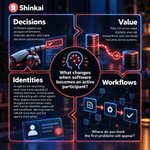
AI agents are becoming capable of making decisions, moving value, and interacting with other agents.
But most digital infrastructure was designed around human users.
Human identities.
Human approvals.
Human workflows.
What changes when software becomes an active participant?
We may need to rethink more than the agents themselves.
Where do you think the first problems will appear?

An AI agent isn't just a chatbot with more features.
It can observe what's happening, gather information, use tools, and take actions toward a goal.
The difference isn't how much it knows.
It's what it can do with what it knows.
Chatbots answer questions.
Agents work toward outcomes.

Everyone's comparing AI models.
Benchmarks. Speed. Reasoning. Context windows.
But the real challenge often starts after you choose one.
Connecting data.
Managing permissions.
Maintaining context.
Handling failures.
Making everything reliable.
A powerful model is only part of a working agent.
The infrastructure matters just as much.